Due to stringent conditions, no companies applied; bill proposed to strengthen Kian Fund support requirements
Plan also underway to ban financial investment in overseas coal power by public financial institutions like KDB
[Asia Economy Reporter Kangwook Cho] Recently, bills have been proposed in the political sphere to raise the eligibility criteria for the 40 trillion won-scale Industrial Stabilization Fund or to ban investments in overseas resource development projects, causing headaches for financial public institutions. Amid an unprecedented economic recession caused by the COVID-19 pandemic, these bills, which are disconnected from the current situation, are being criticized for hampering the efforts of policy banks that should be focusing on economic recovery.
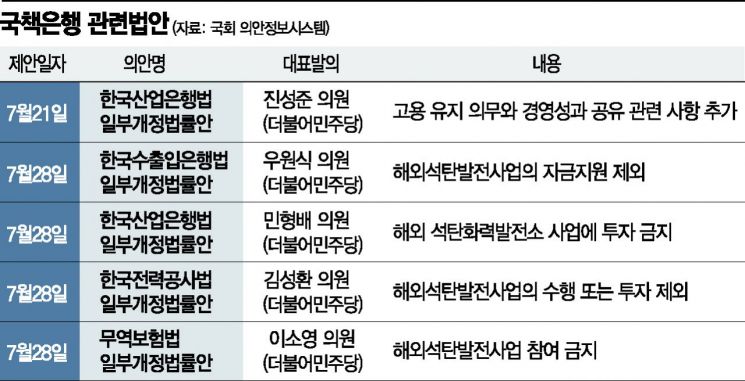
According to the National Assembly and financial circles on the 11th, recently, 10 lawmakers from the Democratic Party, including Jin Seong-jun, proposed an amendment to the Korea Development Bank Act to strengthen the eligibility criteria for the Industrial Stabilization Fund. The amendment stipulates that the review committee operating the fund must impose specific conditions on supported companies to maintain employment and require companies to share their business performance with the fund after receiving financial support. The committee is also tasked with monitoring whether supported companies faithfully comply with the funding conditions. This is intended to enhance the accountability of companies receiving financial support.
However, some criticize this as an ineffective bill. This is because companies that initially intended to receive fund support have not applied so far due to the already stringent conditions. In fact, companies receiving fund support must maintain employment at 90% or higher. Efforts to maintain employment must be submitted to KDB Korea Development Bank. Efforts to secure necessary liquidity, such as asset sales for business improvement, are also prerequisites. Employee salaries are frozen, and dividends as well as share buybacks are prohibited. Support for affiliates is also banned. At least 10% of the total support amount is acquired through equity-linked securities, raising concerns that this could become a channel for future government intervention in management.
A financial sector official said, "The Industrial Stabilization Fund began accepting applications on the 7th of last month, and the eligible industries were expanded from the two major sectors of aviation and shipping to nine sectors including automobiles, shipbuilding, and machinery, but there are still no companies applying for support," adding, "Even if companies qualify, the conditions are so stringent that they hesitate to apply. If these conditions are further tightened, it is questionable whether any company will apply for fund support."
There is also a plan to legally prohibit public financial institutions such as the Korea Development Bank and the Export-Import Bank of Korea from making financial investments in overseas coal power projects. This is under the so-called "Overseas Coal Power Investment Ban Act 4 Bills," proposed by Democratic Party lawmakers including Kim Seong-hwan, chair of the Green New Deal subcommittee of the K-New Deal Committee, Woo Won-shik, Min Hyung-bae, and Kim So-young. The bill includes provisions to exclude overseas coal power projects from the business scope of Korea Electric Power Corporation (KEPCO), the Export-Import Bank of Korea, the Korea Development Bank, and the Korea Trade Insurance Corporation. It points out that although the Korea Development Bank has invested about 2.9 trillion won in domestic and overseas coal-fired power projects and major foreign public financial institutions have declared a halt to coal investments, South Korea continues to invest in overseas coal power projects.
Currently, KEPCO is proceeding with the acquisition of the Vung Ang-2 coal-fired power plant in Vietnam. At the end of June, it also decided to promote the development of two coal-fired power plants in Indonesia. These projects involve the Korea Development Bank, the Export-Import Bank of Korea, and the Korea Trade Insurance Corporation participating as part of a lending consortium alongside global financial institutions to provide financing. The Vung Ang-2 coal-fired power plant project is a national project reflected in Vietnam’s national power development plan, with the Vietnamese government guaranteeing payment of electricity fees, which is evaluated as highly stable. The total project cost for the coal-fired power plant construction in Java, Indonesia, is $3.46 billion (about 4.1 trillion won), with 342 domestic small and medium-sized enterprises participating, expecting $700 million in SME exports and ripple effects.
Additionally, the ongoing controversy over relocating to provincial areas is also a burden. The Presidential Committee on Balanced National Development has started research services this month to establish a financial hub policy. The financial sector criticizes this as an attempt to build justification for relocating policy banks to provincial areas.
Another financial sector official said, "Suddenly banning investments in ongoing projects is an unreasonable measure," adding, "In the context of the ongoing economic recession caused by COVID-19, forcibly implementing investment bans and provincial relocations could undermine the continuity of current policy projects and shrink corporate support for overseas market expansion."
© The Asia Business Daily(www.asiae.co.kr). All rights reserved.
![Clutching a Stolen Dior Bag, Saying "I Hate Being Poor but Real"... The Grotesque Con of a "Human Knockoff" [Slate]](https://cwcontent.asiae.co.kr/asiaresize/183/2026021902243444107_1771435474.jpg)















