Proposal for Solar Power National Audit and Energy Special Committee Emerges in Political Circles
Experts Predominantly Say It Is Insufficient to Label It a 'Solar Power Landslide'
Government Reviews Safety System Improvements... Support for Principal and Interest Repayment Is Premature
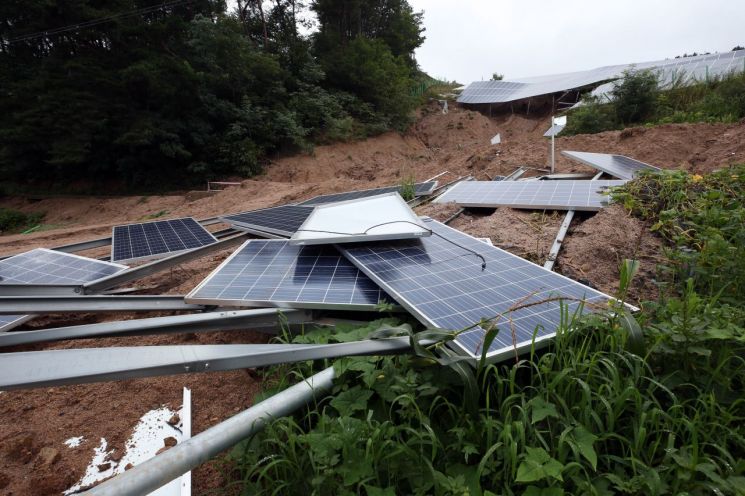
[Asia Economy Reporter Moon Chaeseok] As landslides occurred nationwide due to heavy rains, the solar power business has come under scrutiny. There are opposing views: one claims that the landslide damage worsened due to the Moon Jae-in administration's reckless expansion of solar power projects, while the other argues that the claim that solar power projects caused the landslides is an exaggeration.
According to the Ministry of Trade, Industry and Energy on the 11th, out of 12,721 solar power facilities located in mountainous areas, only 12 sites (0.1%) had landslide damage as of the 9th. Among the 1,174 landslides that occurred this year, only 1% involved solar power facilities in mountainous areas.
◆ Opposition: "National Audit and Energy Special Committee Needed" vs Ruling Party: "Is Disaster a Political Battleground?"
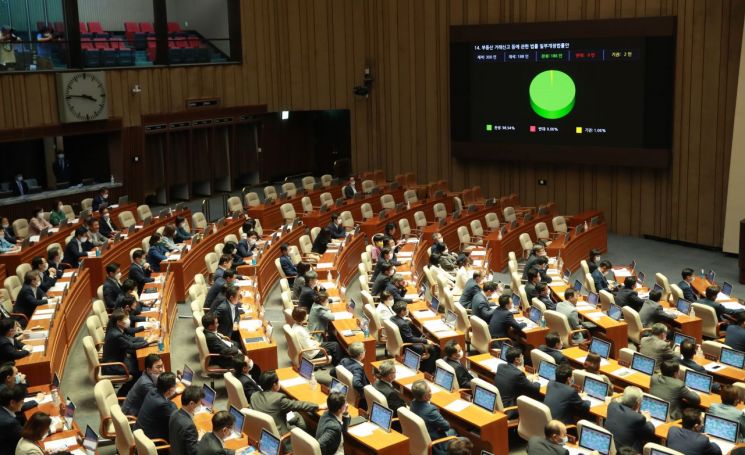
As claims arose that installing solar power in mountainous areas weakens the ground and could spread landslides, controversy emerged in the political sphere over the appropriateness and safety of the projects. The opposition proposed not only a national audit of the solar power projects but also the formation of a special energy committee.
Joo Ho-young, floor leader of the United Future Party, said the day before, "The reckless solar power projects have damaged the environment, and the current government's energy policy is also flawed," adding, "At the end of last month, I met with Kim Tae-nyeon, floor leader of the Democratic Party of Korea, and proposed a special committee or national audit on energy policies including the nuclear phase-out policy and solar power projects."
Ahn Cheol-soo, leader of the People's Party, also said at the party's supreme council meeting, "An audit by the Board of Audit and Inspection should be conducted immediately regarding the connection between the nationwide solar power facilities and the landslides caused by this flood," and added, "If that is insufficient, we will push for a national audit jointly by the opposition to uncover structural problems related to solar power corruption and flood damage."
The government and ruling party argue that the sample size is too small to stir controversy over 'solar power landslides.' It accounts for only 0.1% of the total. The ruling party stated that there was no discussion of a national audit and criticized the opposition for exploiting solar power as a political tool.
Kim Young-jin, senior deputy floor leader of the Democratic Party of Korea, said, "There was no discussion of a national audit related to solar power during the closed-door meeting between the floor leaders of both parties, as mentioned by floor leader Joo." Regarding the establishment of an energy special committee, he said, "There was discussion, but no final agreement was reached. However, a consensus was formed."
Democratic Party lawmaker Yang Eui-won criticized on Facebook, "According to data released by the Korea Forest Service on the 7th, out of 12,721 solar power facilities in mountainous areas nationwide, only 8 sites (0.06%) were damaged, which is about 1% compared to the 809 landslides nationwide. Is 1% the main culprit of landslides?" and added, "(The opposition) should stop their irresponsible behavior of trying to turn even disasters into political strife."
◆ Experts: "Insufficient Evidence to View as 'Solar Power Landslides'"
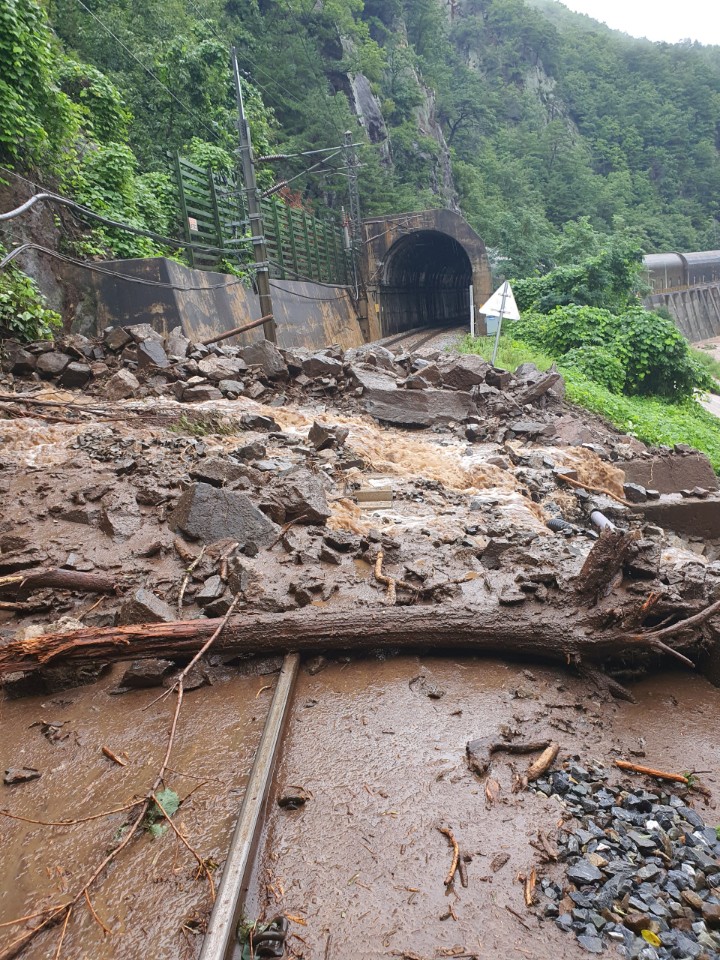
Experts say that while solar power facilities may cause muddy water to accumulate and weaken the ground during heavy rain, they are not the main cause of landslides nationwide.
Park Chang-geun, professor of civil engineering at Catholic Kwandong University, explained, "For example, if rainwater accumulates in highland vegetable fields shaped like forest roads, muddy water can increase the risk of landslides, but the current mountainous solar power projects do not appear to be such cases," adding, "This means landslides did not start from solar power facilities in mountainous areas."
Lee Seong-ho, senior researcher at the Korea Institute of Energy Technology Evaluation and Planning, said, "Heavy rains can cause damage not only to solar power facilities in mountainous areas but also to farmland and other facilities," and pointed out, "The proportion of landslides caused by solar power is not overwhelmingly large compared to total accidents, so it should not be exaggerated to make it seem like the entire solar power sector is problematic."
◆ Government Considering Strengthening Safety Standards... "Discussions on Principal and Interest Repayment Not Yet Underway"
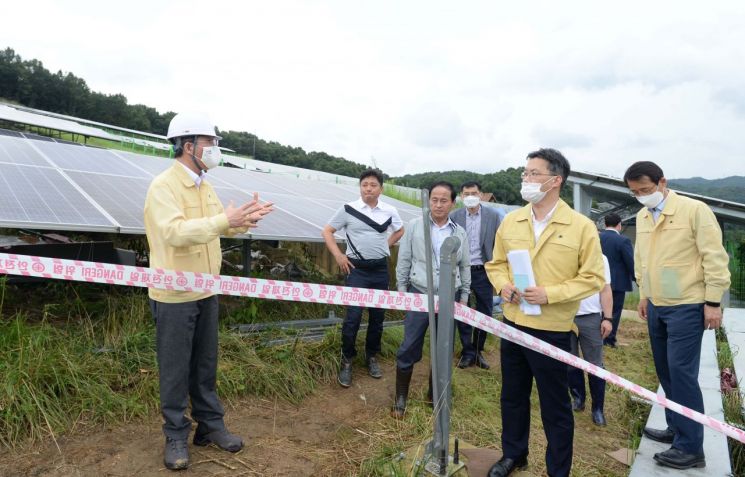
The government announced it will consider additional institutional improvements related to strengthening safety management. It plans to review safety facility management standards and facility location conditions within existing policies such as the introduction of a temporary permit system for solar power in mountainous areas, tightening the slope permit standard from 25 degrees to 15 degrees, mandatory submission of development completion certificates, and mandatory intermediate restoration of mountainous areas. Until the situation is resolved, an emergency response team will operate under the cooperation of the Korea Forest Service and local governments, and additional institutional improvement plans for strengthening safety management of renewable energy facilities, including mountainous solar power, will be reviewed and prepared.
An official from the Ministry of Trade, Industry and Energy said, "As the climate crisis worsens, various variables such as this monsoon, typhoons, and snow may occur, so we want to see if there are parts of the safety standards for mountainous solar power that need reinforcement and how much funding is required," adding, "For example, there have been cases where water overflowed because the drainage size was too small, and we intend to look into such issues."
Discussions regarding 'temporary principal and interest repayment deferral support,' suggested by some in the industry, have not yet taken place. The ministry official explained, "First, we need to see how much stronger typhoons will come and how much more damage will occur, and second, we need to assess the scale of the damage," adding, "Among the 12 affected businesses, none have specifically requested financial support yet, and even if they do, we need to examine the amount of damage, whether it was an unavoidable accident, and whether there was any negligence in management by the business operator."
© The Asia Business Daily(www.asiae.co.kr). All rights reserved.
![Clutching a Stolen Dior Bag, Saying "I Hate Being Poor but Real"... The Grotesque Con of a "Human Knockoff" [Slate]](https://cwcontent.asiae.co.kr/asiaresize/183/2026021902243444107_1771435474.jpg)

















