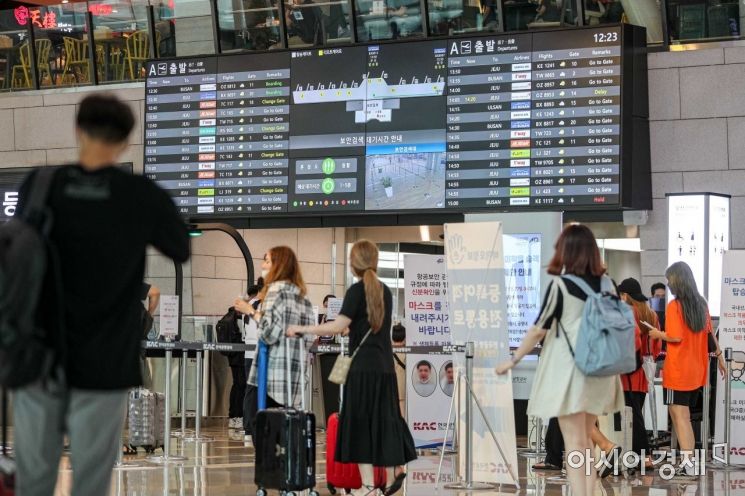
 As the peak vacation season begins, the domestic terminal at Gimpo Airport in Seoul is bustling with travelers on the 2nd./Photo by Kang Jin-hyung aymsdream@
[Asia Economy Reporter Yoo Je-hoon] National major airlines are unable to smile despite a 'brief profit' in the second quarter amid the novel coronavirus disease (COVID-19). A significant portion of the profit turnaround came from cost reductions such as fuel and labor costs, and even the only performing air cargo business sector is difficult to guarantee smooth sailing due to declining rates (freight charges) and domestic and international uncertainties.
According to the TAC Air Freight Index in Hong Kong on the 11th, as of the previous day, the air cargo freight rate on the Hong Kong-North America route recorded $5.45 per kg. This is about 38% higher compared to the same period last year ($3.34) but 35% lower than the annual peak (May, $8.47).
National major airlines Korean Air and Asiana Airlines posted operating profits of 148.5 billion KRW and 115.1 billion KRW respectively in the second quarter, successfully turning to profitability. Although the passenger transport business sector shrank to one-tenth its size, the air cargo business, which experienced a boom due to soaring freight rates, compensated for this.
Both airlines are considered among global airlines with relatively well-diversified portfolios. According to the International Air Transport Association (IATA) and others, both airlines are ranked within the top 10 in air cargo transportation (excluding cargo-only airlines). They are currently operating 23 and 13 cargo aircraft at full capacity, respectively, while also pursuing plans to utilize belly cargo (cargo compartments under passenger aircraft) and convert passenger aircraft into cargo planes.
Professor Heo Hee-young of Korea Aerospace University said, "Until 2010, Korean Air maintained the number one position among all airlines worldwide excluding cargo-only airlines for several years," adding, "The national carriers' ability to turn a profit due to the boom in the air cargo market is because of such know-how."
However, the industry evaluates that the soaring freight rates have been on a downward curve since May-June, so it is not a level to be reassured. Recently, competitors aiming to expand cargo supply have also emerged one after another. Emirates Airlines removed about 3,000 seats from 10 passenger B777-300ER aircraft and deployed them for cargo operations.
Another factor preventing airlines from being fully optimistic is that a significant part of the performance improvement came from cost reductions. Korean Air's total operating expenses in the second quarter were 1.5424 trillion KRW, down 50.6% from the previous year. This was due to reduced fuel costs (about 200 billion KRW) from aircraft operation suspensions and low oil prices, and reduced labor costs (about 500 billion KRW) due to furloughs.
An industry official said, "The effects of cost reduction and soaring cargo freight rates will continue until this year, but this is a typical form of recession-type profit," adding, "There will be limits to the extension of employment retention subsidies, and with signs of the US-China trade dispute reigniting and increasing volatility in the air cargo market, it is uncertain whether such favorable conditions will be formed next year."
© The Asia Business Daily(www.asiae.co.kr). All rights reserved.
![Clutching a Stolen Dior Bag, Saying "I Hate Being Poor but Real"... The Grotesque Con of a "Human Knockoff" [Slate]](https://cwcontent.asiae.co.kr/asiaresize/183/2026021902243444107_1771435474.jpg)















