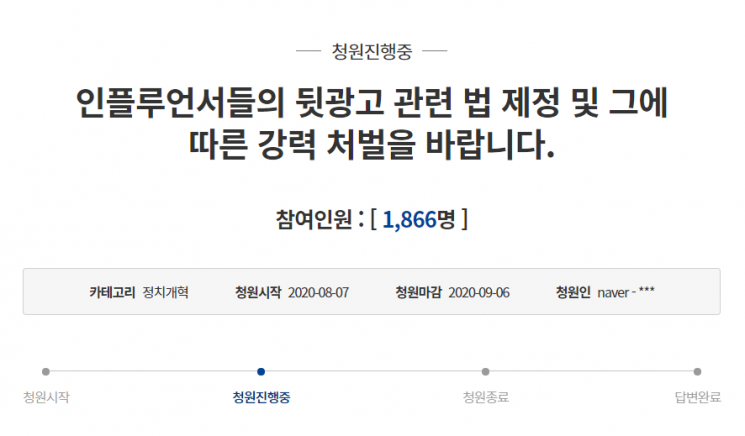
 On the 7th, a petition appeared on the Blue House National Petition Board demanding strict punishment for celebrities' undisclosed advertisements. Photo by Blue House National Petition Board screenshot
[Asia Economy Intern Reporter Kang Juhee] Following the controversy over so-called 'undisclosed advertisements' where popular mukbang (eating broadcast) YouTubers, along with famous celebrities, received advertising fees but failed to disclose them, a petition demanding strict punishment for these individuals has appeared on the Blue House (Cheong Wa Dae) national petition board.
On the 9th, a petition titled "Request for Legislation on Undisclosed Advertisements by Influencers (people with significant influence on the internet) and Strong Punishment Accordingly" was posted on the Blue House national petition board. As of 7:22 a.m. on the 11th, the petition had gained the support of 1,866 people.
The petitioner pointed out, "Many famous influencers are promoting products as if they personally purchased them with their own money, in what is called 'undisclosed advertisements,' despite receiving sponsorships," and added, "Although undisclosed advertisements are widespread, there is still no proper legal standard to punish them."
They continued, "I believe the influence of influencers is as powerful as that of broadcasting. Legal sanctions on advertisements and punishment of the influencers involved are necessary."
The undisclosed advertisement controversy began last month with singer Kang Minkyeong and famous stylist Han Hyeyeon’s 'Naedonnaesan (products I bought with my own money)' content.
They apologized after receiving criticism for misleading consumers by portraying sponsored or paid products they wore or used in their video content as if they had purchased them directly.
This controversy then spread to YouTube mukbang content. It was confirmed that some popular mukbang YouTubers also received sponsorships but did not disclose them, leading to a series of apologies.
As the undisclosed advertisement controversy grew, the Fair Trade Commission (FTC) announced it will implement the "Revised Guidelines on Display and Advertisement Regarding Recommendations and Endorsements" starting this September. The main point is that if YouTubers receive financial support, discounts, or sponsorships for their videos, they must clearly indicate what kind of compensation they received so that consumers can recognize it.
However, critics point out that the revision only sanctions the businesses that request the advertisements, not the YouTubers themselves, making legal punishment of influencers still difficult.
In January, a bill was proposed to amend the "Fair Labeling and Advertising Act" to impose fines of up to 10 million won if influencers fail to disclose paid advertisements, but it was discarded with the end of the 20th National Assembly’s term.
© The Asia Business Daily(www.asiae.co.kr). All rights reserved.

















