[Asia Economy Reporter Cho Hyun-ui] The support obligation criteria, which exclude families with certain income or assets from basic livelihood security benefits even if they are poor, will be gradually abolished from livelihood benefits by 2022.
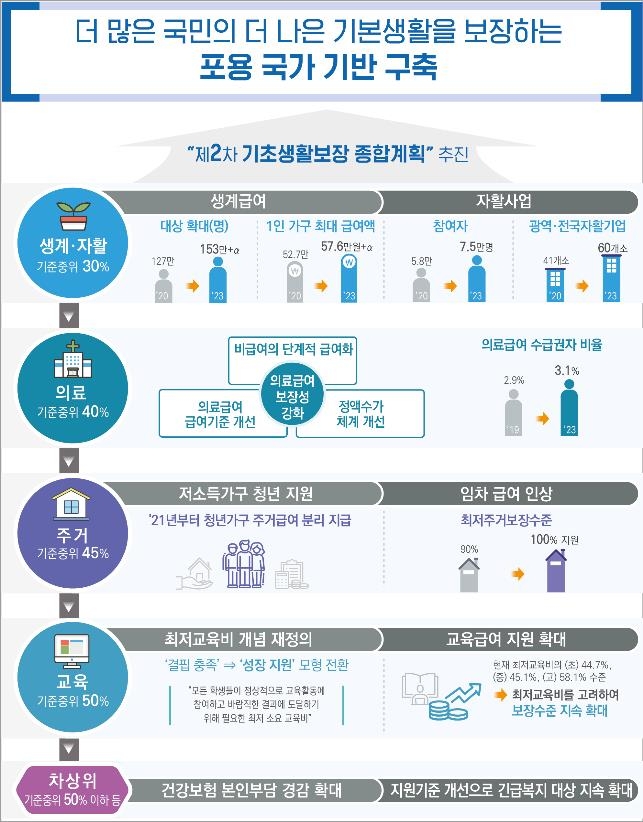
The Ministry of Health and Welfare confirmed the '2nd Comprehensive Plan for Basic Livelihood Security' (2021?2023) containing this content at the Central Livelihood Security Committee held on the 10th.
First, the support obligation criteria applied when selecting recipients of 'livelihood benefits,' one of the main benefits of the Basic Livelihood Security System, will be gradually abolished by 2022. The support obligation criteria have long been considered a major obstacle creating blind spots in poverty.
Until now, many people hesitated to apply for livelihood benefits because they either could not receive benefits due to having 'family members who can provide support,' such as direct relatives within the first degree or spouses, or had to bear the burden of proving that the support obligor lacked the ability to provide support. The government decided to abolish the support obligation criteria for livelihood benefits, which had been maintained for 20 years since the Basic Livelihood Security System was implemented in 2000, judging that eliminating blind spots is urgent to prevent the inheritance of poverty.
The Ministry of Health and Welfare explained, "Since establishing the 1st comprehensive plan, the number of beneficiaries and the level of coverage of the Basic Livelihood Security System have continuously expanded, but considering the high elderly poverty rate and population aging, comprehensive measures to eliminate poverty blind spots, including elderly people without working ability, are required."
The government plans to abolish the support obligation criteria for elderly and single-parent households in 2021, and for other households in 2022. Accordingly, if the beneficiary’s own income and assets meet the criteria, they will receive livelihood benefits regardless of the presence or absence of a support obligor. The government estimates that about 180,000 households and 260,000 people will newly receive benefits.
However, the criteria will still apply to support obligors with an annual income exceeding 100 million KRW or real estate assets exceeding 900 million KRW.
The government will also promote improvement measures instead of applying the support obligation criteria in medical benefits.
From January 2022, households with support obligors including elderly people receiving basic pensions will be excluded from the criteria application. Along with this, during the 2nd comprehensive plan period (2021?2023), the government will also promote measures to improve the reflection criteria for support costs and the income and assets of beneficiaries, expanding the scope of beneficiaries to allow 199,000 people (134,000 households) to receive medical benefits.
The asset criteria for automobiles under the Basic Livelihood Security System will also be partially relaxed. Considering the current situation where automobiles are regarded more as a means of living than as 'assets,' the government plans to partially relax the automobile asset criteria by reflecting various factors such as household characteristics and automobile utilization, and apply differentiated standards by benefit type.
The government intends to actively support ensuring the basic living of the poor through this 2nd comprehensive plan. First, the method of calculating the median income used as the selection criteria for 73 welfare projects including the Basic Livelihood Security System will be strengthened by basing it on the Household Financial Welfare Survey instead of the existing Household Trend Survey, thereby enhancing benefit coverage.
The Ministry of Health and Welfare stated, "We will realize the livelihood benefit guarantee level for 1-2 person households, which constitute most beneficiary households."
For medical benefits, protection for low-income and crisis households within health insurance will be continuously strengthened. For rare, incurable, and severe diseases among the near-poor, the government is considering gradually relaxing and applying the same support obligation criteria as medical benefits. Practical support measures such as lowering the standard amount for catastrophic medical expenses support will be prepared.
In housing benefits, the current rent, which is about 90% of the market rent, will be gradually adjusted to a realistic level by 2022. To help youth independence, housing benefits will be separately paid to unmarried youth within beneficiary households starting in 2021.
Education benefits will move away from item-based support considering various needs of beneficiaries and will be integrated into an 'education activity support fund' to allow autonomous spending. Support for new educational activities, including remote education, will also be strengthened.
The plan also includes institutionalizing home medical benefits, proper management of Basic Livelihood Security System beneficiaries, and improving the delivery system efficiency.
Minister of Health and Welfare Park Neung-hoo said, "The establishment of the 2nd comprehensive plan, including the abolition of the livelihood benefit support obligation criteria, will be an opportunity to fully realize the blueprint for guaranteeing the basic livelihood of the people drawn 20 years ago when the Basic Livelihood Security System was implemented."
© The Asia Business Daily(www.asiae.co.kr). All rights reserved.
![Clutching a Stolen Dior Bag, Saying "I Hate Being Poor but Real"... The Grotesque Con of a "Human Knockoff" [Slate]](https://cwcontent.asiae.co.kr/asiaresize/183/2026021902243444107_1771435474.jpg)















