Longest rainy season with record cumulative rainfall... Additional concerns over flood damage
Significant impact on solar power facilities due to landslides? Only 1.1% of total damage cases
Currently, 'all mountain areas nationwide' are at risk... Korea Forest Service emphasizes "Minimizing damage is the top priority"
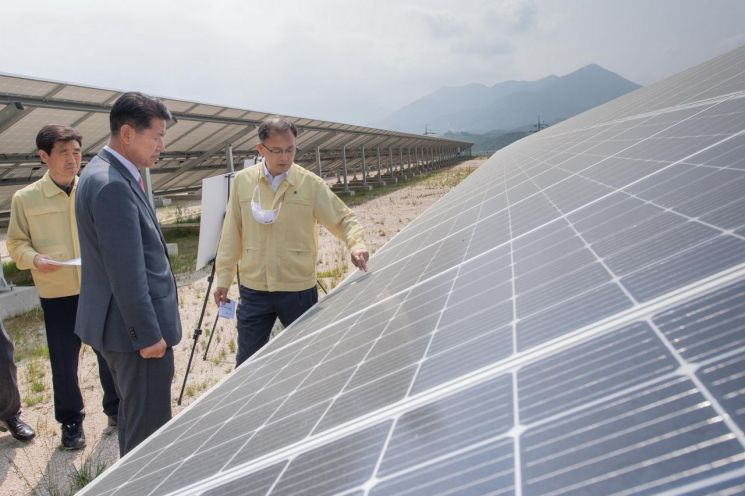 Before the rainy season began, on June 6, Commissioner Park Jong-ho conducted a preliminary inspection of the solar power generation facility. Commissioner Park emphasized, "To prevent casualties caused by landslides, preventive activities and proactive evacuation in case of emergencies are crucial." He especially urged, "In the current situation where the accumulated rainfall has weakened the ground, residents in landslide-prone areas around mountainous regions need to exercise special caution." Provided by the Korea Forest Service
[Asia Economy (Daejeon) Reporter Jeong Il-woong] As heavy rains continue across the country, the risk of landslides is higher than ever. The forestry authorities plan to focus administrative efforts on minimizing damage from landslides and enabling proactive evacuation of residents in case of emergencies.
According to the Korea Forest Service on the 10th, this year’s monsoon season began on June 24 and is expected to last for more than 50 days. As of this date, the monsoon has already continued for 48 days, far exceeding the average monsoon period of 32 days from 1981 to 2010.
This year also broke the record for average nationwide rainfall during the monsoon period. The accumulated average rainfall nationwide over the past 48 days is 750mm, which is about 343.5mm more than the 406.5mm recorded during the longest monsoon period on record in 2013.
The problem is that the continuous rain has saturated the mountainous areas. The Korea Forest Service is concerned that if more rain falls while the mountains are already saturated, large-scale landslides could occur anywhere in the country. As of the 9th, landslides nationwide have caused 4 deaths, 2 missing persons, and 4 injuries, with 1,079 cases of property and facility damage reported.
Above all, the Korea Forest Service emphasizes that landslide damage caused by heavy rain is not limited to specific regions. For example, some have raised concerns that recent solar power facilities installed in mountainous areas increase the risk of landslides.
However, as of the 9th, only 12 sites (0.009%) of the 12,721 locations with installed solar power facilities in mountainous areas have reported damage, accounting for 1.1% of all landslide damage sites (1,079 sites). It is difficult to conclude that the presence of solar power facilities alone has increased the number or scale of landslide incidents.
Regarding this, a Korea Forest Service official said, “The cumulative rainfall nationwide is recording an all-time high,” adding, “It is not that any specific area such as solar power facility installation sites is more dangerous, but rather ‘all regions nationwide’ are exposed to landslide risks.”
In particular, the official emphasized, “Reflecting concerns that landslide risks are higher around recently installed solar power facility areas, the Korea Forest Service formed a ‘Special Mountain Inspection Team’ of 342 members and completed on-site inspections of 2,180 secondary landslide damage sites from the 5th to the 9th.”
He added, “The most important thing at this moment is to prevent any additional casualties from landslides. The Korea Forest Service is organizing dedicated personnel with local governments to check the evacuation status of residents in landslide-prone areas twice daily and is making every effort to ensure proactive evacuation in case of emergencies.”
Meanwhile, on the 8th at 12 p.m., the Korea Forest Service expanded the landslide crisis alert to the ‘Severe’ level for 16 cities and provinces nationwide except Jeju Island, and on the 9th at 7 a.m., issued landslide forecasts (warnings and advisories) for 81 cities, counties, and districts nationwide.
In addition, the Korea Forest Service is maintaining a 24-hour emergency response system, monitoring the landslide information system ‘Tank Model’ (landslide occurrence prediction system), cumulative rainfall data, and ultra-short-term precipitation forecasts provided by the Korea Meteorological Administration to respond to landslide disasters.
© The Asia Business Daily(www.asiae.co.kr). All rights reserved.
![Clutching a Stolen Dior Bag, Saying "I Hate Being Poor but Real"... The Grotesque Con of a "Human Knockoff" [Slate]](https://cwcontent.asiae.co.kr/asiaresize/183/2026021902243444107_1771435474.jpg)















