Analysis of 2Q Earnings Reports from 11 Global Automakers
Hyundai Leads Operating Profit... Tesla and Toyota Also Profitable
Success from Exchange Rate Effects, SUV, and Premium Strategies
Hyundai-Kia Defies Traditional Giants, Faces Tesla Head-On in EV Battle
[Asia Economy reporters Suyeon Woo and Jaehee Kwon] The global finished car industry, hit hard by the novel coronavirus disease (COVID-19), is undergoing a shift in the landscape. Only three companies?Hyundai Kia Motors, Tesla, and Toyota?that increased sales mainly in the Korean and Chinese markets, which were the first to recover from the COVID-19 impact, have continued profitable operations. They are widening the gap with competitors by taking advantage of the fact that most traditional automobile powerhouse brands have fallen into the red due to the COVID-19 aftermath.
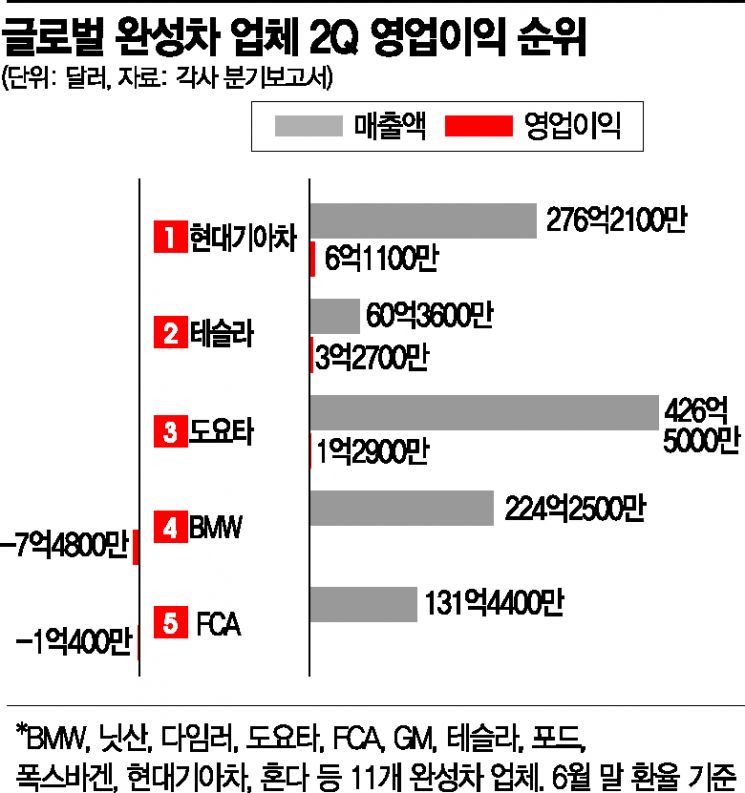
On the 10th, Asia Economy analyzed quarterly reports of 11 major global finished car manufacturers (Hyundai Kia Motors, Tesla, Toyota, BMW, FCA, Honda, GM, Nissan, Daimler, Ford, Volkswagen) and found that Hyundai Kia Motors recorded an operating profit of $611 million (KRW 735 billion, based on the June 30 exchange rate) in the second quarter of this year, ranking first. Tesla followed with $327 million (KRW 393 billion), and Toyota was third with $129 million (KRW 155 billion).
Among the 11 major finished car manufacturers, only Hyundai Kia Motors, Tesla, and Toyota posted profits. Eight companies from the U.S., Europe, and Japan all recorded losses. The operating margin, which indicates operating profit relative to sales, was 5.4% for Tesla, 2.2% for Hyundai Kia Motors, and 0.3% for Toyota.
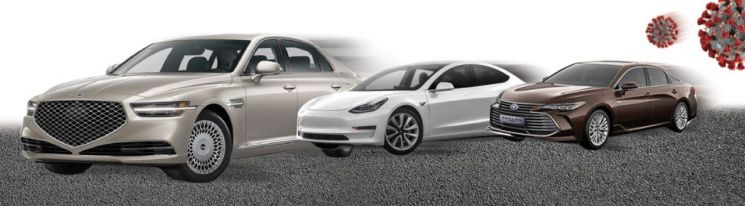
The reason Hyundai Kia Motors could achieve the top operating profit among global finished car manufacturers even during the COVID-19 phase was largely due to favorable exchange rate effects and successful portfolio restructuring through sports utility vehicle (SUV) and premiumization strategies. Additionally, while the global market was still affected by COVID-19 in the second quarter, the domestic market, which quickly succeeded in quarantine measures, is interpreted as having driven the performance rebound. This was thanks to strong domestic sales centered on high value-added models.
In the second quarter, the SUV share of Hyundai’s sales was 40.8%, and Kia’s was 53.7%. During the same period, while global sales dropped by about 30%, domestic sales increased by 12.7% for Hyundai and 26.8% for Kia. Notably, the Genesis brand accounted for 16.2% of Hyundai’s domestic sales, doubling compared to the previous year.
Tesla’s California factory in the U.S. was shut down for a month starting at the end of March, but the Shanghai factory in China, which began production at the end of last year, successfully resumed early operations in early January, maintaining steady demand in China. Another profitable company, Toyota, was supported by the resilient Chinese market recovering from COVID-19, but it was insufficient to catch up with Hyundai Kia Motors and Tesla.
In the second quarter of this year, Toyota sold 482,000 units in China, a 14% increase from the previous year, contrasting with major markets where sales sharply declined during the same period, including Japan’s domestic market (-30%), the U.S. (-61%), and Europe (-50%).
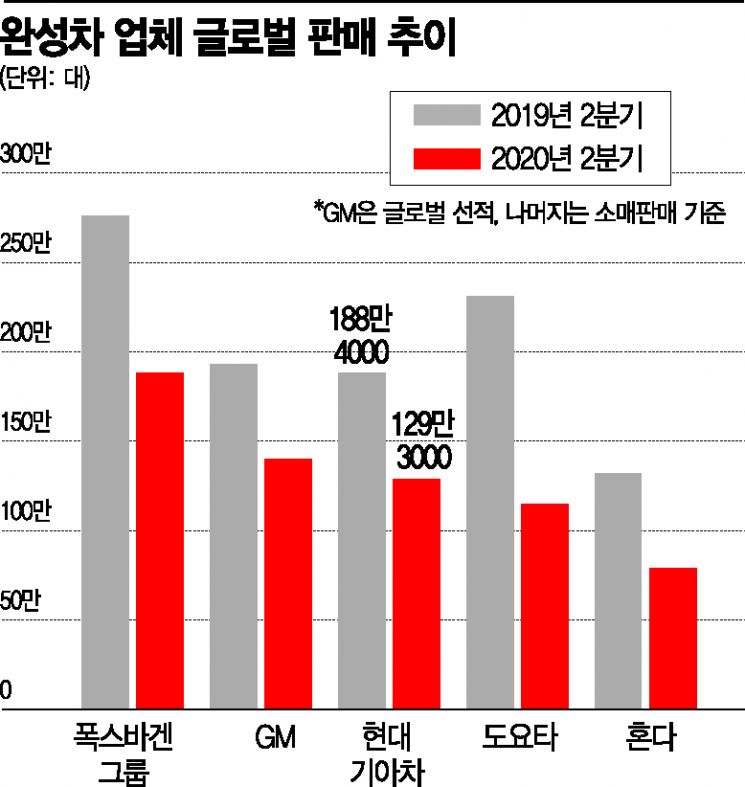
A notable point in the performance of these three companies is that Tesla recorded profits for four consecutive quarters without wavering despite the COVID-19 impact, entering a full-fledged profitable management trajectory. Tesla has been increasing its profit margin by establishing a full-scale mass production system, starting operations at its first overseas production base, the Shanghai factory in China, at the end of last year, and beginning production of the affordable SUV 'Model Y' in the U.S.
Tesla’s global sales in the second quarter were only about 90,000 units. There is still a large gap in sales scale compared to Hyundai Kia Motors, which sold 1.3 million units. However, it is noteworthy that Tesla’s operating profit during the same period reached KRW 393.4 billion, nearly half of Hyundai Kia Motors’ KRW 735 billion.
Hyundai Kia Motors, which overtook traditional giants by turning the COVID-19 crisis into an opportunity, is now expected to engage in a head-to-head battle with Tesla, an emerging powerhouse in the paradigm shift era. Especially from next year, Hyundai Kia Motors plans to consecutively launch high-performance electric vehicle models applying dedicated platforms, anticipating fierce market share competition with Tesla in the electric vehicle market. The competition between the two companies will cover not only electrification strategies but also mobility software technologies such as autonomous driving.
Researcher Woo Ji-woong of Ebest Investment & Securities said, "From the third quarter of this year onward, the market direction will be reorganized mainly around companies with high adaptability to electrification. While Tesla, which quickly established an electric vehicle mass production system compared to other companies, stands at the center of the market, Hyundai Kia Motors will also begin full-scale reevaluation starting with mass production of dedicated electric vehicle platforms from January next year."
© The Asia Business Daily(www.asiae.co.kr). All rights reserved.



















