Typhoon Jangmi Moving North Toward Busan... Small but Expected to Bring Over 250mm of Heavy Rain
Concerns Over Ground Collapse and Landslides, Recovery from Flood Damage Incomplete as Preparations for Major Storm Resume
30 Dead and 12 Missing Since the 1st... 4,000 Households Displaced Across 11 Cities and Provinces
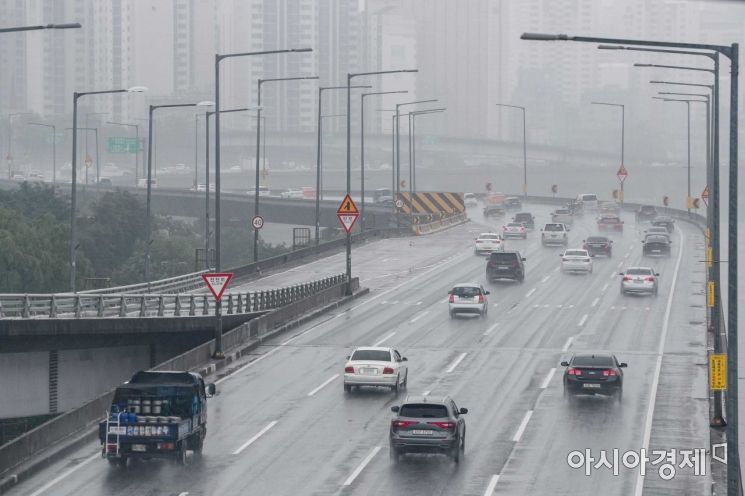 On the 10th, when the main section controls of Gangbyeonbuk-ro and Olympic-daero were lifted, traffic flow on Gangbyeonbuk-ro viewed from the north end of Seogang Bridge in Mapo-gu, Seoul, was proceeding smoothly. Photo by Kang Jin-hyung aymsdream@
[Asia Economy Reporters Jo In-kyung and Lee Hyun-joo] Even before recovering from the damage caused by the monsoon rains, a typhoon is approaching, putting the entire country on alert once again. Although it is a small-scale typhoon, it is expected to bring strong winds along with heavy rainfall exceeding 250mm, causing additional damage in Jeju and the southern regions. The prolonged monsoon has weakened the ground in many areas, raising concerns about landslides and collapses of embankments or levees.
In Jeonnam, where rain damage has been concentrated since the 7th, recovery efforts have not yet been completed, and preparations for typhoon damage must begin again. Especially with the typhoon's landfall and forecasts of heavy rain nationwide until the 11th, the period from the afternoon of the 10th through the next day is expected to be a critical time for the typhoon's impact.
Typhoon Jangmi (JANGMI), as of 9 a.m. on the 10th, is located about 150 km southeast of Seogwipo and is moving toward Busan at 40 km/h. It is a small typhoon with maximum wind speeds of 68 km/h and a strong wind radius of 200 km. It is expected to make landfall near Tongyeong on the southern coast of Gyeongnam around 3 p.m.
As the typhoon moves northward, typhoon warnings have been issued for Jeju and some islands in the southern Jeonnam Namhae region. Heavy rain warnings are in effect for parts of western Gyeongsang and eastern Jeonnam, with forecasts of strong rain exceeding 30 mm per hour. Preliminary typhoon warnings have been announced for most southern areas, and the regions affected by the typhoon are expected to expand over time.
The Jeju Disaster and Safety Headquarters has urged people to avoid entering dangerous areas due to concerns about landslides and embankment collapses. They also warned about damage to crops from flooding and fruit falling due to strong winds. Beaches in Busan, including Haeundae, Songjeong, and Gwangalli, have all banned bathing and are dismantling facilities installed on the sandy beaches. In Jeonnam’s Gurye, Gokseong, and Damyang areas, which suffered severe damage from record-breaking heavy rain over the past four days, a support team composed of Jeonnam provincial government officials is conducting emergency recovery work to prevent further disasters.
The typhoon making landfall on the southern coast in the afternoon is expected to pass near Busan around 4 p.m., then move through inland Gyeongsang and exit near Pohang around 6 p.m., according to the Korea Meteorological Administration. Although the typhoon is small, the hot and humid air around it is rapidly rising and meeting cooler air coming inland from the West Sea, resulting in strong rainfall.
The Chungcheong and southern regions, which will be directly affected by the typhoon, are expected to record cumulative rainfall of 50 to 150 mm by tomorrow. Chungcheong and Jeonbuk, also influenced by the stationary front, are forecasted to receive very heavy rain exceeding 250 mm. Seoul, Gyeonggi, Gangwon, and Jeju are expected to receive 30 to 80 mm of rain, with southern Gangwon receiving over 120 mm, according to the meteorological agency. Most rain will stop by tomorrow afternoon, but in Seoul, Gyeonggi, Gangwon Yeongseo, and Jeolla, it will continue until night.
Meanwhile, since the 1st of this month, the nationwide death toll from the heavy rains stands at 30, with 12 missing and 8 injured. Including the 6 deaths and missing persons from the boat capsizing accident in Uiamho, Chuncheon, the numbers are even higher. The number of disaster victims is 6,946 people in 4,023 households across 11 cities and provinces, with 3,425 of them staying with relatives, in gymnasiums, or village halls. The area of farmland damaged by the rain over ten days reaches 25,113 hectares, and a total of 14,091 cases of facility damage, including house destruction and road flooding, have been reported.
© The Asia Business Daily(www.asiae.co.kr). All rights reserved.
![Clutching a Stolen Dior Bag, Saying "I Hate Being Poor but Real"... The Grotesque Con of a "Human Knockoff" [Slate]](https://cwcontent.asiae.co.kr/asiaresize/183/2026021902243444107_1771435474.jpg)















