Strengthened Occupancy Requirements, Revised Lease Protection Act Enforced... Jeonse Crisis Deepens
New Residential Complexes Usually Cheaper Than Nearby Market Prices Now Exceeding Them
Yongsan Central Park, Moving In This Month, Priced 100M-300M KRW Higher Than Market
Off-Season Over, Jeonse Crisis Expected to Worsen Ahead of September Moving Season
[Asia Economy Reporter Onyu Lim] The trend of rising jeonse (long-term lease) prices is spreading. Landlords are not just raising asking prices but actual transaction prices are soaring as well. The revised Housing Lease Protection Act, including the Jeonse and Monthly Rent Cap System and the Contract Renewal Request Right, has triggered landlords' defensive mechanisms, and with the worsening shortage of listings, tenants are reluctantly signing contracts at higher prices. Notably, jeonse prices are rising even in aging reconstruction complexes and newly occupied complexes that were typically leased below market prices.
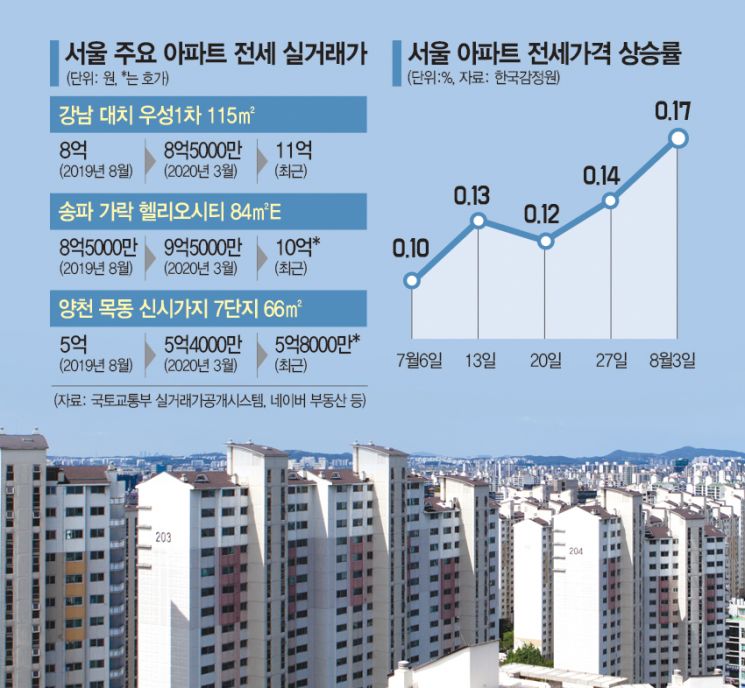
Daechi Woosung 1st Complex 115㎡ Jeonse Jumps from 900 Million KRW to 1.1 Billion KRW... "Abolition of Autonomous Private High Schools, Strengthened Actual Residence Requirements, Enforcement of Lease Protection Law"
According to the real estate industry on the 10th, on the 20th of last month, a jeonse contract was signed at a record high of 1.1 billion KRW for a 115㎡ (exclusive area) unit in Daechi Woosung 1st Complex, Daechi-dong, Gangnam-gu, Seoul. Earlier last month, the jeonse transaction was made at 820 million KRW. Daechi Woosung 1st Complex is an aging reconstruction complex built 36 years ago. Because of this, its jeonse prices had been relatively low compared to surrounding apartments. After surpassing 900 million KRW for the first time in February this year, prices hovered around 800 to 900 million KRW but then surged to the 1.1 billion KRW range within a month.
The contract date, the 20th of last month, coincided with the period when moves to revise the Housing Lease Protection Act were intensifying. As the jeonse contract period was set to extend to 4 years and the deposit increase rate upon contract renewal was expected to be capped at 5%, landlords appear to have significantly raised jeonse prices in response. A representative from nearby real estate agency A said, "Recently, due to the abolition of autonomous private high schools, the concentration in the Gangnam 8 school districts has intensified, and with strengthened actual residence requirements, jeonse listings have dried up. In this situation, with the revised Lease Protection Act being enforced, landlords raised jeonse prices as they wished."
Nearby Eunma Apartments, also a representative aging reconstruction complex, have jeonse listings as rare as finding a star in the sky. According to Naver Real Estate, there are currently only 5 jeonse listings in this complex with 4,424 households.
Jeonse Prices Rise Even in Newly Occupied Apartments... "Decrease in Jeonse Listings Due to Strengthened Actual Residence Requirements"
Rapid jeonse price increases are also observed in newly occupied complexes. For example, in Yongsan Central Park Harrington Square in Yongsan-gu, Seoul, which is moving in this month, jeonse prices are about 100 million to 300 million KRW higher than nearby complexes. The asking price for the smallest 92㎡ unit is 1.3 billion KRW, similar to 112㎡ units in Yongsan Prugio Summit and 144㎡ units in Yongsan City Park 1st Complex.
Typically, jeonse prices in newly occupied complexes are cheaper than nearby areas because a large volume of jeonse listings flood the market before move-in. For example, the E-type 84㎡ jeonse in Helio City, Garak-dong, Songpa-gu, Seoul, currently priced at 900 million to 1 billion KRW, was leased at 600 million to 700 million KRW when it moved in during the second half of 2018, which was relatively cheap compared to surrounding prices. However, due to the recent preference for new apartments, strengthened actual residence requirements related to reconstruction and capital gains tax, and the enforcement of the Jeonse and Monthly Rent Cap System and Contract Renewal Request Right, jeonse prices in newly occupied complexes are now similar to or even higher than market prices.
According to the Korea Real Estate Board, as of the 3rd, Seoul apartment jeonse prices rose by 0.17%. This is the largest increase in about seven months since the end of last December (0.19%). The real estate industry expects the jeonse shortage to worsen further as the moving season begins in September after the summer off-season. Since Minister Kim Hyun-mi of the Ministry of Land, Infrastructure and Transport announced plans to lower the conversion rate from jeonse to monthly rent, landlords aiming to raise jeonse prices have been appearing one after another. A real estate industry official predicted, "In September, when moving demand surges, jeonse shortages with no listings and soaring rents will worsen, especially in areas with good subway access and school districts."
© The Asia Business Daily(www.asiae.co.kr). All rights reserved.
![Clutching a Stolen Dior Bag, Saying "I Hate Being Poor but Real"... The Grotesque Con of a "Human Knockoff" [Slate]](https://cwcontent.asiae.co.kr/asiaresize/183/2026021902243444107_1771435474.jpg)















