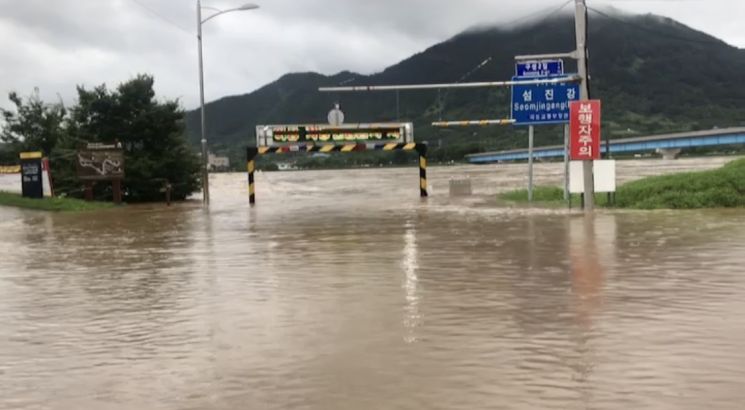
[Asia Economy Reporter Park So-yeon] Heavy rain continued for the second day in the Gwangju and Jeonnam regions. Rivers and streams overflowed, houses, farmland, and roads were submerged, and landslides struck, resulting in the worst flood damage. Eight people lost their lives.
Casualties Mount... 8 Dead, 1 Missing
Unable to withstand the relentless heavy rain, a landslide occurred, causing five people to lose their lives at once.
On the evening of the 7th, at around 8:29 PM, soil collapsed from a mountain behind a village in Osan-myeon, Gokseong-gun, burying five houses.
After three people died, two more were found dead during a resumed search operation the next day, which had been halted due to continuous heavy rain.
At around 5 AM on the 8th, a fire broke out in a house in Geumseong-myeon, Damyang-gun, where a person in their 70s was found dead inside.
Damyang-gun authorities determined that the fire was caused by a fallen utility pole due to the weakened ground from the heavy rain.
At around 4 AM, an 8-year-old child was swept away by the swollen water in a stream in Bongsan-myeon, Damyang-gun, and was found dead at around 1:20 PM.
Flood Damage Continues to Farmland and Fish Farms
Flood damage occurred throughout Gwangju and Jeonnam, both in urban and suburban areas.
In Jeonnam alone, 71 houses were damaged, buried, or flooded, and 3,255 hectares of farmland were affected by flooding and other damage.
By crop type, 3,155 hectares of rice including 800 hectares in Hampyeong, 699 hectares in Yeonggwang, and 354 hectares in Jangseong; 86 hectares of facility crops; 12 hectares of field crops; and 2 hectares of fruit trees were damaged.
In Ok-gwa, Gokseong, a fish farm raising 300,000 eel fry was flooded.
Embankments were washed away at 30 meters of Changpyeongcheon in Damyang, 100 meters of Oryecheon, 30 meters of Dongcheon in Hwasun, 40 meters of Seosicheon in Gurye, and 30 meters of Bulgapcheon in Yeonggwang.
In Gwangju, 793 damage reports were received over two days.
Roads at 228 locations were flooded, and 237 public facilities and 556 private facilities suffered damage.
247 houses, as well as 92 sewage systems, 17 stone retaining walls, and 34 hectares of farmland were also severely damaged.
Isolated residents were precariously rescued by boat, herds of cattle escaped, and entire underground parking lots in apartment complexes were submerged.
Large facilities such as Kumho Tire factory in Gokseong, Gwangju Technopark Complex 1, and the headquarters building's electrical and mechanical rooms were not spared.
Rivers Overflow, Embankments Collapse... Flood Warnings Issued Nationwide
On the morning of the day, the Seomjin River, flowing through Gurye and Gokseong in Jeonnam, overflowed its embankments, flooding surrounding farmland.
At 5:50 AM, water overflowed Gwangjuho in Damyang-gun, restricting access to the surrounding area.
Water levels are rising toward critical limits at various points along the Yeongsan River, the lifeline of Honam.
An embankment collapsed at Seosicheon in Gurye, and the Hwangryonggang Danggwangcheon in Jangseong also flooded, prompting nearby residents to evacuate urgently.
Gwangjucheon, flowing through downtown Gwangju, nearly overflowed but water levels slightly decreased; however, the continuous heavy rain means the situation cannot be considered safe.
Flood warnings were issued at four points along the Yeongsan River: Gukrakgyo and Jangnokgyo in Gwangju, and Naju Bridge and Nampyeong Bridge in Naju; and at three points along the Seomjin River: Geumgokgyo in Gokseong, Gurye Bridge in Gurye, and Songjeong-ri.
Dams in the Yeongsan and Seomjin River basins, including Damyang Dam, Gwangju Dam, Jangseong Dam, Naju Dam, and Juam Dam, have mostly exceeded their restricted water levels.
Train and Subway Services Suspended
All KTX and regular train services on the Jeolla Line between Iksan and Yeosu Expo Station have been suspended.
According to Korea Railroad Corporation (KORAIL), due to track flooding between Dongsan and Jeonju and rising water levels on the bridge between Gokseong and Amnok Station, all train services on the Iksan to Yeosu Expo Station section were suspended from 10 AM that day.
As a result, all trains on the Jeolla Line (KTX, Saemaeul, Mugunghwa) operate only between Yongsan Station and Iksan Station.
Train services at Gwangju Station were also suspended as trains could not cross the bridge due to flooding of Wolgokcheon Bridge.
The Saemaeul train (8 round trips) from Seoul Yongsan to Gwangju operates only up to Gwangju Songjeong Station, and the Mugunghwa train (12 trips) from Yongsan operates only up to Iksan Station.
Due to heavy rain over two days starting the previous day, five train services were suspended on three sections: Songjeong to Suncheon, Suncheon to Mokpo, and Suncheon to Jangseong.
Gwangju subway also shortened its route due to road flooding near Pyeongdong Station.
Gwangju Subway Line 1 has 20 stations from Nokdong to Pyeongdong Station, but operates only between Nokdong and Dosan Station, excluding Pyeongdong Station.
Up to 563mm of Rain in Two Days... Additional 50mm to 100mm Expected Until the 9th
Rain eased in the afternoon, but additional rainfall is forecast.
As of 4 PM on the 8th, the rainfall over two days recorded 563.0mm in Ok-gwa, Gokseong; 542.5mm in Damyang; 510.0mm in Buk, Hwasun; and 484.7mm in Gwangju.
More than 200mm of rain fell for two consecutive days.
Heavy rain warnings remain in effect for nine cities and counties in Jeonnam: Gwangju, Hwasun, Naju, Yeonggwang, Hampyeong, Suncheon, Jangseong, Gurye, Gokseong, and Damyang.
Heavy rain advisories have been issued for seven cities and counties in Jeonnam: Muan, Jangheung, Sinan, Mokpo, Yeongam, Gwangyang, and Boseong.
The Korea Meteorological Administration forecasts an additional 50 to 100mm of rain in Gwangju and Jeonnam, with the rain expected to stop by the morning of the 9th (afternoon for the southern coast).
Strong rain may return from the evening of the 8th to the early morning of the 9th, with a brief pause before resuming on the afternoon of the 10th.
The Korea Meteorological Administration urged, "Please refrain from going out or driving, avoid staying near rivers or valleys, and be cautious of safety accidents."
© The Asia Business Daily(www.asiae.co.kr). All rights reserved.
![Clutching a Stolen Dior Bag, Saying "I Hate Being Poor but Real"... The Grotesque Con of a "Human Knockoff" [Slate]](https://cwcontent.asiae.co.kr/asiaresize/183/2026021902243444107_1771435474.jpg)















