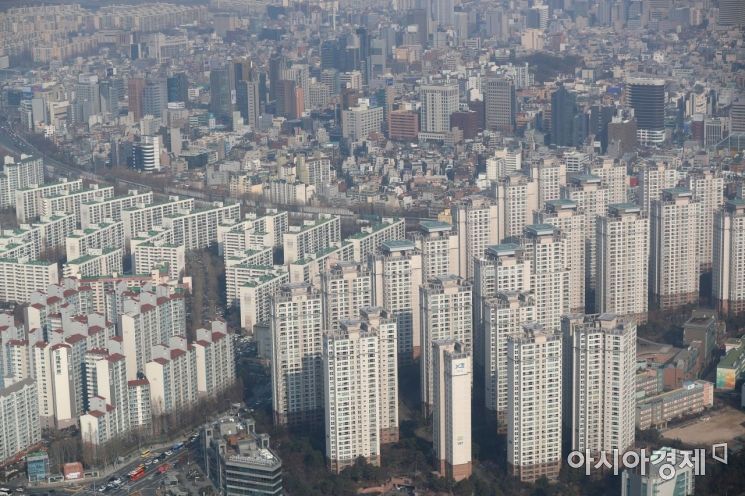
[Asia Economy Reporter Kim Yuri] The government and Seoul Metropolitan Government will establish specific guidelines next week for the core of this week's housing supply expansion plan, the 'public participation high-density reconstruction (public reconstruction).' In particular, they are considering measures to enable reconstruction complexes, which were technically unable to build 50-story buildings under the '2030 Seoul Plan,' by changing zoning and central area systems. Initially, Seoul City showed a skeptical response to the effectiveness of public reconstruction and insisted that 'even public reconstruction must follow the height standards specified in the 2030 Seoul Plan,' but this is essentially a surrender.
However, the fact that many exceptions will be made to the direction of the 2030 Seoul Plan, Seoul's highest-level urban plan, which could undermine consistency in urban planning, and that private associations' participation will remain low unless the government's stance on '90% profit recovery' changes even if the changes are made despite these risks, are still pointed out as problems.
Public reconstruction involves relaxing the floor area ratio (FAR) for reconstruction projects involving public entities such as Korea Land and Housing Corporation (LH) and Seoul Housing Corporation (SH) from a maximum of 300% to 500%, and allowing up to 50 floors. Even general residential areas will be upgraded to semi-residential areas to allow the construction of 50-story apartments. They are also considering adjusting the central area system to meet the conditions for 50-story development. The ratio and method of non-residential use in mixed-use developments such as residential-commercial complexes will also be discussed to increase participation incentives.
◆To curb housing prices... Will Seoul's highest urban plan be shaken?= Next week, the Ministry of Land, Infrastructure and Transport and Seoul City will create specific guidelines on increasing the FAR and relaxing height restrictions for public reconstruction through task force (TF) meetings. Private participation is essential to achieve the goal (50,000 households), but since it cannot be forced, they plan to first expand the scope of possible participation.
To this end, the city is discussing upgrading the 'other areas,' where 50-story reconstruction is not possible, to urban/metropolitan centers or regional/district centers. Under the 2030 Seoul Plan's central area system, Seoul is classified into downtown/metropolitan centers, regional/district centers, and other areas. The 50-story construction mentioned in public reconstruction is possible only in downtown/metropolitan centers or regional/district centers or higher. Within these areas, the maximum number of floors is finally determined based on zoning (general residential, semi-industrial, semi-residential, commercial areas, etc.) and whether the building is a mixed-use residential-commercial complex or solely residential.
Currently, in 'other areas,' even if built as a mixed-use residential-commercial complex in commercial or semi-residential areas, the maximum height is limited to 40 floors. Most reconstruction complexes, such as Eonma Apartments in Daechi-dong, Gangnam-gu, mentioned several times before and after the August 4th measures, fall under 'other areas.' Ultimately, this review aims to adjust the central area system to open the way for any project entity willing to participate in public reconstruction.
However, this requires breaking the balance of the highest-level urban plan. There may be fairness controversies over the results of reviews conducted with predetermined directions in future evaluations. An industry insider said, "The idea that private landowners will participate if given some incentives is ironic," adding, "Just because the public is involved doesn't mean it's always good, but it seems they insist on this method, shaking the urban planning framework without even considering revitalizing private reconstruction."
◆Ultimately according to the government's will? The goal is 'securing volume'= Seoul City was initially skeptical about public reconstruction because it saw that participation by associations and other project entities is essential to secure actual volume. As Deputy Prime Minister and Minister of Economy and Finance Hong Nam-ki emphasized when announcing the August 4th measures, there is no way to force participation other than voluntary involvement. Even if associations decide on public reconstruction, it comes with the premise of 'recovering more than 90% of the expected profit based on the increased FAR.' This is why nearly doubling the FAR and relaxing height restrictions do not offer significant benefits to project entities. Industry experts point out that the government, desperate to secure volume, tries to find ways with the premise of profit recovery, which leads to 'another misstep' when associations reject the plan after weighing interests.
Major reconstruction sites, including Gangnam, have already distanced themselves from public reconstruction. Yeouido has also expressed a negative stance on expanding donation instead of upgrading zoning. A representative of the Samboo Apartment Reconstruction Promotion Committee said, "We have no particular interest because the existing project plan (FAR, etc.) is sufficient."
Ultimately, some mid-rise complexes with low profitability under current standards, such as those with FAR close to 200%, are likely to closely consider the public reconstruction option. Most of these have just reached the 30-year reconstruction eligibility. Reconstruction complexes over 40 to 50 years old, facing safety threats, are not even undergoing review procedures or passing safety inspections but are being considered for pilot projects. If their project progress accelerates, fairness issues will inevitably arise. Professor Kwon Dae-jung of Myongji University Graduate School of Real Estate said, "With various regulations such as reconstruction excess profit recovery and price ceiling systems still applied, approaching with 'FAR belongs to the public' and '90% recovery' makes it difficult to achieve the goal of securing supply volume."
© The Asia Business Daily(www.asiae.co.kr). All rights reserved.
![Clutching a Stolen Dior Bag, Saying "I Hate Being Poor but Real"... The Grotesque Con of a "Human Knockoff" [Slate]](https://cwcontent.asiae.co.kr/asiaresize/183/2026021902243444107_1771435474.jpg)
















