Government: "We Did Everything Possible... Health Insurance Premiums Pose Unexpected Challenge"
NHIS 2Q Long-term Care Benefits Down 500 Billion KRW YoY, 900 Billion KRW QoQ
Spending Relative to GDP, Government Consumption Growth Rate Slows
[Asia Economy Reporter Kim Eun-byeol] "We thought the government had done everything it could to mitigate the shock of the novel coronavirus infection (COVID-19) and prevent a sharp decline in economic growth, but there was something we missed. That was health insurance expenditure. Because people avoided going to hospitals due to fear of infection, health insurance funds were spent less, slowing the growth of government consumption, and as a result, the gross domestic product (GDP) growth rate is likely to fall short of expectations."
This was a confession from a senior government official just before the Bank of Korea announced the real GDP for the second quarter at the end of last month. It means that although maximum efforts were made to prevent the plummeting growth rate caused by COVID-19 and some containment was expected, an unexpected obstacle appeared in the form of health insurance expenditure. People avoided hospitals out of concern for secondary infections, and as the number of hospital visits decreased, health insurance spending also declined proportionally, reducing the effect of government fiscal stimulus. Typically, hospitals provide medical services to patients and then apply to the National Health Insurance Service for reimbursement of medical benefits. Although medical benefit payments had been steadily increasing recently due to factors such as aging, the upward trend was halted by COVID-19.
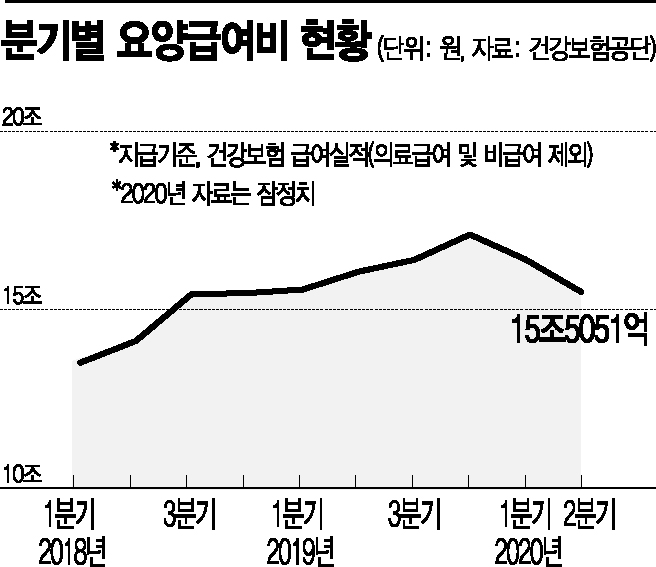
According to data compiled by Asia Economy on the 7th upon request from the National Health Insurance Service, medical benefit payments in the second quarter of this year amounted to 15.5051 trillion won, a decrease of about 560 billion won compared to the same period last year. Considering that medical benefit payments had been increasing steadily, a year-on-year decline is not common. In the past, during the Middle East Respiratory Syndrome (MERS) outbreak, medical benefit payments also decreased. The second quarter medical benefit payments this year were about 910 billion won less than the first quarter (16.4178 trillion won), before COVID-19 spread in earnest. A National Health Insurance Service official said, "Since the implementation of 'Moon Jae-in Care,' the coverage has expanded, and people were visiting hospitals more frequently, but this time, visits actually decreased." However, the official added, "Insurance premium reductions were given in places like Daegu due to COVID-19, and the number of households falling behind on premium payments increased, so the funds themselves are not in surplus."
It is already known that people avoided hospital visits as COVID-19 spread. However, it seems the government did not fully consider that this could affect GDP as well. According to the Bank of Korea and others, health insurance premiums account for 15-20% of government expenditure recorded in GDP. Although the government is injecting massive fiscal resources to boost growth, a decrease in health insurance expenditure can offset the effects of fiscal spending.
A Bank of Korea official explained, "Typically, the growth rate of health insurance-related expenditures is higher than the average government consumption growth rate, but in the second quarter, it was unusually lower than the year-on-year government consumption growth rate (6.0%)."
Although the COVID-19 spread has somewhat eased recently, there are still few people willing to spend money on medical and health care. According to the Bank of Korea's Consumer Sentiment Survey, the medical and health expenditure outlook Consumer Sentiment Index (CSI) recorded 113 in January this year, but dropped to 110 in March and 107 in May. This is similar to the level in March 2009 (106), right after the financial crisis. A government official said, "Even if the government injects a lot of money to defend the growth rate, it cannot force people to visit hospitals, so growth rate calculations must take this factor into account for the time being."
© The Asia Business Daily(www.asiae.co.kr). All rights reserved.
![Clutching a Stolen Dior Bag, Saying "I Hate Being Poor but Real"... The Grotesque Con of a "Human Knockoff" [Slate]](https://cwcontent.asiae.co.kr/asiaresize/183/2026021902243444107_1771435474.jpg)















