Including Redevelopment Zone Cancellation Areas in Public Redevelopment Targets under the 8·4 Measures
Increased Interest in Redevelopment-Canceled Areas such as Singil-dong in Yeongdeungpo-gu, Jangwi-dong in Seongbuk-gu, and Jeonnong-dong in Dongdaemun-gu
"It Takes Years Just to Redesignate Redevelopment Zones... Urgent Need for Residential Environment Changes Even if More Rental Housing Is Built"
However, Conflicts May Arise as Some Areas Proceed with Projects Like Jiju-taek and Garoju-taek Maintenance After Cancellation
[Asia Economy Reporter Onyu Lim] In Yeongdeungpo-gu Shingil 16 District, which was deregulated from the Seoul Redevelopment Promotion Zone (New Town) in 2014, there is a movement among residents to resume the project following the government's August 4 supply plan announcement. A resident of the area, Mr. A, said, "If the project proceeds by the usual method, it will take years just to redesignate the redevelopment zone," adding, "Even if a few more rental housing units are built, it is better to proceed quickly through the public redevelopment method."
According to frontline real estate industry sources on the 7th, expectations for 'public redevelopment' are growing in various areas of Seoul where redevelopment zones have been deregulated, such as Shingil-dong in Yeongdeungpo-gu, Jangwi-dong in Seongbuk-gu, and Jeonnong-dong in Dongdaemun-gu. This follows the government's announcement in the August 4 plan that deregulated redevelopment areas will also be included as targets for public redevelopment.
Public redevelopment is a project in which public entities such as Korea Land and Housing Corporation (LH) or Seoul Housing and Communities Corporation (SH Corporation) participate in redevelopment projects to improve the residential environment of deteriorated areas and promote housing supply within the city. In exchange for supplying 50% of the units as rental housing excluding the quota for association members, incentives such as zoning upgrades, increased floor area ratio, and exemption from the price ceiling system are provided.
In particular, as the government expanded the scope of public redevelopment to include deregulated redevelopment areas through this plan, more districts are showing interest in the project. Previously, in the May and June plans, the government limited the targets of public redevelopment projects to existing redevelopment zones only.
From the perspective of redevelopment zones where projects are currently proceeding normally, there was little response to choosing public redevelopment because the required donation ratio of rental housing was high. However, as the project targets have expanded, interest is increasing in deregulated redevelopment areas where there is no capacity for additional financial burden and project progress is slow.
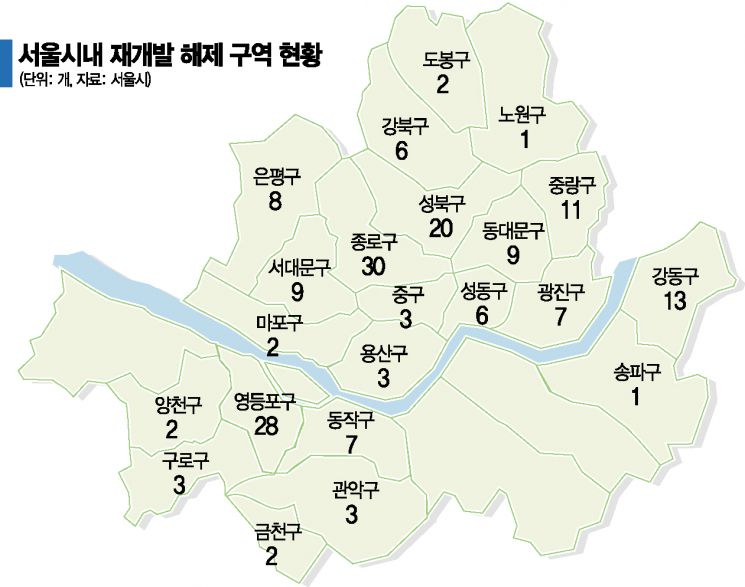
Currently, there are a total of 176 deregulated redevelopment zones in Seoul. Jongno-gu has the most with 30 sites, followed by Yeongdeungpo-gu with 28, Seongbuk-gu with 20, Gangdong-gu with 13, Jungnang-gu with 11, Seodaemun and Dongdaemun-gu with 9 each, Eunpyeong-gu with 8, Gwangjin and Dongjak-gu with 7 each, and Gangbuk and Seongdong-gu with 6 each.
The most proactive area is Seongbuk 3 District in Seoul, which was deregulated by official order in September 2017. This district, which had received project implementation approval, had its project canceled due to a low consent rate during the redevelopment plan revision process. A homeowner in Seongbuk 3 District said, "We have even submitted a cooperation letter for public redevelopment to the Seongbuk District Office," adding, "It is such a deteriorated area that it is difficult to put out a fire once it starts, so improving the residential environment is urgent."
Sangye 3 District in Nowon-gu, the only area deregulated from redevelopment zones in 2014, is also exploring participation in public redevelopment. A nearby real estate agent said, "If public redevelopment happens, the project's profitability will increase, so although there is no price increase yet, signs of listings being withdrawn are appearing."
In particular, the government's consideration of additional support measures to expand public redevelopment is also acting as a positive factor. A Ministry of Land, Infrastructure and Transport official said, "We are reviewing easing donation requirements to promote public redevelopment projects." The Ministry of Land and Seoul City plan to conduct a public redevelopment contest in September to select target projects.
However, it is uncertain whether deregulated redevelopment areas will be selected as target sites if competition for public redevelopment intensifies. A redevelopment industry official said, "In areas deregulated due to opposition from owners, the momentum for promotion has been greatly lost, and in many areas, local housing associations and street maintenance projects are being pursued after deregulation, so conflicts with existing projects are expected."
© The Asia Business Daily(www.asiae.co.kr). All rights reserved.
![Clutching a Stolen Dior Bag, Saying "I Hate Being Poor but Real"... The Grotesque Con of a "Human Knockoff" [Slate]](https://cwcontent.asiae.co.kr/asiaresize/183/2026021902243444107_1771435474.jpg)















