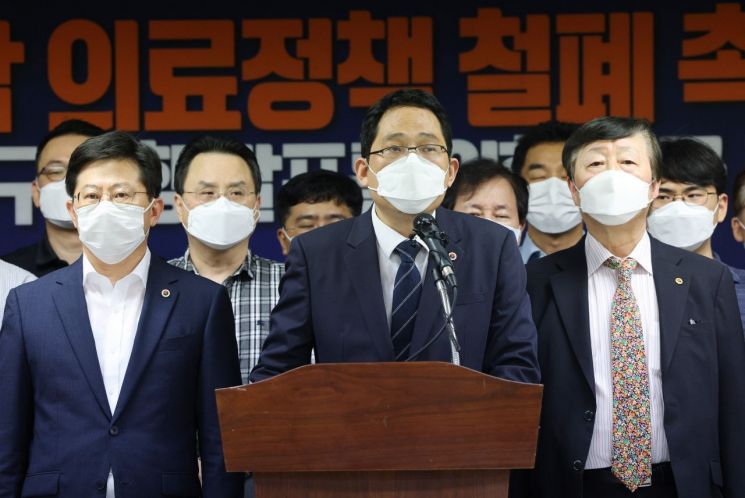
 President Choi Dae-jip of the Korean Medical Association and the executive members held an emergency press conference on the afternoon of the 1st at the Korean Medical Association in Yongsan-gu, Seoul, to urge the abolition of the 'Four Major Evil Medical Policies' and to announce demands to the government.
 [Image source=Yonhap News]
[Asia Economy Reporter Heo Midam] As residents have announced a strike on the 7th, the government expects no disruption in medical services due to securing substitute personnel. However, patient waiting times are anticipated to increase.
The Korean Intern Resident Association has decided to launch a full-scale strike, including essential personnel in intensive care units, maternity wards, surgeries, dialysis rooms, and emergency rooms, in protest against the recent government announcement to increase medical school quotas.
On the 6th, Son Youngrae, spokesperson for the Ministry of Health and Welfare, stated at a back briefing at the Government Seoul Office regarding the medical strike, "Disruptions may occur at large university hospitals where residents work, but since substitute personnel such as fellows and professors have been secured, we do not expect significant disruptions in medical services on the day of the strike," adding, "However, waiting times are likely to be longer."
Each training hospital is assessing the number of residents participating in the strike and striving to secure substitute personnel. Kim Heonju, Director of Health Policy at the Ministry of Health and Welfare, said, "The assessment of participant numbers is being actively conducted by the respective institutions (training hospitals), and substitute personnel are being secured by each institution," adding, "I understand that measures are being considered to ensure no disruption in essential medical services, such as changing work shifts or using annual leave."
The government, recognizing issues such as regional medical disparities, intends to resolve conflicts through dialogue. Spokesperson Son said, "Both the Korean Medical Association and we (the government) share a common awareness of the problem," adding, "We agree on the direction that issues such as regional medical disparities, workforce imbalance, and the shortage of doctors in essential but less profitable fields need to be addressed."
He continued, "However, while pushing for an increase in medical school quotas, the Medical Association points out that the solution should not be through quota increases alone but through improving regional conditions and rationally reorganizing the medical delivery system," adding, "We (the government) believe that both quota increases and improvement measures must go hand in hand to achieve the goal. If we resolve the issues through discussions with the medical community, I believe we can find a path for mutual growth for the entire medical sector."
© The Asia Business Daily(www.asiae.co.kr). All rights reserved.
![Clutching a Stolen Dior Bag, Saying "I Hate Being Poor but Real"... The Grotesque Con of a "Human Knockoff" [Slate]](https://cwcontent.asiae.co.kr/asiaresize/183/2026021902243444107_1771435474.jpg)















