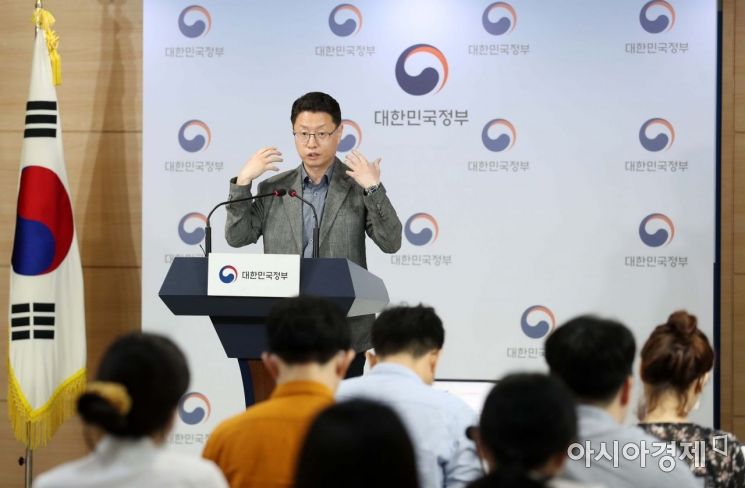
 Hong Jin-bae, Director of Communication Policy at the Ministry of Science and ICT, is announcing the results of the 2020 first half 5G communication service quality evaluation at the Government Seoul Office Building on the 5th. Photo by Moon Ho-nam munonam@
[Asia Economy Reporter Joselgina] "At this point, it is difficult to judge whether the average 5G download speed is good or bad. It can be said to be 3 to 4 times faster than LTE."
Amid ongoing quality controversies surrounding 5G services that have been commercialized for over a year, the Ministry of Science and ICT released quality evaluation results showing that the average 5G speed of the three mobile carriers is less than 700 Mbps (megabits per second). This speed is 3 to 4 times faster than LTE but falls far short of the 20 times faster theoretical speed mentioned at the time of 5G commercialization.
In particular, there are fewer than 4,000 multi-use facilities such as department stores and terminals in Seoul and six major metropolitan cities where 5G service is available, and one-third of these have been confirmed to have unstable service connections. This is why voices calling for accelerated investment are growing, as 5G needs to play the role of a "data highway" at the core of the "Digital New Deal."
◆First-ever Quality Evaluation... 4 Times Faster than LTE
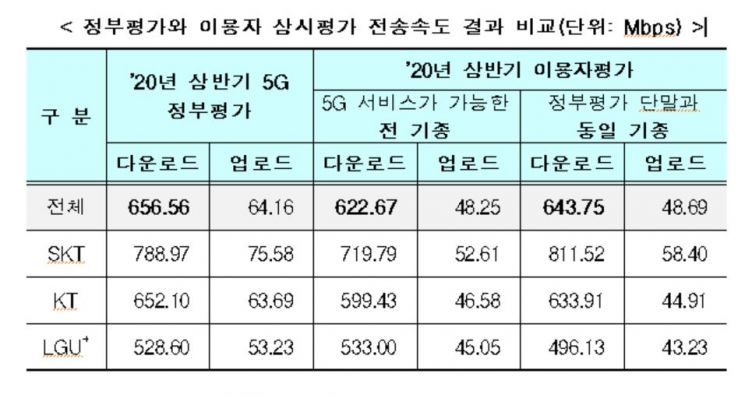
According to the first 5G mobile communication quality evaluation announced by the Ministry of Science and ICT on the 5th, the average download speed of the three carriers measured in Seoul and six major metropolitan cities was 656.56 Mbps, and the average upload speed was 64.16 Mbps. This is about 4 times faster in download speed and about 1.5 times faster in upload speed compared to the LTE speeds checked last year.
The handover rate from 5G to LTE recorded an average of 6.19%. This means that 6 out of 100 connections switch to LTE instead of 5G. The lower the number, the higher the stability of 5G connection. The average connection time, which refers to the time taken until the initial network connection, was 102.24 ms for download and 93.81 ms for upload, with a latency of 30.01 ms and a data loss rate of 0.57%.
This is the first official quality evaluation in Korea since the commercialization of 5G in April last year. The Ministry of Science and ICT stated, "Seoul has built coverage over an average area of about 425.53㎢ for the three carriers, providing 5G in most areas except forest land, and 5G is provided in downtown and major areas in the six major metropolitan cities."
Hong Jin-bae, Director of the Communications Policy Bureau at the Ministry of Science and ICT, responded to criticism that 5G speeds are much lower than the figures mentioned at the time of commercialization by saying, "LTE speeds were also slow in the early stages of quality measurement, but speeds increased as the frequency bandwidth widened and the network stabilized. As technology develops and frequency bandwidth expands, 5G will also approach theoretical speeds."
He added, "Considering that 5G speeds are about 3 to 4 times faster than LTE, it is believed that the network is being built stably."
◆SK Telecom Ranks First in 5G Speed… LG Uplus Leads in Coverage
Among the carriers, SK Telecom boasted the fastest 5G speed. Based on download speed, it recorded 788.97 Mbps, far ahead of KT (652.10 Mbps) and LG Uplus (528.60 Mbps). SK Telecom’s 5G speed was up to 50% faster than other carriers. The latency, a key factor for 5G services such as cloud gaming, AR, and VR, also showed the best performance.
SK Telecom also had the highest 5G availability rate within multi-use facilities subject to inspection, at 79.14%. The 5G availability rate refers to the proportion of signal strength sufficient for smooth 5G use. SK Telecom provides 5G in a total of 1,606 facilities. LG Uplus was found to provide 5G in 1,282 facilities (availability rate 60.08%), and KT in 938 facilities (64.56%).
The 5G speeds of the three carriers revealed on this day far exceed Verizon 5G’s 506.1 Mbps, which OpenSignal previously announced as the world’s fastest among major global carriers. OpenSignal had also announced that the 5G availability rates of global carriers were SK Telecom 15.4%, LG Uplus 15.1%, and KT 12.6%, ranking 2nd to 4th worldwide.
LG Uplus ranked first in coverage area, followed by KT and SK Telecom. This is based on information disclosed on the three carriers’ websites. In Seoul, the coverage area was around 410 to 440㎢, with little difference among the three carriers, but in the six major metropolitan cities, LG Uplus’s coverage (993.87㎢) was noticeably wider. The Ministry of Science and ICT explained, "There were no cases of exaggerated coverage compared to reality."
Additionally, the rate of switching from 5G to LTE during use was lowest for KT (4.55%, based on download), followed by SK Telecom (4.87%) and LG Uplus (9.14%). This means KT received the highest evaluation for 5G connection stability.
◆Quality Controversies Inevitable Despite Maximum Investment by Three Carriers
With the first-ever quality evaluation results disclosed, voices claiming that the carriers’ network investments are still insufficient are expected to grow louder.
There are fewer than 4,000 multi-use facilities such as department stores and terminals where 5G service is available, and only 67.93% of these have signal strength sufficient for smooth use. Among transportation facilities, 5G has been installed in only 313 out of 649 underground subway stations. Meanwhile, the rate of switching from 5G to LTE inside subway cars, where smartphone usage is high, approached 20%.
Despite the three carriers investing about 9 trillion won last year to accelerate network construction, quality controversies have intensified mainly among 5G smartphone users. According to the Korea Communications Commission, 20% of the 280 dispute resolution applications received by the Communications Dispute Mediation Committee, launched in June last year, were consumer complaints related to 5G quality.
The Ministry of Science and ICT’s decision to split the annual quality evaluation into two for 5G is not unrelated to this. At the briefing, Director Hong said, "There was a need to promote investment amid the COVID-19 situation," and "The purpose is also to provide communication quality that meets the public’s expectations." In the first half of this year, the three carriers made investments of around 4 trillion won through early execution.
SK Telecom, which ranked first in 5G speed, stated, "Following the largest-ever equipment investment in 2019, we are continuously striving to strengthen 5G infrastructure by advancing investments as early as possible in the first half of this year. We will proactively apply 5G network technology, build equipment densely to maintain the highest level of customer experience quality, and focus on building the data highway, which is the core of the Digital New Deal."
The Ministry of Science and ICT plans to announce the overall 2020 telecommunications service quality evaluation results, including the second half 5G quality evaluation results, after December. Director Hong emphasized, "Although 5G coverage and quality are improving rapidly, investment acceleration is necessary for 5G to play an important role as a data highway," and "Network investment must be expanded so that the public does not experience inconvenience in using 5G." Regarding criticism that the promotion of 5G being 10 to 20 times faster than LTE at commercialization was exaggerated advertising, he drew a line by saying, "Whether it is false or exaggerated advertising is a matter for the Fair Trade Commission to review."
Meanwhile, the user continuous evaluation results, where users measure directly with their devices, showed an average download speed of 622.67 Mbps and an upload speed of 48.25 Mbps, similar to the government evaluation results.
© The Asia Business Daily(www.asiae.co.kr). All rights reserved.
![Clutching a Stolen Dior Bag, Saying "I Hate Being Poor but Real"... The Grotesque Con of a "Human Knockoff" [Slate]](https://cwcontent.asiae.co.kr/asiaresize/183/2026021902243444107_1771435474.jpg)
















