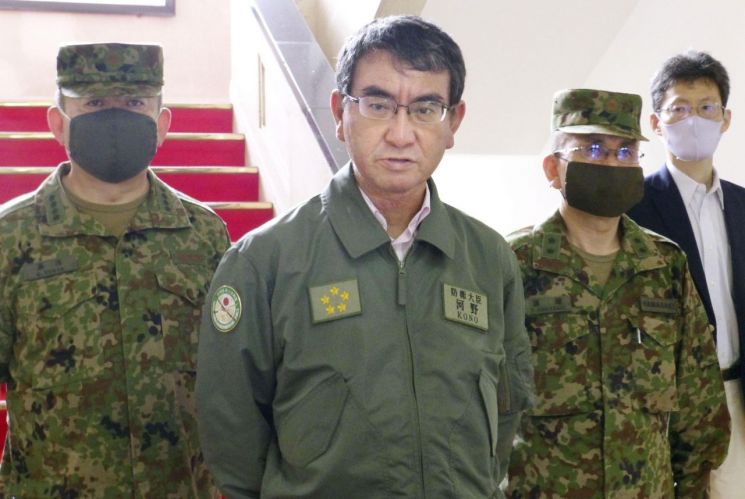
[Asia Economy Reporter Jeong Hyeon-jin] Japanese Defense Minister Kono Taro took a hardline stance, stating that there is no need to obtain the understanding of neighboring countries such as South Korea or China regarding Japan's possession of enemy base strike capabilities.
According to the Japanese Ministry of Defense on the 5th, at a press conference the previous day, when asked whether Japan had failed to sufficiently gain the understanding of neighboring countries such as South Korea or China concerning the discussion on possessing enemy base strike capabilities and the resulting changes in Japan's defense policy, Defense Minister Kono responded, "Why is South Korea's understanding necessary when it comes to defending our country's territory...?" He also retorted regarding China, "Why is such understanding necessary especially when China is primarily increasing its missile capabilities?"
When asked again about the importance of seeking the understanding of neighboring countries, Defense Minister Kono replied, "I believe we have been clearly explaining Japan's defense in the Defense White Paper."
Enemy base strike capability refers to the ability to attack and destroy bases within enemy territory, such as ballistic missile launch facilities, using bombers or cruise missiles. Ultimately, this could lead to the argument that if movements indicating an enemy's intention to attack Japan are detected, a strike must be carried out just before the attack is executed. Since Japan expresses concern over North Korea's missile threats, if Japan envisions intercepting ballistic missiles not by shooting them down in flight but by neutralizing them within the adversary's territory, it could also impact security on the Korean Peninsula.
Within Japan, following the cancellation of the ballistic missile defense system plan 'Aegis Ashore,' the ruling Liberal Democratic Party and others argue that it is necessary to possess enemy base strike capabilities. When criticisms arise that using enemy base strike capabilities essentially constitutes a preemptive strike, they explain it as "the ability to neutralize ballistic missiles within the adversary's territory under the concept of exclusive defense while complying with international law within the scope of the Constitution" to avoid controversy.
At the same press conference, Defense Minister Kono also addressed the issue of repeated approaches by Chinese government vessels near the Senkaku Islands (Chinese name Diaoyutai Islands), stating, "If a situation arises where the Self-Defense Forces must respond, we will respond firmly." When asked about plans to visit Yasukuni Shrine on August 15, which is Liberation Day in South Korea and the end-of-war memorial day in Japan, he replied, "There are no particular plans."
© The Asia Business Daily(www.asiae.co.kr). All rights reserved.

















