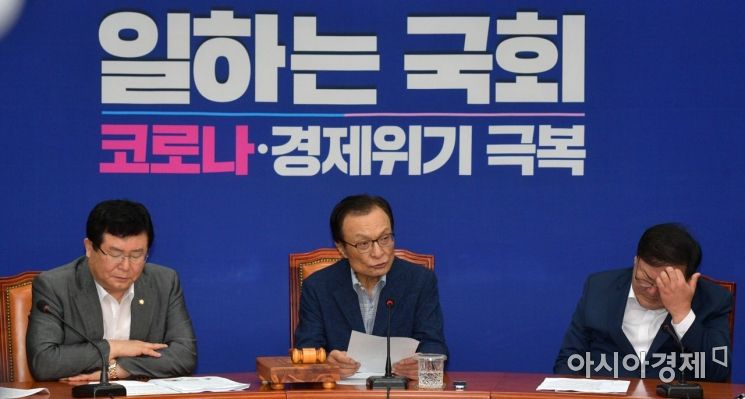
 Lee Hae-chan, leader of the Democratic Party of Korea, is attending the Supreme Council meeting held at the National Assembly on the 5th and delivering opening remarks. Photo by Yoon Dong-joo doso7@
[Asia Economy Reporter Kang Nahum] The Democratic Party of Korea has demanded the resignation of Prosecutor General Yoon Seok-yeol. They are also increasing pressure by stating that if the United Future Party does not select members to recommend for the Corruption Investigation Office for High-ranking Officials (CIO), they will present alternative measures. It is expected that the ruling party's strong legislative drive for reforming power institutions will continue in the upcoming September regular session of the National Assembly, which is just over a month away.
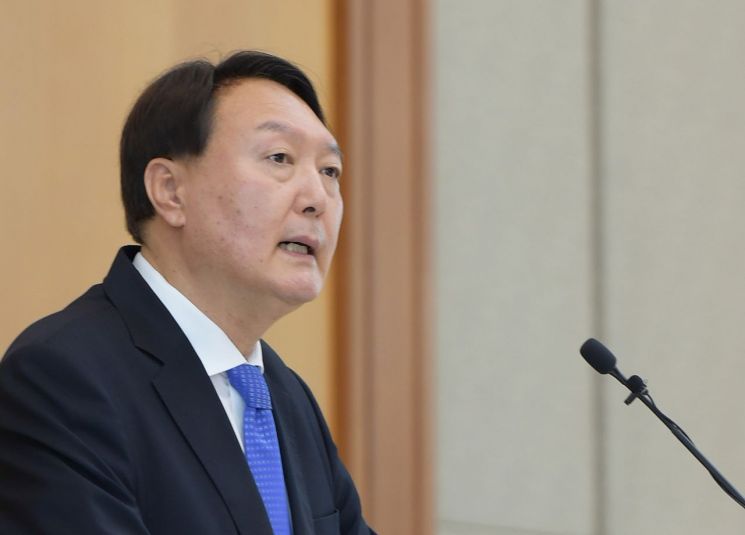
Seol Hoon, a Supreme Council member of the Democratic Party, demanded Yoon’s resignation on the 5th. At the Supreme Council meeting that day, he said, "Prosecutor General Yoon stated at the new prosecutors' oath-taking ceremony that true democracy is rejecting dictatorship and totalitarianism disguised as democracy. This is a claim that the Moon Jae-in administration is not democratic but dictatorial and totalitarian."
He added, "Yoon’s closest aides are suspected of attempting political manipulation, and Yoon clashed with his superiors while trying to protect his close aides. In such a situation, does he have the right to mention dictatorship and totalitarianism? If he maintains his position as Prosecutor General, how is that different from joining the ranks of dictatorship and totalitarianism? It would be wiser to step down and enter the path of full-fledged politics." The ruling party leadership’s official demand for resignation is unusual.
As seen in Seol’s remarks, Prosecutor General Yoon’s recent pointed statement calling it a "dictatorship disguised as democracy" has become a decisive stimulus to boost the ruling party’s reform will.
Accordingly, the ruling party-led push for the 'Power Institution Reform Act' is expected to gain momentum in the September regular session. The bill limits prosecutors’ primary direct investigations to "only necessary areas" and changes the relationship between the prosecution and police to a "cooperative investigative relationship." Furthermore, the scope of prosecutors’ direct investigations is limited to six major crimes specified in the amended Prosecutors’ Office Act: corruption crimes, economic crimes, crimes by public officials, election crimes, defense industry crimes, and large-scale disasters. Kim Tae-nyeon, the Democratic Party floor leader, expressed a strong will to push the bill during previous party-government consultations, stating that "democratic control and command will be strengthened" in relation to prosecutorial reform.
The Democratic Party is also expected to strongly drive the launch of the Corruption Investigation Office for High-ranking Officials (CIO). With the passage of the three follow-up bills for the CIO in the July extraordinary session, the legal foundation for the CIO’s launch has been fully established. The only remaining step before the official launch is the United Future Party’s recommendation of members for the CIO chief’s selection committee. If the United Future Party fails to submit the list of recommended members during the September regular session, there is speculation that the ruling party may forcibly elect the CIO chief through legal amendments during the session.
In fact, Democratic Party leader Lee Hae-chan said at the Supreme Council meeting that day, "The United Future Party must appoint candidate recommendation committee members by the start of the August session (18th) at the latest and fulfill their legal responsibilities. Otherwise, the Democratic Party clearly states that it will prepare alternative measures for the launch of the CIO." He added, "The legal deadline for establishing the CIO, set for July 15, has passed without progress, and the current situation is illegal. The Democratic Party has no intention of tolerating the illegal status caused by the United Future Party and the delay in launching the CIO."
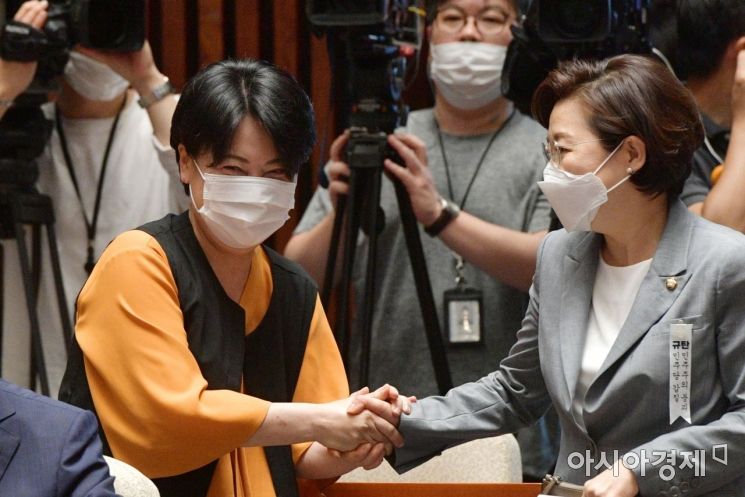 Yoon Hee-sook, a member of the Future United Party who is gaining attention for her 5-minute speech on the Housing Lease Protection Act, is attending an emergency party meeting held at the National Assembly on the 4th, greeting Kim Jeong-jae and other members./Photo by Yoon Dong-joo doso7@
Attention is also focused on what tactics the United Future Party will adopt in the September regular session. The party was helpless in overcoming the Democratic Party’s numerical superiority during the July extraordinary session and was defeated in the process of passing various bills. However, the United Future Party confirmed the possibility of a new form of struggle by stirring public sentiment with Yoon Hee-sook’s five-minute speech. It is highly likely that they will focus on "messages" and engage in public opinion battles in the next session as well.
There is still a possibility of bipartisan cooperation. The Democratic Party has been criticized for "exceeding the limits of unilateral rule" by bypassing the main opposition party during the bill passage process. If the 'Working National Assembly Act,' which was introduced as the party’s top priority bill, passes, the formation and convening of subcommittees in each standing committee will be mandatory. Since the floor leaders of both parties previously agreed on unanimous consent within subcommittees, there is speculation that negotiations will take place during the review of each bill.
© The Asia Business Daily(www.asiae.co.kr). All rights reserved.
![Clutching a Stolen Dior Bag, Saying "I Hate Being Poor but Real"... The Grotesque Con of a "Human Knockoff" [Slate]](https://cwcontent.asiae.co.kr/asiaresize/183/2026021902243444107_1771435474.jpg)

















