Dispute Between Korea Music Copyright Association and Domestic Businesses Over Music Copyright Fee Collection Regulations

[Asia Economy Reporter Kim Heung-soon] Conflicts have erupted among stakeholders over how much copyright fees should be paid for music used in online video services (OTT). Rights holder organizations argue that copyright fees should be significantly increased based on overseas OTT platforms like Netflix, while domestic OTT operators contend that the rationale for the proposed increase by rights holder organizations is unclear and that fairness with other services should be comprehensively considered. Although the government has emphasized strengthening the domestic OTT industry base, it has been criticized for stepping back and remaining passive on this contentious issue, thereby exacerbating the conflict.
The OTT Trend... "New Standards Needed"
KOMCA - Domestic Operators About Fivefold Difference in Desired Rates
According to the Ministry of Culture, Sports and Tourism and related industries on the 5th, the Korea Music Copyright Association (KOMCA), a music copyright collective management organization, has requested the revision of the 'Music Copyright Usage Fee Collection Regulations' to allow charging music copyright fees to OTT operators. These regulations outline how to calculate compensation for the use of musical works in various forms such as performances, broadcasts, and transmissions. Established in 1988 under the Copyright Act, the regulations have been revised 33 times over 32 years, updating rules whenever new media such as cable TV, satellite broadcasting, IPTV, and terrestrial DMB emerged.
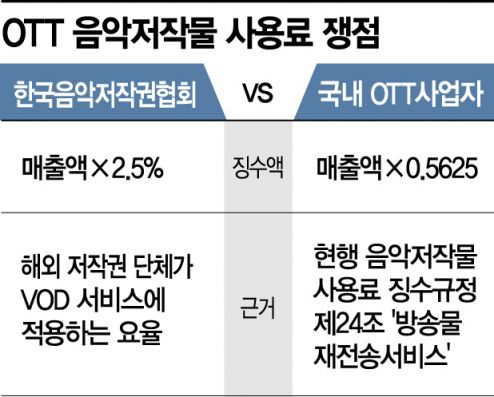
The key point of KOMCA's proposed revision is the creation of a new category called 'video transmission service,' referring to OTT. According to the new clause, when providing video content such as entertainment shows, dramas, movies, or documentaries that use musical works incidentally, the operator must pay KOMCA the greater amount between 2.5% of sales revenue multiplied by the music usage fee rate or 175 KRW per subscriber for each OTT. For example, if annual sales are 1 million KRW, KOMCA would collect 25,000 KRW as a fee for using music.
A KOMCA official stated, "The 2.5% music usage fee rate was determined based on a report published by the International Confederation of Societies of Authors and Composers (CISAC) and reflects the collection rates applied by overseas copyright organizations to video-on-demand (VOD) services. Since Netflix has signed a contract to pay music copyright fees according to this global standard, domestic OTT companies should also comply with this rate," he asserted.
The proposed revision submitted by KOMCA is expected to be discussed at the '3rd Music Industry Development Committee,' appointed by the Ministry of Culture, Sports and Tourism, and at the Copyright Commission, which reviews copyright matters and mediates disputes. The Ministry plans to collect opinions from stakeholders, including OTT operators, by the 10th. Afterward, within two months, the committee will review and decide, and upon approval by the Minister of Culture, Sports and Tourism, the revision will be finalized.
Negotiations Stumble... Ministry of Culture, Sports and Tourism: "Prioritize Parties' Agreement"
Collecting Stakeholder Opinions Until the 10th
Domestic OTT companies agree that new standards for calculating music copyright fees are necessary but argue that basing the increase on Netflix is excessive. They have demanded that copyright fees be collected according to the 'broadcast retransmission service' regulations previously applied to broadcasters' streaming services. Under these regulations, after applying discount criteria, the music copyright fees payable by domestic OTT companies amount to about 0.56% of sales revenue, which is roughly one-fifth of the rate KOMCA is seeking.
An industry insider said, "Given that sales and profit margins are not large, it is difficult to bear the copyright fees demanded by KOMCA," adding, "This is not just a matter related to musical works; there is also a possibility that fees for other relatively significant copyright holders, such as broadcast writers, could increase in a chain reaction."
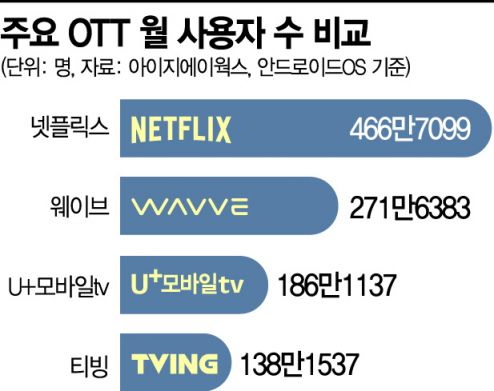
According to the mobile big data platform company IGAWorks, as of June, the number of Netflix users based on the Android operating system was 4.66 million, far exceeding domestic OTT platforms such as Wavve (2.72 million), U+ Mobile TV (1.86 million), and TVING (1.38 million).
The OTT industry also expresses skepticism about KOMCA's refusal to disclose the contract details with Netflix, which KOMCA cites as the basis for the fee increase. Domestic OTT operators have formed a joint consultative body to request dialogue with KOMCA in response to this issue, but KOMCA is reportedly not responding adequately.
The Ministry of Culture, Sports and Tourism maintains a neutral stance, emphasizing that music copyright fees should be prioritized through agreement among stakeholders. A copyright expert said, "If music copyright fees are calculated based on Netflix, a dominant player in the global market, domestic OTT companies will face significant dissatisfaction and burdens, which could be passed on to consumers. The government needs to mediate to establish appropriate standards."
An OTT industry representative said, "The government pledged to nurture five domestic media platforms into global platforms capable of competing with Netflix by 2022, yet it is neglecting the burden on domestic operators by insisting they follow Netflix's lead on music copyright fees," adding, "We plan to file objections during the Ministry of Culture, Sports and Tourism's opinion collection period."
© The Asia Business Daily(www.asiae.co.kr). All rights reserved.
![Clutching a Stolen Dior Bag, Saying "I Hate Being Poor but Real"... The Grotesque Con of a "Human Knockoff" [Slate]](https://cwcontent.asiae.co.kr/asiaresize/183/2026021902243444107_1771435474.jpg)

















