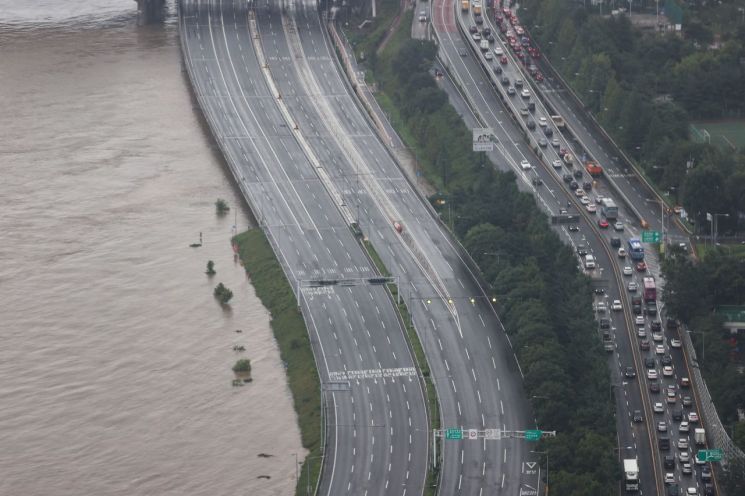
 On the afternoon of the 3rd, as heavy rain continued across the Seoul metropolitan area and the water level of the Han River rose, both directions of Olympic-daero viewed from 63 Square in Yeongdeungpo-gu, Seoul, were closed and completely empty. [Image source=Yonhap News]
[Asia Economy Reporter Heo Midam] On the 3rd, more than 300mm of heavy rain poured over the central region, and with another heavy rain forecast for tomorrow, dams in the Han River basin are on high alert for water level control. Related agencies have taken preemptive measures such as gradually increasing the discharge volume to prevent damage caused by the heavy rain.
According to the Korea Water Resources Corporation and the Han River Flood Control Office on the 5th, dams in the Bukhan River basin such as Chuncheon Dam, Uiam Dam, and Cheongpyeong Dam began discharging water through sluice gates starting from the 2nd. This is the first sluice gate discharge this year.
Excluding the Peace Dam, Hwacheon Dam, which is the uppermost dam in the Bukhan River basin, is also approaching its restricted water level (175m), and thus began its first sluice gate discharge of the year around 8 p.m. that day. The discharge volume is up to 3,000 tons per second. Accordingly, Paldang Dam, which is currently discharging 12,000 tons per second, plans to increase its discharge to 15,000 tons per second when Hwacheon Dam releases water.
Chungju Dam, a multipurpose dam in the Namhan River basin, opened its sluice gates for the first time in two years since 2018. Currently discharging 1,500 tons per second, Chungju Dam plans to increase the discharge to 2,000 tons per second and adjust the volume flexibly based on downstream and weather conditions. It has approval to discharge up to 3,000 tons per second.
Goesan Dam, which started discharging water on the 30th of last month, is also releasing water with all seven sluice gates open.
When Paldang Dam in the Bukhan River basin and Chungju Dam in the Namhan River basin discharge 15,000 tons per second and 3,000 tons per second respectively, 18,000 tons per second of water flows into the upper Han River. In particular, the discharge volume of Paldang Dam directly affects the water level of the Han River, so close attention is being paid.
As the discharge volumes of dams in the Han River basin increase and the water level rises, the number of vehicle control zones on roads throughout Seoul is expected to increase.
Seoul City has completely restricted traffic on the Seoul Eastern Arterial Road since 5:05 a.m. that day. The Jamsu Bridge has been fully closed to traffic since the afternoon of the previous day (the 2nd). Both directions of the Olympic-daero section from Hangang Railway Bridge to Dangsan Railway Bridge are fully closed.
A representative from the Han River Flood Control Office stated, "Due to continuous heavy rain and preparations for the approaching typhoon 'Hagupit,' we have no choice but to increase sluice gate discharges at dams in the Han River basin."
© The Asia Business Daily(www.asiae.co.kr). All rights reserved.
![Clutching a Stolen Dior Bag, Saying "I Hate Being Poor but Real"... The Grotesque Con of a "Human Knockoff" [Slate]](https://cwcontent.asiae.co.kr/asiaresize/183/2026021902243444107_1771435474.jpg)
















