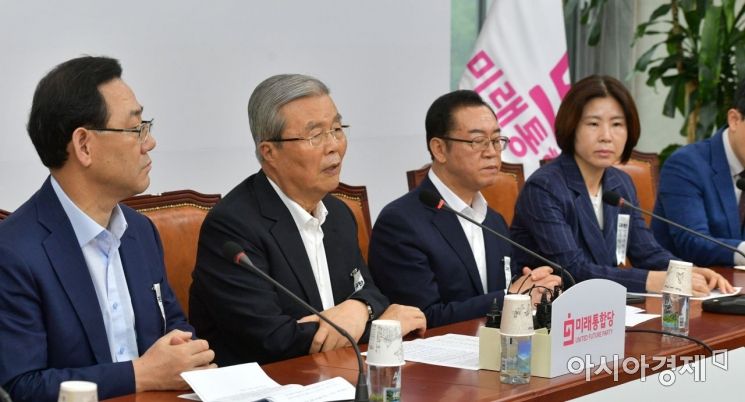
 Kim Jong-in, Emergency Committee Chairman of the United Future Party, is attending the Emergency Committee meeting held at the National Assembly on the 3rd and delivering an opening remark. Photo by Yoon Dong-joo doso7@
[Asia Economy reporters Lee Ji-eun and Kang Na-hum] Yoon Hee-sook, a member of the Future United Party, has sparked political controversy by criticizing the 'Three Lease Laws' and raising the issue of the 'conversion of jeonse to monthly rent.' As the United Party launched a full-scale offensive against the ruling party, pointing out conflicts between tenants and landlords and the burden of monthly rent, the ruling party defended itself by saying, "The opposition party is also responsible for the real estate price surge."
Kim Jong-in, chairman of the Future United Party's Emergency Committee, said at the Emergency Committee meeting held at the National Assembly on the 3rd, "The 'Three Lease Laws' led by the government and ruling party have heightened the conflict structure between tenants and landlords," adding, "I want to ask whether the government made a cold judgment on whether this could succeed when it institutionally intervened in market prices." This was a criticism of the jeonse and monthly rent market disruption issue raised earlier by Rep. Yoon.
Joo Ho-young, the floor leader, also referred to the remarks of Rep. Yoon Jun-byung of the Democratic Party of Korea, who said "monthly rent is not bad," and criticized, "I don't know how many Democratic Party lawmakers have actually lived on monthly rent and know it well to make such comments," adding, "Our party's Rep. Yoon appropriately pointed out the substantive problems of the (Three Lease Laws) and painfully pointed out procedural issues, but the Democratic Party is showing a very petty behavior of attacking the messenger personally." In response, Rep. Yoon emphasized his previous claim on MBC Radio's 'Kim Jong-bae's Focus,' saying, "It is not appropriate to describe jeonse as good and monthly rent as evil."
Earlier, Song Seok-jun, chairman of the United Party's Real Estate Special Committee, criticized on Facebook that "the jeonse system has acted as a kind of savings method unique to Korea, serving as a ladder for Koreans to own their homes and a stepping stone to the middle class," and questioned, "Why is this natural system preferred by the market and the people seen as a bad system?" Kim Hyun-ah, a member of the United Party's Emergency Committee, also pointed out on CBS Radio's 'Kim Hyun-jung's News Show' that "no one in Korea prefers the monthly rent system."
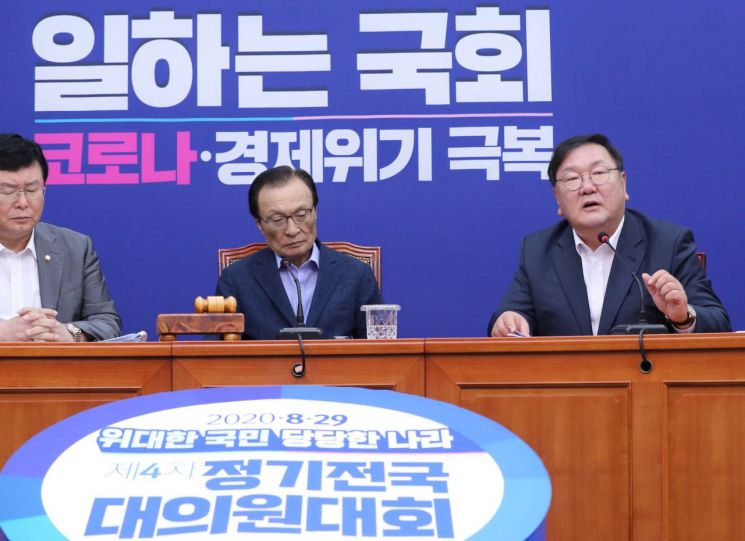
The Democratic Party leadership, in relation to the real estate controversy, strengthened internal unity within the party and government while actively defending against criticism. Lee Hae-chan, leader of the Democratic Party, ordered the government and party at the morning Supreme Council meeting to "respond quickly as conflicts due to misunderstandings about the system between landlords and tenants are expected" regarding the Three Lease Laws. This expressed concern over signs that the political controversy might escalate into conflicts between landlords and tenants.
Kim Tae-nyeon, floor leader, raised the 'opposition party original sin theory.' He said, "Although the Democratic Party is responsible for not stabilizing the overheated real estate market early, the United Party should not evade responsibility for the real estate price surge," pointing out that the so-called 'Three Real Estate Laws' such as the abolition of the price ceiling on pre-sale prices, the postponement of the recovery of excess profits from reconstruction, and allowing three houses per union member were concentrated during the Park Geun-hye administration. He also criticized Rep. Joo's remark that the government and ruling party's real estate policy is 'communism' as an "outdated colorism."
However, the opposition party original sin theory has also been criticized within the ruling party. Joo Jin-hyung, Supreme Council member of the Open Democratic Party, questioned, "What grounds are there to say that the law enacted at the end of 2014 is the main cause of the surge?" and pointed out, "Isn't this an attempt to divert public dissatisfaction by scapegoating someone else because public backlash is growing?"
Meanwhile, the National Assembly held a plenary meeting of the Legislation and Judiciary Committee on the same day to submit 16 follow-up bills related to the government's real estate measures and the establishment of the High-ranking Officials' Crime Investigation Office (HOCI). Among the bills submitted to the Legislation and Judiciary Committee, amendments to the Comprehensive Real Estate Tax Act, Corporate Tax Act, and Income Tax Act include raising the comprehensive real estate tax rate up to 6.0% for owners of three or more houses or two houses in regulated areas, and including pre-sale rights in the number of houses for the purpose of imposing heavy capital gains tax on multi-homeowners. Also included in the agenda were amendments to the Real Estate Transaction Reporting Act introducing a jeonse and monthly rent reporting system, the Housing Act imposing a residence obligation within five years on residents of houses under the private land pre-sale price ceiling system, and amendments to the Local Tax Act raising acquisition tax rates to 8% to 12% for multi-homeowners in regulated areas.
© The Asia Business Daily(www.asiae.co.kr). All rights reserved.


















