7월 Apartment Jeonse Transactions Total 6,304
Half of February, Lowest in 9 Years
Seoul's Overall Lease Transactions Also Decrease
Landlords Shift to Monthly Rent to Cover Property Tax Burden
Complexes with More Monthly Rent than Jeonse Increase
No Monthly Rent in Areas with Good School Districts
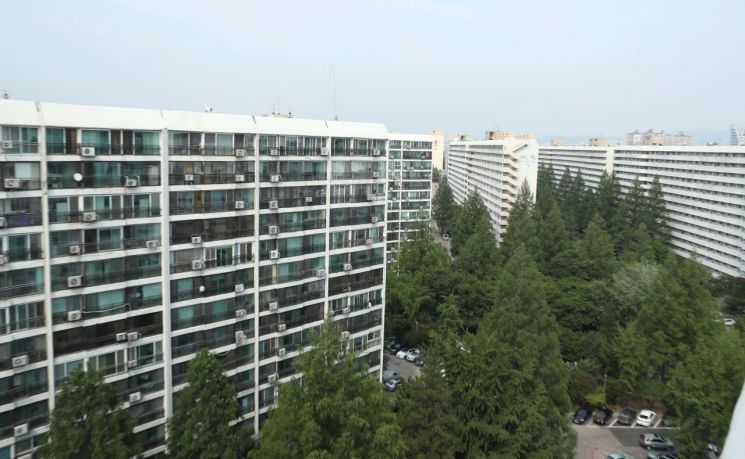
[Asia Economy Reporter Onyu Lim] Concerns about the disappearance of Jeonse (long-term lease) due to the implementation of the 'Three Lease Laws'?the Jeonse and Monthly Rent Cap System, the Lease Renewal Request System, and the Jeonse and Monthly Rent Reporting System?are beginning to materialize. In July, the volume of Jeonse transactions for apartments in Seoul hit its lowest point in nine years, while the proportion of monthly rent listings in the rental market is rapidly increasing. Although the government and ruling party introduced the Three Lease Laws under the pretext of protecting tenants, from the early stages of implementation, landlords have been rushing to convert Jeonse leases into monthly rent, increasing the burden on tenants.
July Seoul Jeonse Transaction Volume Halved Compared to February... Below 6,000 Transactions for the First Time Since 2011
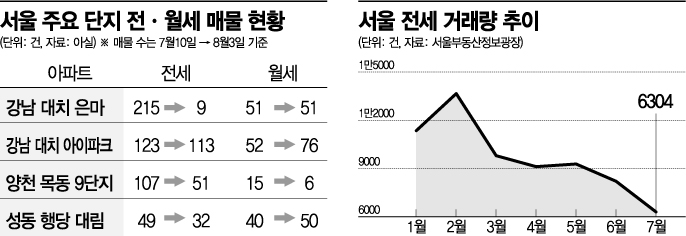
According to the Seoul Real Estate Information Plaza on the 3rd, the volume of Jeonse transactions for apartments in Seoul last month was 6,304. This is less than half of the 13,661 transactions recorded in February, which was the highest this year. The Jeonse transaction volume falling to the 6,000 range is the first occurrence since 2011.
The overall rental transaction volume in Seoul, including Jeonse, semi-Jeonse, and monthly rent, shows a similar trend. Last month, the transaction volume was 8,344, which is only 43% of the 19,232 transactions in February. Since Jeonse and monthly rent transaction volumes are counted based on tenants' fixed-date registration reports, it is difficult to consider this as the total transaction volume, but it is accepted as reflecting the overall market trend.
Tenant Protection Measures Like Lease Renewal Request System Lead to Concentration on Monthly Rent Instead
The contraction of the Jeonse market appears to have deepened last month when the government announced the Lease Renewal Request System, the Jeonse and Monthly Rent Cap System, and the Jeonse and Monthly Rent Reporting System. As the plan to guarantee tenants four years of residence and cap rent increases at 5% or less became a foregone conclusion, Jeonse prices soared and listings sharply decreased. In particular, a significant portion of the new rental listings after the law's enforcement at the end of last month are monthly rent listings. The increased burden of property holding taxes due to measures like the July 10 Real Estate Policy has also been cited as a cause, as landlords convert Jeonse leases into monthly or semi-monthly rent to offset this. Concerns that landlords would pass a significant portion of institutional risks and tax burdens onto tenants are becoming a reality.
Noticeably Increasing Proportion of Monthly Rent... Daechi-dong I-Park 29%→40%, Haengdang-dong Daerim 45%→61%
Accordingly, the proportion of monthly rent in apartments in major Seoul areas is noticeably increasing. According to the real estate listing site Asil, there are a total of 189 rental listings in Daechi I-Park, Daechi-dong, Gangnam-gu, of which 76 (40%) are monthly rent. The proportion of monthly rent increased by 11 percentage points compared to July 10 last month. At that time, there were 175 rental listings, of which only 52 (29%) were monthly rent. In Jamsil-dong Jugong Complex 5 in Songpa-gu, the monthly rent proportion also rose by 5 percentage points to 11% (58 out of 506 listings) from 6% (32 out of 527 listings) on July 10. Even considering that many listings are duplicated across multiple agencies, this is a noticeable change. A representative from a real estate agency in Daechi-dong explained, "Landlords who can afford to return deposits are converting to monthly or semi-monthly rent to cover the property holding tax burden."
Complexes where the proportion of monthly rent listings exceeds Jeonse listings are also emerging. In Heukseok Hangang Centreville in Heukseok-dong, Dongjak-gu, 72 out of 130 rental listings (55%) are monthly rent. This complex had only 29% monthly rent (57 out of 194 listings) as of July 10. In Haengdang-dong, Seongdong-gu, Daerim's monthly rent proportion also increased from 45% to 61%. A representative from a real estate agency in Haengdang-dong said, "When the Lease Protection Act was discussed, the ratio of Jeonse to monthly rent was about 60 to 40 last month, but now the number of semi-monthly and monthly rent listings exceeds Jeonse."
A bigger problem is that complexes in areas with excellent school districts and locations are experiencing shortages even in monthly rent listings. Eunma in Daechi-dong, Gangnam-gu, which has a large complex of 4,424 households, saw its Jeonse listings drop from 215 on July 10 to only 9 now. Even including monthly rent, the total number of Jeonse and monthly rent listings is only 60. In Sinjeong-dong, Yangcheon-gu, Sinshigaji Complex 9 also saw Jeonse listings halve from 107 to 51, while monthly rent listings decreased from 15 to 6. A representative from a real estate agency in Mok-dong said, "As Jeonse listings dry up, more tenants are trying to find monthly rent due to their children's schools, but finding listings is like finding a needle in a haystack."
The burden on tenants due to the shift to monthly rent is increasing further. The government-announced Jeonse-to-monthly rent conversion rate (4% annually) itself is higher than bank loan interest rates, and the actual conversion rates of many monthly rent listings on the market are much higher than this. For example, in Daechi-dong Eunma, a 76㎡ (exclusive area) apartment currently has a Jeonse market price with a deposit of 600 million KRW, and a semi-monthly rent market price with a deposit of 350 million KRW plus monthly rent of 1.5 million KRW. This means the Jeonse-to-monthly rent conversion rate is 6%, which is 2 percentage points higher than the government-announced rate.
© The Asia Business Daily(www.asiae.co.kr). All rights reserved.
![Clutching a Stolen Dior Bag, Saying "I Hate Being Poor but Real"... The Grotesque Con of a "Human Knockoff" [Slate]](https://cwcontent.asiae.co.kr/asiaresize/183/2026021902243444107_1771435474.jpg)

















