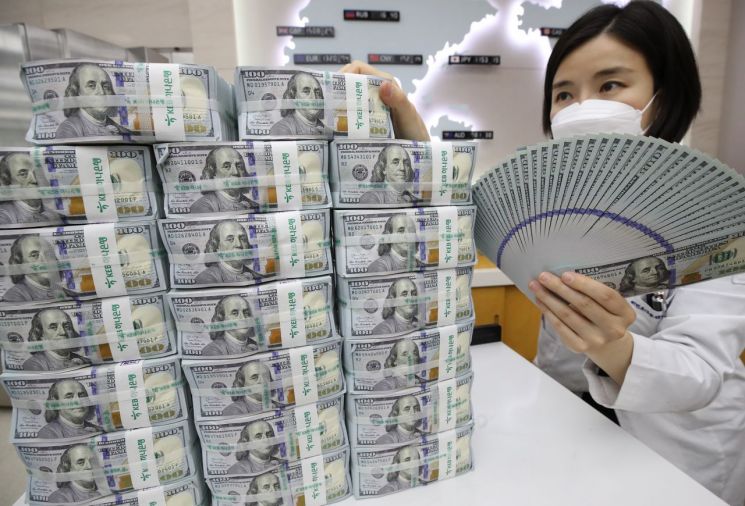
600 Billion Dollar Korea-US Currency Swap Extended Until March Next Year
[Asia Economy Reporter Eunbyeol Kim] "There are currently no concerns in the market, but I hope the currency swap serves as a backstop. Since the pandemic crisis is not over yet, the intention is to allow other countries to use the currency swap whenever needed." (Jerome Powell, Chair of the U.S. Federal Reserve (Fed))
The U.S. Fed extended currency swap agreements for another six months on the 29th (local time) with nine countries including South Korea. Besides countries like Japan, the UK, and Switzerland that have unlimited currency swap agreements, central banks from nine countries including South Korea, Australia, Brazil, Mexico, Singapore, Sweden, Denmark, Norway, and New Zealand all participated. The Fed also extended the temporary facility (FIMA) for repurchase agreement (RP) transactions, which supply dollars in exchange for U.S. Treasury securities held by each central bank, until the end of March next year.
After the rapid spread of the novel coronavirus disease (COVID-19) in March and April caused market turmoil, both financial markets and foreign exchange markets of various countries are relatively stable now. Nevertheless, why did the Fed request an extension of the currency swap agreements?
"The COVID-19 crisis is not over yet"
The currency swap agreements with the U.S. were set to expire at the end of September. Therefore, the Fed could have decided at the Federal Open Market Committee (FOMC) meeting on September 15-16 without delay. However, the extension was made two months ahead of maturity, which seems to be largely influenced by a negative outlook on the economy.
Chair Powell has repeatedly emphasized that the COVID-19 crisis is not over and could be very prolonged. On the day the currency swap extension was decided, during the post-FOMC press conference, he pointed out, "The future of the economy largely depends on the success in containing COVID-19," adding, "In recent weeks, virus infections have increased and measures to contain it have resumed, which have started to weigh heavily on economic activity."
He continued, "Full recovery is unlikely until people are confident that it is safe to engage in broad activities," and "We will use the full range of tools to support economic recovery."
Therefore, opinions in New York Wall Street and elsewhere generally expected the currency swap extension. Since the Fed had already announced before the FOMC that it would extend various lending and market support programs, it is inevitable to maintain dollar liquidity supply mechanisms worldwide until the situation calms down.
Bank of America (BoA) stated, "Extending the operation period of currency swaps with foreign central banks was largely expected," and "It is expected to help stabilize financial markets."
Market stability prioritized over concerns of dollar weakness
The U.S. dollar currently accounts for more than 60% of global foreign exchange reserves. According to the International Monetary Fund (IMF), 88% of international foreign exchange transactions are conducted in U.S. dollars.
Recently, the U.S. dollar has shown a continuous weakening trend. The dollar index, which measures the value of the dollar against six major currencies, fell to the 93 level for the first time in about two years since June 2018. On July 31 (local time), the dollar index closed at 93.46. The Fed's active provision of dollar liquidity worldwide during the early COVID-19 period, combined with the European Union (EU) agreeing on July 21 to provide a 760 billion euro (approximately 152 trillion KRW) economic recovery fund, further weakened the dollar.
The fact that the U.S. shows no signs of controlling COVID-19 compared to the EU also fuels the weak dollar. Ultimately, the key to recovering from this crisis depends on how well COVID-19 is controlled and how economic activities recover. The preliminary GDP growth rate for the U.S. in the second quarter of this year was recorded at an annualized -32.9%. Although better than market expectations, it is the worst figure since statistics began to be compiled, weakening investor sentiment.
Political uncertainty is also increasing due to the upcoming U.S. presidential election scheduled for November.
Although dollar liquidity is flooding worldwide and the dollar is weakening, the Fed intends to maintain supply even if it means tolerating a weak dollar. Despite warnings that the U.S. dollar could lose its status as the global reserve currency due to its weakness, the Fed aims to prepare for crises with abundant supply and build trust as the 'central bank of the world.'
© The Asia Business Daily(www.asiae.co.kr). All rights reserved.
![Clutching a Stolen Dior Bag, Saying "I Hate Being Poor but Real"... The Grotesque Con of a "Human Knockoff" [Slate]](https://cwcontent.asiae.co.kr/asiaresize/183/2026021902243444107_1771435474.jpg)















