Bank of Korea 'Damaged Currency Disposal and Exchange Scale in the First Half of 2020'
Damaged Currency Amounting to 2.7 Trillion Won... Largest Since 2011

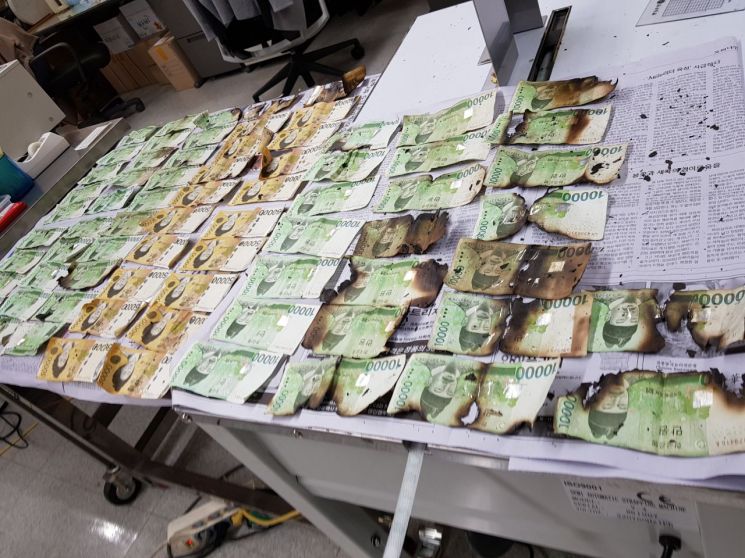
[Asia Economy Reporter Eunbyeol Kim] # Mr. Eom, who lives in Ansan, Gyeonggi Province, ran money received as condolence money through a washing machine due to anxiety about the novel coronavirus infection (COVID-19). Over 20 million won worth of money was torn, and he eventually exchanged it for new bills at the Bank of Korea.
# Mr. Kim, who lives in Incheon, put stored bills in a microwave and ran it. Mr. Kim also microwaved the money as a preventive measure due to anxiety about the COVID-19 virus. Around the time COVID-19 was rapidly spreading domestically, fake news circulated online claiming that 'putting bills in the microwave and running it sterilizes them.' As a result, the bills were burned, and Mr. Kim exchanged over 5 million won. This was because the microwave's microwaves affected the anti-counterfeiting devices attached to the bills (holograms, embedded security threads, etc.).
Money that was damaged by fire or moisture and became unusable amounted to about 2.7 trillion won in the first half of this year.
According to the '2020 First Half Damaged Currency Disposal and Exchange Scale' announced by the Bank of Korea on the 31st, the number of damaged bills disposed of by the Bank of Korea in the first half of this year was 345.7 million, an increase of 500,000 bills (0.1%) compared to the same period last year (345.2 million bills). In terms of amount, the damaged currency totaled 2.6923 trillion won. This is the highest ever since related statistics began to be compiled in 2011.
Of the bills, 330.4 million bills totaling 2.691 trillion won were discarded as unusable. Ten-thousand won bills accounted for 68.6% of the discarded banknotes, with 226.6 million bills disposed of. This was followed by 1,000 won bills (85.6 million), 5,000 won bills (12.6 million), and 50,000 won bills (5.5 million).
Coins totaling 15.3 million pieces, worth 1.3 billion won, were discarded, with 10-won coins accounting for 51% of the discarded coins. Next, 100-won coins made up 33.5% of the discarded coins.
Damaged currency exchanged through the Bank of Korea's currency exchange counters in the first half amounted to 6.05 billion won, an increase of 2.42 billion won compared to the same period last year. The number of bills exchanged was 94,300 (worth 2.52 billion won), with 50,000 won bills accounting for 49.2%.
Looking at the reasons for currency damage, cases due to fire amounted to 1.32 billion won, the largest amount by value. Cases due to improper storage such as decay caused by moisture amounted to 1.02 billion won, and cases due to careless handling such as putting money in the washing machine or shredder mistakenly amounted to about 190 million won.
The Bank of Korea exchanges the full amount for bills burned in fires if at least three-quarters of the original area remains. If the remaining area is between two-fifths and less than three-quarters, only half the amount is exchanged, and if less than two-fifths remains, no exchange is made. Coins are fully exchanged if their shape is recognizable.
© The Asia Business Daily(www.asiae.co.kr). All rights reserved.
![Clutching a Stolen Dior Bag, Saying "I Hate Being Poor but Real"... The Grotesque Con of a "Human Knockoff" [Slate]](https://cwcontent.asiae.co.kr/asiaresize/183/2026021902243444107_1771435474.jpg)
















