[Solution Report] Interview with Sangmin Kim, CEO of Beluga, a Liquor Distribution Platform
Challenging the Innovative Distribution Platform Transforming the Liquor Industry
 Beluga, which introduced the first regular delivery service for craft beer in Korea, is preparing for a new leap by launching an alcoholic beverage wholesale distribution platform. Photo by Sangmin Kim, CEO of Beluga
[Asia Economy Reporter Kim Heeyoon] Beluga, which attracted market attention by introducing Korea's first beer subscription delivery service along with the activation of the subscription economy, suddenly stopped its delivery business in July last year. It was the second business suspension due to government liquor regulations. CEO Kim Sangmin of Beluga took the crisis as an opportunity and, after much effort, launched a B2B (business-to-business) comprehensive liquor distribution platform in August last year to reorganize the business.
While operating the beer subscription delivery service, CEO Kim introduced 'curation' to reduce customer churn. Through this process, he built strong relationships with craft beer importers and wholesale business owners, and naturally became aware of the closed nature of the liquor distribution structure. "The information asymmetry within the industry was so severe that people didn’t even know where to buy the liquor they wanted. I judged that if we systematized this to enable easy ordering and created a distribution platform where various liquor products could be seen at a glance, we would have a chance. So, I challenged myself to develop the platform in earnest."
Beluga established a B2B liquor distribution channel connecting suppliers who directly brew or import liquor, wholesalers responsible for logistics and distribution, and retailers who want to handle various liquor products. Existing liquor distribution involved retailers selecting liquor within the closed product information they received through wholesale sales representatives and ordering only by phone. CEO Kim emphasized, "The first task was to solve the information asymmetry between stores, which had difficulty making rational decisions based on one-sided information from sales representatives, and the sales representatives who struggled due to the lack of transparent information about each store."
From 'Blind' Phone Orders to Online Platform Launch, Users Increased Naturally
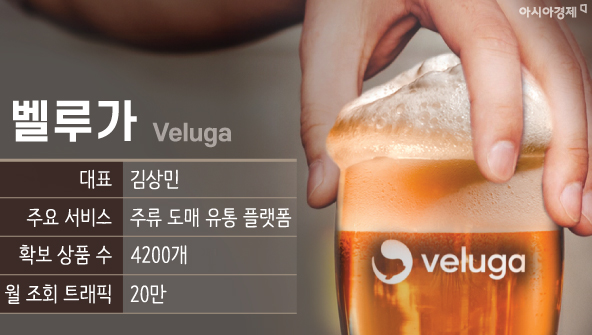
First, when suppliers register their products on the platform, they can easily create an online catalog through social networking services (SNS) to promote and secure new clients. Wholesalers can manage order details and client management collectively online. Retailers can quickly grasp the latest trends in the liquor industry, search for the products they want, and place orders directly. As product promotion, prevention of ordering mistakes, and trend analysis?what suppliers, wholesalers, and retailers most need?were naturally resolved within the platform, users began to increase. CEO Kim explained, "By precisely addressing the points customers needed, users found the platform on their own without special promotion." Within 10 months of launch, Beluga grew into a platform with 200,000 monthly views and 4,200 secured products.
Under current law, online liquor sales are illegal except for traditional liquor. It is difficult to generate profits from the distribution platform alone. Beluga is preparing a new revenue model in the logistics area arising during the liquor import process. Noting that the beer market, as a single liquor category, is the largest in the domestic liquor market at 6 trillion won, they focused on beer’s typical one-year shelf life. It takes an average of six months from beer import, including ship transit and customs clearance, to arrival at retailers. Because of this, importers have relied on intuition rather than analysis to estimate demand. CEO Kim said, "Until now, suppliers loaded only the necessary quantity into one container, but Beluga proposes a model that consolidates multiple companies’ ordered products into one container and operates shared warehouses to reduce import time and distribution costs." He added, "If orders match expected demand, inventory problems are solved, and based on the time and cost savings here, we want to achieve a virtuous cycle in distribution." Beluga is also preparing a system that provides demand forecast data by product and period based on accumulated data from clients, allowing each supplier to statistically prepare product demand in advance.
Beluga experienced business closure twice due to the National Tax Service’s liquor notification issues. However, since the allowance of liquor sales through smart orders in March, Beluga has newly established itself as a liquor distributor, even being invited to the National Tax Service’s liquor industry opinion gathering session. CEO Kim said, "Our goal is to have 30% of the total market transaction volume take place on Beluga through platform service commercialization," and expressed his ambition, "We want to create a big wave in the market as an e-commerce and logistics fulfillment (including product receipt, sorting, inventory and quality control, delivery, and the entire process until reaching the customer) platform that helps anyone challenge the liquor business."
© The Asia Business Daily(www.asiae.co.kr). All rights reserved.
![Clutching a Stolen Dior Bag, Saying "I Hate Being Poor but Real"... The Grotesque Con of a "Human Knockoff" [Slate]](https://cwcontent.asiae.co.kr/asiaresize/183/2026021902243444107_1771435474.jpg)
















