Low accident data may delay loss ratio estimation
Accident cases and injured persons increase by 95% annually on average

[Asia Economy Reporter Oh Hyung-gil] Jeong-sik Han (pseudonym, 29), who purchased an electric kickboard for commuting ahead of summer, recently fell and fractured his leg while riding the kickboard on the road. After receiving treatment at the hospital, he filed a claim for indemnity medical insurance benefits with his insurer, but the insurance company refused to pay. He was also notified that his insurance contract would be terminated if he continued to use the kickboard. The insurer explained that he violated the duty of disclosure by not informing them about his kickboard usage.
He expressed frustration, saying, "When I signed up for insurance, no one asked about my intention to purchase a kickboard or explained anything. If an accident happens, are users supposed to bear the damage all by themselves?"
As the use of 'Personal Mobility' devices such as electric kickboards increases ahead of summer, related accidents are also surging. However, there are few ways to receive compensation for damages caused by such accidents. Currently, insurance policies that cover PM traffic accidents are rare, leading to an increase in cases where victims receive no coverage.
The government and insurance industry have begun discussions to introduce insurance for kickboard users, but property and casualty insurers are reluctant. They cite the lack of sufficient data to calculate loss ratios and the recent sharp increase in accidents, which would inevitably lead to high premiums if insurance products were launched.
According to the insurance industry on the 30th, kickboards are classified under the Road Traffic Act as 'motorized bicycles,' which are two-wheeled motor vehicles like motorcycles. If a kickboard is used continuously rather than temporarily, users must notify their insurance company.
Insurers may cancel contracts or refuse to pay claims if the insured fails to fulfill the notification obligation, and premiums may be increased. Even if users notify insurers about kickboard use, it remains difficult to receive compensation for damages caused by kickboard accidents.
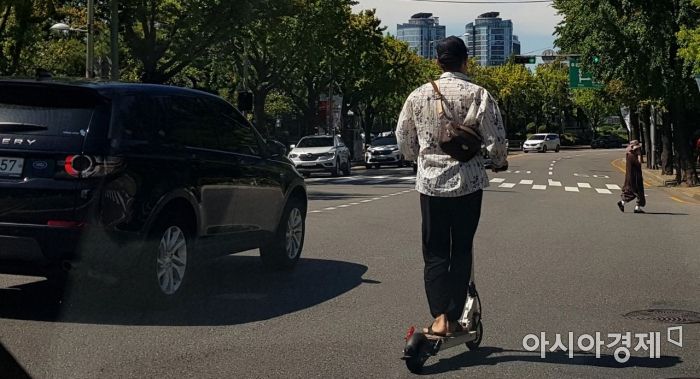 On the 13th, a citizen wearing no protective gear was riding an electric scooter weaving through cars on the Namsan Circular Road in Seoul. Photo by Dongju Yoon doso7@
Only Group Insurance for Kickboard Sharing Service Providers
Recently, traffic accidents involving Personal Mobility (PM) devices, including kickboards, have surged.
According to the Road Traffic Authority, there were 789 traffic accidents caused by PM devices over the past three years, resulting in 835 injuries and 16 deaths. The number of accidents and injuries increased by more than 95% annually on average, and the number of fatalities doubled in two years.
Monthly data shows that 13.4% of all PM traffic accidents occurred in August, the month with the highest number of accidents. PM traffic accidents increased from July and maintained this trend until October, then gradually decreased from November onward.
Notably, starting this December, the Road Traffic Act and the Bicycle Use Promotion Act will be enforced, allowing kickboard use without a motorized vehicle license and permitting use on bicycle lanes. The number of kickboard users is expected to continue rising, raising concerns about an increase in related accidents.
However, kickboards currently remain in an insurance coverage blind spot.
Kickboards are a type of vehicle but are not subject to the Automobile Liability Security Act, which governs automobile accident liability and compensation. This is because the Automobile Management Act Enforcement Rules exclude vehicles with a maximum speed of 25 km/h or less from registration requirements. Therefore, compensation through automobile insurance is not available.
There are no insurance products available for individuals using kickboards. Only some kickboard sharing service providers have purchased group insurance.
The Ministry of Land, Infrastructure and Transport, property and casualty insurers, and related companies have started discussions to introduce insurance for shared kickboards, and voices calling for mandatory kickboard insurance are emerging. However, the insurance industry feels that launching dedicated insurance products is not easy.
An insurance industry official said, "There is no consensus on whether kickboards should be considered automobiles requiring mandatory insurance or bicycles, and calculating loss ratios will be difficult. Rather than mandating individual insurance enrollment, providing coverage through group insurance similar to local government bicycle insurance seems more realistic."
Hwang Hyun-ah, a research fellow at the Korea Insurance Research Institute, pointed out, "If an accident occurs due to the fault of an electric kickboard driver, the driver bears liability for damages, which can impose a significant financial burden, and victims may not receive compensation. It is necessary to clearly define the legal status of kickboards and proactively establish regulations related to accident liability and insurance."
© The Asia Business Daily(www.asiae.co.kr). All rights reserved.
![Clutching a Stolen Dior Bag, Saying "I Hate Being Poor but Real"... The Grotesque Con of a "Human Knockoff" [Slate]](https://cwcontent.asiae.co.kr/asiaresize/183/2026021902243444107_1771435474.jpg)


















