Emart, Homeplus, and Lotte Mart
Operate Picking & Packing and Fulfillment Centers
Distribution Law Regulates Mandatory Closures for Large Marts
No Restrictions for E-commerce Companies
Industry Calls It a "Tilted Playing Field"
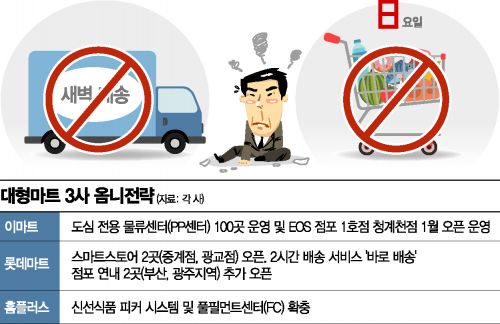
[Asia Economy reporters Minyoung Cha and Seungjin Lee] Large supermarkets that have shifted online to compete with e-commerce giants are sighing over regulations on dawn delivery. Despite undertaking efficiency improvements to survive the enormous burden of investing in online logistics facilities, the reality is that discriminatory regulations against e-commerce companies are blocking these efforts.
Distribution Industry in Transformation
According to the distribution industry on the 28th, Emart operates about 100 out of its 140 stores as Picking & Packing (PP) centers equipped with an online logistics system that shops on behalf of customers. Among them, the Cheonggyecheon branch was newly introduced as a store-type logistics center (EOS). The Cheonggyecheon branch is the most advanced type of store, receiving orders online and offering a '2-hour delivery' system four times a day. It is characterized as an omnichannel strategy store equipped with automated facilities such as product sorting equipment and conveyor belts in a corner of the shopping space.
Emart's online-offline integrated strategy is regarded as the most efficient profit model in the era of non-face-to-face commerce. In fact, based on cumulative data from January to June this year, the total sales growth rate of existing offline stores was -0.1%, holding up well. Even looking only at discount stores (large supermarkets), which account for more than 70% of total sales, the performance fell by only -1.8% year-on-year.
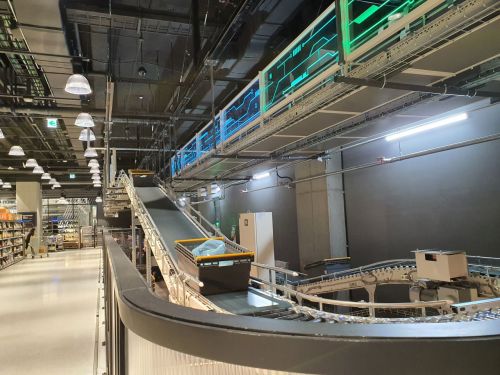
According to the securities industry, Emart's PP centers recorded a high sales growth rate close to 30% year-on-year. Especially, the order completion rate through the integrated online mall SSG.com soared to nearly 100% around March, when the COVID-19 crisis peaked. This month, it has maintained a rate of 85-90%.
Homeplus is also expanding its fresh food picker system and fulfillment centers (FC) within existing stores. As of this month (July), the proportion of online and mobile sales exceeds about 10% of total sales, slightly up from the 9% range last year. The number of mobile shopping app users also averaged 1.1 million orders, increasing to an average of 1.2 million orders from February to April.
Lotte Mart also plans to expand its omnichannel strategy. Following the launch of 'Fulfillment Stores' offering 'Baro Delivery'?an immediate delivery service within 2 hours?at Junggye and Gwanggyo branches in February, it plans to open a third fulfillment store in Busan by the end of October. At Lotte Mart's Junggye and Gwanggyo branches, online order volume in July doubled to 850 orders compared to before the introduction of Baro Delivery.
The Paradox of Dawn Delivery Only for E-commerce
Although the three major supermarkets are investing in omnichannel strategies to respond online, the situation is complicated. The Distribution Industry Development Act (Distribution Act), which uniformly applies to offline discount stores, is a major obstacle.
The Distribution Act mandates large supermarkets to close twice a month on Sundays, with some differences depending on local governments. Operating hours are restricted from 10 a.m. to 11 p.m., and online deliveries from these stores are subject to the same restrictions. Therefore, dawn delivery and Sunday delivery for online orders are not allowed.
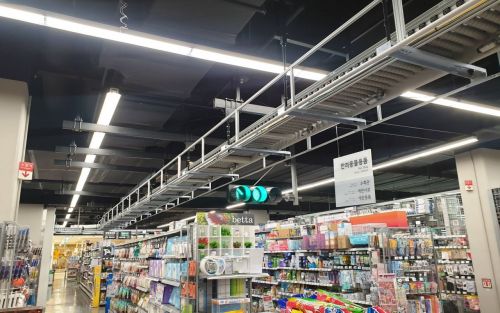
Since e-commerce companies are not subject to such restrictions, the large supermarket industry complains of a 'tilted playing field.' Although building separate online-only logistics centers is free from delivery regulations, it is difficult to make large-scale investments while having offline stores that can be used properly. A large supermarket industry official explained, "Each store has different demand for online delivery, and due to reasons such as site acquisition and costs, building large logistics centers is difficult. Meanwhile, fulfillment can utilize idle space within stores and operate selectively in stores with high online demand, but regulations reduce efficiency."
Earlier, Woojung Choi, CEO of SSG.com, also voiced the industry's difficulties due to the Distribution Act regulations to the government. In June, when Minister Sung Yun-mo of the Ministry of Trade, Industry and Energy visited the Emart Cheonggyecheon fulfillment store, CEO Choi conveyed, "There are many difficulties experienced on the ground due to the Distribution Act in the era of online-offline integration."
An official from the large supermarket industry said, "With fresh food accounting for more than 40% of online delivery items, regulations on large supermarkets are becoming stricter and failing to keep up with the changing distribution market," adding, "Concerns are growing that the industry may wither." Another supermarket industry official emphasized, "Discussions to develop dawn delivery are blocked due to the Distribution Industry Act regulations. If there are signs of regulatory easing, we are willing to actively consider it to enhance supermarket competitiveness."
© The Asia Business Daily(www.asiae.co.kr). All rights reserved.



















