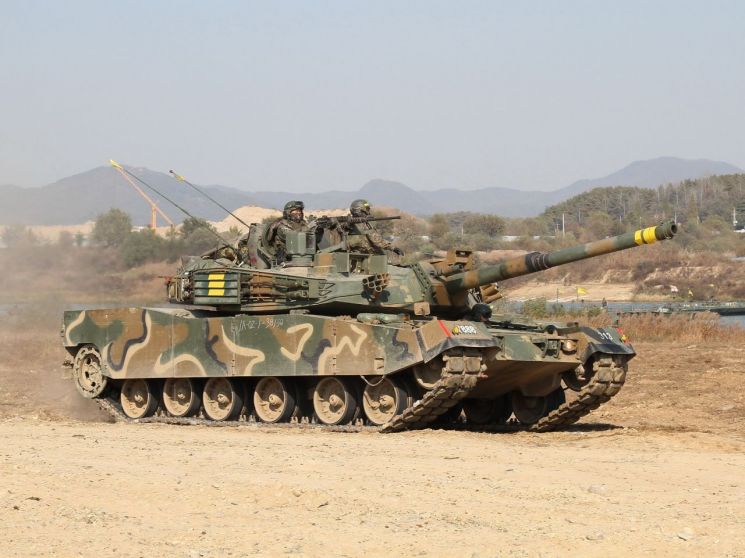
[Monthly Defense Times Editor-in-Chief An Seung-beom] While promoting the export of used K1 tanks overseas, the replacement of the 120mm main gun is being pursued. When exporting used K1 tanks, the plan is to replace the existing 105mm main gun with a 120mm main gun before sale. Along with this, a proposal was made this year to also replace the main gun of the K1 tanks currently in use by our military with a 120mm main gun.
The overseas export of the K1 tank began in 2017 when then Minister of National Defense Song Young-moo consulted with the Defense Acquisition Program Administration. The target export countries are Southeast Asian nations, with a plan to upgrade and export about 100 units as part of military restructuring. The plan to replace the K1 tank’s main gun with a 120mm gun has been discussed since 2020 in conjunction with the overseas export efforts.
▲ Impact of K2 Tank Production Reduction = The K2 tank began initial mass production with 100 units in July 2014, and as of July 2020, the second batch of 106 units is being produced and deployed to the 8th Mechanized Infantry Division and the 11th Mechanized Infantry Division.
Originally, the second batch production was scheduled to start in 2016, but a defect in the transmission component of the domestically developed powerpack (Doosan Infracore DV-27K 1,500 horsepower diesel engine + S&T Dynamics EST15K automatic transmission), which was to be installed from the second batch onward, caused production delays.
Eventually, due to ongoing defects in the transmission, the German RENK transmission was directly imported and combined with the domestic engine for performance testing. From the end of 2019, production of about 100 units of the second batch began, and by 2021, these were being deployed to frontline units.
The third batch production is planned to start immediately after the second batch ends, but timely production remains uncertain due to issues with applying the domestically developed powerpack.
Of course, since the Army has expressed the need for about 270 additional K2 tanks to fully replace the aging M48A5 tanks, there is still room for a fourth additional production batch.
▲ Proposal to Replace K1 Tank Main Gun with 120mm Gun = Due to the reduction in K2 tank production, the role of the K1 series tanks in our armored forces has become very important. As of July this year, the K1/K1A1 tanks are undergoing performance upgrades to K1E1/K1A2 models equipped with friend-or-foe identification devices, front/rear cameras, and digital battlefield management systems. The K1E1 upgrade is expected to be completed by 2026, and the K1A2 by 2022.
In 2016, the Joint Chiefs of Staff approved a project to equip both K1E1/A2 tanks with chemical, biological, radiological, and nuclear (CBRN) protection positive pressure and cooling systems, as well as auxiliary power units (APU), and to replace the gunner’s sight on the K1E1 with a Korean Gunner’s Primary Sight (KGPS). This is planned to be pursued as a follow-up performance upgrade project (K1E2) starting in 2024.
These are the currently known upgrade plans, but the reduction in K2 tank production demands a different transformation for the K1 series tanks. The proposal is to replace the K1 tank’s main gun from the 105mm rifled gun to the same 120mm smoothbore gun used on the K1A1/A2 tanks.
In the late 1990s, when developing the K1A1 tank, the military originally planned to upgrade all K1 tanks by replacing their turrets.
The 120mm main gun produces greater recoil than the existing 105mm gun, which caused suspension damage during test firing. Therefore, upgrading existing K1 tanks to K1A1 specifications would also require replacing all suspensions.
Because of this, upgrading over 1,000 K1 tanks would have incurred very high costs, so the plan was changed to produce all K1A1 tanks as new builds, resulting in 484 units being newly manufactured.
Replacing the K1 tank’s main gun with a 120mm gun aims to unify the main guns of our military tanks to the 120mm smoothbore, thereby enhancing firepower and standardizing ammunition supply systems.
In fact, compared to major Western military powers, this is quite late. As of 2020, the U.S. Army operates the M1A2 SEP tank, the French Army the Leclerc tank, and the German Bundeswehr the Leopard 2A5~A7 tanks, all equipped with 120mm main guns and long since operational.
Moreover, the Leopard 3 tank, jointly developed by Germany and France with a target operational date of 2030, is planned to be equipped with a 51-caliber 130mm main gun developed by German Rheinmetall. This gun offers 50% greater penetration than the existing 55-caliber 120mm gun and aims for production by 2025.
The proposal to replace all K1 tanks’ 105mm guns with 120mm guns not only strengthens the firepower of our main battle tanks and unifies ammunition for logistical efficiency but also allows the tank production line, which risks idling due to K2 production cuts, to be maintained until the next-generation tank is operational with an upgrade volume of about 1,000 units.
Replacing the K1 tank’s main gun is not hardware-wise impossible, as it was originally intended to be applied to all vehicles during the early development of the K1A1 tank. The design reportedly already exists.
The existing KM68A1 105mm rifled gun would be replaced with the KM256 120mm smoothbore gun, requiring the turret to be replaced with the one newly designed during the K1A1 development to accommodate the 120mm main gun.
Along with turret replacement, the most critical part is the suspension. Replacing the main gun with a 120mm gun increases the combat weight from 51.1 tons to 53.2 tons (based on K1A1), and the stronger recoil compared to the 105mm gun makes suspension upgrades essential.
In fact, the K1A1 tank applied an upgrade to increase the nitrogen pressure in its hydropneumatic suspension, but the strength was insufficient, and suspension damage still occasionally occurs during maneuvers or firing exercises.
Therefore, when applying the 120mm main gun to the K1 tank, the option of adopting the semi-active hydropneumatic suspension from the K2 tank is also being considered. This would be accompanied by increasing the powerpack output to 1,500 horsepower in the planned K1A3 upgrade to accommodate the increased combat weight.
Additionally, other proposed upgrades under military review include enhancing frontal armor protection through armor material replacement, installing unmanned remote-controlled weapon stations (RCWS) for the commander's cupola, and adding EMP/neutron shielding devices.
© The Asia Business Daily(www.asiae.co.kr). All rights reserved.

















