Biohealth and Future Cars
Contentious Stakeholder Projects Remain Distant Dreams
High Review Thresholds Lead to Most Giving Up
Experts: "Fast-Track Needed to Shorten Three-Month Approval Process"
[Asia Economy Reporters Moon Chaeseok, Jang Sehee]#The chairman of company A, which manufactures automotive emission reduction parts, experienced a frustrating incident. After developing a device to improve fuel efficiency and reduce vehicle emissions, he applied for the regulatory sandbox (regulatory exemption system) but only received a response a month later stating, "This does not apply; please apply under the New Technology Special Case Project." As a result, he could not benefit from regulatory sandbox advantages such as 'temporary approval' or 'demonstration exemption.' He wasted time waiting for approval. Chairman A expressed his frustration, saying, "New industries like biohealth, artificial intelligence (AI), and autonomous driving must accumulate data through testing alongside technology development. Our competitors are overseas companies, but administrative procedures are holding us back, and various regulations prevent data accumulation. How can the regulatory sandbox policy be effective under these circumstances?"
Although the government has initiated improvements to the regulatory sandbox system this year, complaints persist on the ground. Especially in industries with sharply conflicting interests such as biohealth and future vehicles, there are remarks that the regulatory sandbox policy is a 'pie in the sky.' The approval threshold is so high that companies feel it is a waste of time to apply, as rejection is almost certain. There are also criticisms that the regulatory sandbox has become just another regulation.
◆Industries with sharp conflicts dare not even apply for approval= The regulatory sandbox is a system that exempts or defers existing regulations for products and services in new industrial fields for a certain period. It was first introduced last year with the intention of allowing companies to innovate freely without regulations, like playing freely in a sandbox.
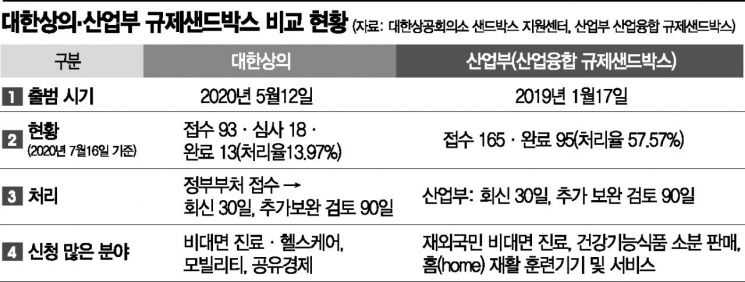
When a company applies for the regulatory sandbox, it must pass legal review, regulatory ministry examination, preliminary review committee (expert committee), and special review committee to receive demonstration exemption or temporary approval and operate. By law, the competent ministry must respond to the company within three months, but if interests conflict sharply, this can be delayed further. The government holds review meetings roughly every two months.
Companies say the system's effectiveness is low. Due to sharp conflicts of interest and high chances of being blocked in the review, some do not even dare to apply for the regulatory sandbox. The pharmaceutical and biohealth sectors are representative examples.
A typical example is the consumer-requested (DTC) genetic testing service. Although the government approved the regulatory sandbox, the business has not been properly conducted for over a year after approval due to the review by the public IRB (Institutional Review Board) designated by the Ministry of Health and Welfare.
Professor Kwak Noseong, Special Professor of Science and Technology Policy at Hanyang University, said, "Only one out of four DTC genetic tests received approval, and even approved projects have limited scope and are not properly progressing. In the future, groundbreaking innovations including benefits from the regulatory sandbox in biohealth such as digital medicine should be made, but businesses like remote pharmaceutical delivery services are moving in a direction where companies do not even dare to apply for the regulatory sandbox," he pointed out.
Kim Pilsoo, Chairman of the Korea Electric Vehicle Association, said, "From the perspective of innovative companies, how timely they can present action plans aligned with market trends is crucial, but most companies do not even know what regulations and laws apply or how to write proposals, despite support from local governments and public institutions." He added, "There are even remarks that it is better not to apply than to waste effort going through the review process, and the regulatory sandbox is becoming just another regulation."
◆"Review committees should be subdivided and staff increased"= To improve convenience for the private sector, the government added the Korea Chamber of Commerce and Industry as a private reception agency in addition to existing sector-specific dedicated agencies (ICT, industry, finance, region). However, since the regulatory sandbox threshold itself was not lowered and only reception channels increased, processing speed actually decreased.
Experts say, "Increasing reception channels does not guarantee better processing," and now committees should be organized differently by asset size and industry. Chairman Kim suggested, "Committees should be separately established by asset size and industry to more carefully judge whether an idea is worth considering. If committees are subdivided, overlapping laws can be resolved at lower levels, and the review committee only needs to organize the agenda, reducing the current competitive rush to the review stage that undermines the regulatory sandbox's purpose."
Professor Kim Soyoung of Seoul National University's Department of Economics said, "Projects without significant meaning to warrant regulatory relaxation should be filtered out at earlier stages by about two-thirds, and the remaining one-third of cases should be intensively reviewed by the review committee. Dividing review stages or adding personnel is also one way to improve review quality."
© The Asia Business Daily(www.asiae.co.kr). All rights reserved.