Kazianis, Director of Korea Affairs, Raises Possibility in Op-Ed
North Korea Unlikely to Move Unless Proposal Differs Significantly from Previous Negotiations
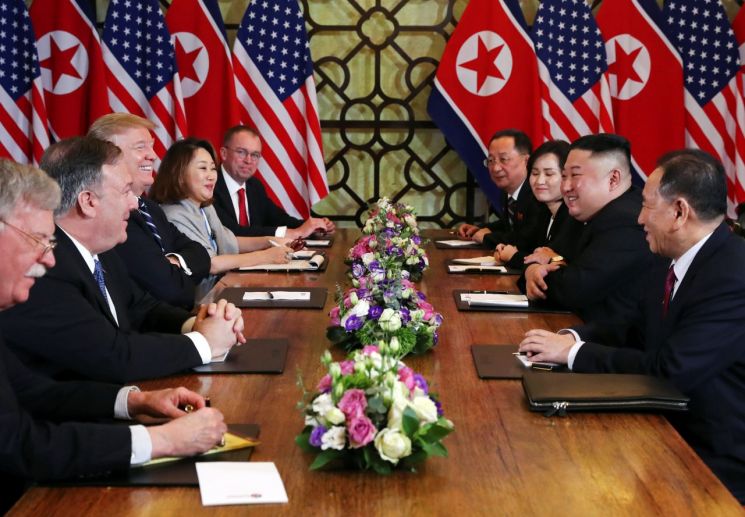
[Asia Economy Reporter Lim Cheol-young] As claims emerge that the Donald Trump administration in the United States is considering new proposals to break the long-standing deadlock in North Korea-US denuclearization talks, attention is focused on whether a new negotiation card that surpasses the ‘Hanoi No Deal’?which effectively caused the breakdown of dialogue?will be presented.
The possibility of a new negotiation card was raised by Harry Kazianis, Director for Korea at the Center for the National Interest, a US think tank, in an article titled “President Trump Wants a Breakthrough Agreement with North Korea Before the Election” published in the American Conservative. Director Kazianis predicted that if North Korea responds to the new negotiation card proposed by the US, a third North Korea-US summit could be held in one of the Asian countries, where both sides might sign an agreement.
The problem is that unless the new proposal is completely different in nature from the one presented by the US at the Hanoi summit in Vietnam last February, the likelihood of North Korea accepting it is low. Experts view that as long as North Korea maintains its existing stance, the possibility of an ‘October surprise’ is very low, similar to the failed Hanoi summit, the surprise Panmunjom meeting in June, and the working-level talks in Stockholm, Sweden in October.
North Korea has already made it clear with a strong tone not to engage in talks based on the US proposal at the Hanoi summit last year, saying “do not harbor foolish dreams.” Kim Yo-jong, First Deputy Director of the North Korean Workers’ Party, emphasized in a lengthy statement on the 10th that “the US should not harbor the foolish dream of trying to renegotiate partial sanctions relief and the permanent dismantlement of large-scale nuclear facilities such as the Yongbyon complex, which is the nerve center of our nuclear development, as was on the Hanoi summit table.”
North Korea insists that the US approach should proceed as an ‘equivalent’ action-for-action exchange of ‘withdrawal of hostility for resumption of North Korea-US negotiations.’ It reiterated that the ‘non-equivalent’ proposal of ‘Yongbyon dismantlement for partial sanctions relief’ presented at the unsuccessful Hanoi summit table is unacceptable. While North Korea has advocated a one-to-one exchange between denuclearization and security guarantees, the US position has been to pursue phased normalization of relations and peace settlement based on complete denuclearization.
In response, a shift in the White House’s stance toward resuming North Korea-US talks is being sensed. Director Kazianis conveyed in his article that the so-called ‘Trump team’ is developing the idea of a bilateral summit and that there is a mood against holding summits just for photo opportunities, which could be criticized. This suggests that the White House is aware of North Korea’s rejection of ‘formal North Korea-US summits’ as revealed through successive statements. At one point, a framework for six-party talks involving China, Russia, and Japan was proposed to bring North Korea to the negotiating table, but it reportedly yielded no results.
Quoting two White House sources, Director Kazianis described the current framework under discussion as a ‘tailored package,’ stating, “Discussions are still ongoing about what to offer North Korea, and it is something that provides enough to take ‘appropriate steps’ toward denuclearization without President Trump being called weak by the Democratic presidential campaign.” It is reported that a plan is being seriously considered in which the US would offer a sanctions relief package if North Korea dismantles one or more key production facilities and officially declares a moratorium on nuclear and missile tests.
A White House official said, “We are willing to exchange concessions for concessions and put many new things on the table, willing to take some risks that we did not take in the past. We need to know what North Korea wants. We want to make this work,” Kazianis reported.
Whether North Korea will actively respond if the White House conveys a new proposal remains uncertain. Professor Jung Dae-jin of Ajou University analyzed, “Unless a completely new negotiation card containing specific measures for easing sanctions on North Korea emerges, it seems unlikely that North Korea will respond. Moreover, given the uncertainty surrounding President Trump’s chances of re-election, North Korea may not actively engage in dialogue considering this factor.”
© The Asia Business Daily(www.asiae.co.kr). All rights reserved.

![User Who Sold Erroneously Deposited Bitcoins to Repay Debt and Fund Entertainment... What Did the Supreme Court Decide in 2021? [Legal Issue Check]](https://cwcontent.asiae.co.kr/asiaresize/183/2026020910431234020_1770601391.png)














