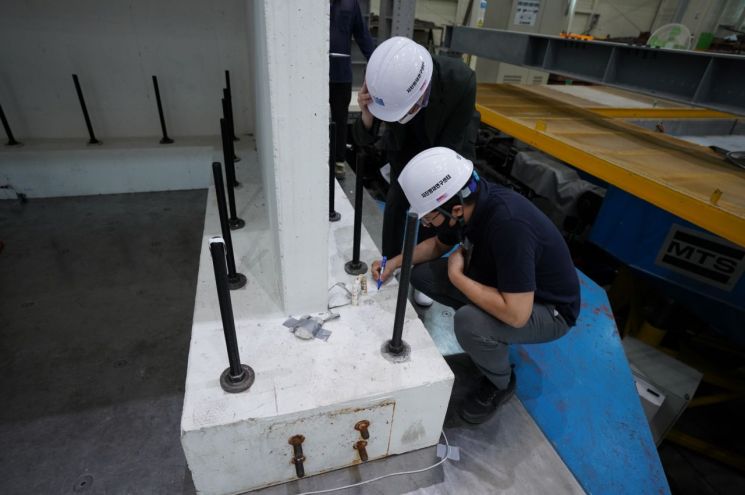
 The research team at the Korea Atomic Energy Research Institute is reviewing the seismic safety of the shear wall structural model after the experiment concluded.
[Asia Economy Reporter Junho Hwang] A reproduction of the 2016 Gyeongju earthquake, the largest earthquake ever recorded in South Korea, was conducted to verify the seismic resistance of nuclear power plants, and the results showed that sufficient stability has been secured. The Korea Atomic Energy Research Institute held a public experiment on the 14th at the Earthquake Disaster Prevention Research Center on the Yangsan Campus of Pusan National University to measure the stability of nuclear power plant structures. Pusan National University possesses the largest vibration table testing facility in the country.
In this vibration table experiment, seismic waves recorded at the Myeonggye-ri seismic observation station, which is closest to the epicenter of the Gyeongju earthquake, were reproduced. Dr. In-Gil Choi’s research team at the Korea Atomic Energy Research Institute fabricated a 5-meter-high, three-story shear wall structure representing a nuclear power plant building and exposed it to artificial seismic waves identical to those of the actual earthquake. As a result, the shear wall was analyzed to have secured sufficient stability.
For nuclear power plants currently operating in South Korea, Shin-Kori Units 3 and 4 are designed with seismic resistance performance of 0.3g (corresponding to an earthquake magnitude of about 7.0), while other plants are designed for 0.2g (corresponding to an earthquake magnitude of about 6.5). However, since the seismic design was based on the design criteria presented by the U.S. Nuclear Regulatory Commission (US NRC), there have been concerns that the characteristics of earthquakes occurring domestically are not fully considered. The shear wall structure refers to a structure designed to resist horizontal loads.
The research team plans to use the results obtained from this experiment to advance seismic response prediction technology for nuclear power plant structures. Deputy Director In-Gil Choi, who led the study, said, "The public vibration table experiment conducted this time is meaningful in that it directly verified through experiments how earthquakes occurring domestically affect operating nuclear power plants," adding, "We expect that the results of this experiment will contribute to improving the seismic safety of nuclear power plants."
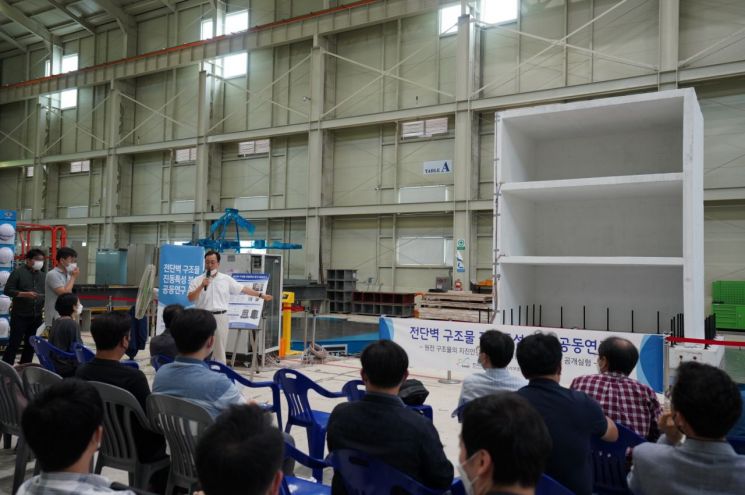 Dr. Min-gyu Kim of the Instrumentation Structure Prediction and Diagnosis Research Division at the Korea Atomic Energy Research Institute is conducting a briefing for researchers before the experiment.
© The Asia Business Daily(www.asiae.co.kr). All rights reserved.
![Clutching a Stolen Dior Bag, Saying "I Hate Being Poor but Real"... The Grotesque Con of a "Human Knockoff" [Slate]](https://cwcontent.asiae.co.kr/asiaresize/183/2026021902243444107_1771435474.jpg)

















