Support for Partial Return of Unpaid Wages Survey Increases
Negotiations Underway with Leasing and Operating Companies
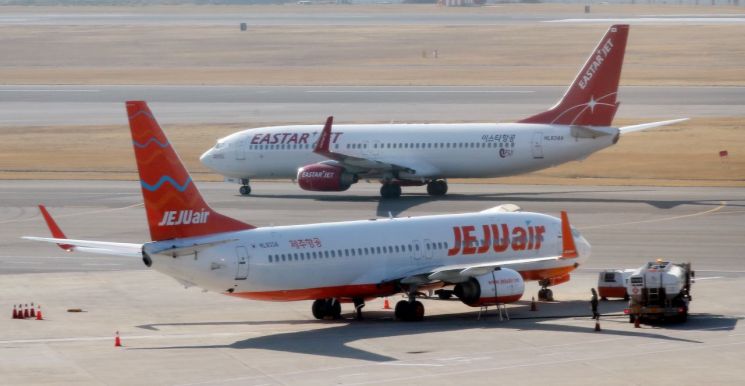
[Asia Economy Reporter Yoo Je-hoon] As the deadline for Jeju Air's announced acquisition and merger (M&A) of Eastar Jet approaches in two days, industry attention is intensifying. While Eastar Jet is desperately trying to reduce its outstanding payments on its own, there are also speculations within and outside the industry that additional support from the government and policy financial authorities could act as a 'lubricant.'
According to the aviation industry on the 13th, Eastar Jet is making an all-out effort to reduce outstanding payments amounting to 170 billion KRW ahead of the 15th, when Jeju Air stated that it could notify contract termination if preconditions for acquisition are not met.
Eastar Jet plans to first request the labor representatives to sign a consent form to return two months' worth of suspension pay from the 25 billion KRW in unpaid wages soon. This follows a survey conducted on the 10th regarding the return of unpaid wages, where 42% of 1,261 employees excluding the pilots' union participated, and about 75% expressed approval.
An Eastar Jet official said, "Currently, as operations are suspended, it is not possible to obtain consent forms directly from employees, so we are considering obtaining signatures from the labor representatives as a last resort." Eastar Jet expects that if all employees participate, it could reduce unpaid wages by about 6.5 billion KRW.
In addition, negotiations are underway with key related parties such as lessors, ground handling companies, and aviation authorities, which are central to the outstanding payments. The company believes that if discussions proceed smoothly, outstanding payments could be reduced to below 100 billion KRW. Although not finalized, positive responses have reportedly been received from lessors and oil companies. An industry insider said, "It is understood that Eastar Jet has reduced outstanding payments by about 25 billion KRW through negotiations with related parties."
However, it is uncertain how these efforts will influence Jeju Air's willingness, as Jeju Air's financial situation is not favorable. As of the first quarter, Jeju Air's cash assets were about 99 billion KRW, more than halved compared to the previous quarter. With hundreds of billions of KRW in losses expected in the second quarter as well, a rights offering is currently underway. This is why Jeju Air has expressed concerns about the risk of 'falling into joint insolvency.'
For this reason, some argue that additional support from authorities is necessary for the M&A to succeed. So far, KDB Industrial Bank and Korea Eximbank have agreed to provide 170 billion KRW to Jeju Air, contingent on the successful conclusion of the Eastar Jet M&A. The industry estimates that the costs related to Eastar Jet's various outstanding payments and normalization will exceed 200 billion KRW, which may be insufficient for Jeju Air. Eastar Jet had previously requested prior support but reportedly did not achieve significant results.
An industry insider said, "Since the authorities are directly involved in mediation and facilitation, this is not a deal Jeju Air can easily walk away from," adding, "It will be interesting to see if last-minute additional financial support or incentives emerge."
© The Asia Business Daily(www.asiae.co.kr). All rights reserved.