[Asia Economy Reporter Kangwook Cho] Recently, financial crimes such as voice phishing targeting low-income individuals with increased funding needs due to the spread of the novel coronavirus disease (COVID-19) have been on the rise. There is even growing concern as small high-interest loan crimes targeting teenagers have surged.
In particular, there have been cases where teenagers lend private loans to other teenagers, which leads to secondary harm in the form of school violence, causing shock.
According to financial authorities and the financial sector on the 11th, it has been revealed that high-interest small loans called "proxy deposits" targeting financially and legally vulnerable groups such as teenagers have become widespread, resulting in reported damages.
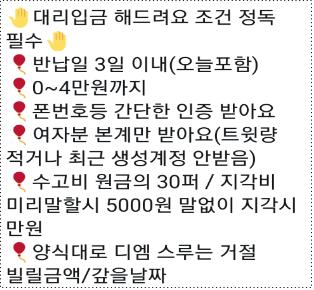
Proxy deposit operators mainly post advertisements on SNS and lure teenagers who need concert tickets, celebrity merchandise, or game expenses, lending small amounts around 100,000 KRW for a short term (2 to 7 days).
Although the borrowed amounts are small, the short-term interest rates range from 20% to 50%. When converted to annual interest rates, this amounts to over 1000%.
In particular, if repayment is delayed, a late fee of 1,000 to 10,000 KRW per hour is charged, disguised under the term "late fee." The problem is that terms like "service fee" and "late fee" are used, and idol photos are posted to make it appear as if the transactions are between acquaintances. Moreover, under the pretext of identity verification, contact information of family and friends is requested, and the practice often targets only teenagers (especially girls).
There were even teenagers who engaged in proxy deposits as a way to earn pocket money. Investigations revealed that this has evolved into a form of school violence where friends' money is extorted in the form of loan sharking.
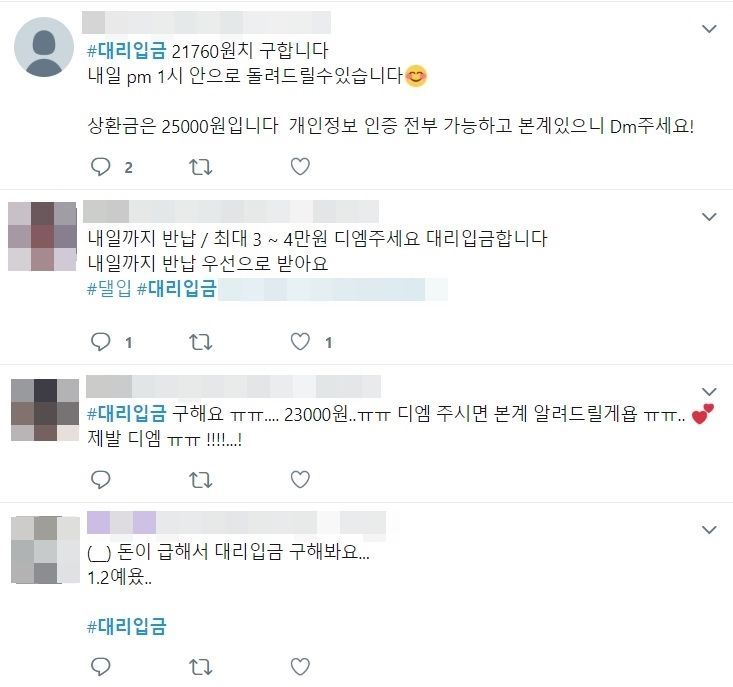
From June last year to May this year, 2,100 reports of proxy deposit advertisements were received by the Financial Supervisory Service.
Looking at the damage cases, Mr. A borrowed 100,000 KRW for three days and repaid 140,000 KRW. However, he was additionally charged a late fee of 50,000 KRW (1,500 KRW per hour) for 36 hours of delay and has even been subjected to illegal debt collection such as threatening calls at night.
Ms. B wanted to buy merchandise of her favorite idol but had no purchase funds, so she used proxy deposits from several people through SNS, borrowing amounts ranging from 20,000 to 100,000 KRW. However, unable to repay, she kept rolling over the debt and eventually repaid 4 million KRW including interest.
High school student Mr. C, addicted to gambling, raised gambling funds through proxy deposits with a weekly interest rate of 50% (annual interest rate of 2,600%), and eventually his gambling debt ballooned to 37 million KRW over four years.
The Financial Supervisory Service explained that proxy deposits are high-interest private loans with an annual interest rate exceeding 1000%, far surpassing the legal interest rate (24%). They also warned that lending proxy deposits to others is subject to criminal punishment. Posting advertisements on SNS and repeatedly making proxy deposits to multiple people may violate the Loan Business Act and Interest Rate Restriction Act and could lead to criminal charges.
They advised that if one is threatened with having their phone number, address, or school information spread on SNS for not repaying after using proxy deposits, they should seek help from school police officers, teachers, parents, or others around them.
They also warned that since there are frequent fraudulent acts where some teenagers deliberately borrow money via proxy deposits and do not repay, engaging in proxy deposits with the thought of helping those who need pocket money or urgent funds is very dangerous.
The Financial Supervisory Service plans to strengthen financial education by cooperating with related agencies, such as requesting police investigations upon receiving reports of proxy deposit transaction damages, and providing repeated guidance and education to help teenagers naturally learn about the risks of illegal finance and how to respond.
Recently, they filmed a video to prevent voice phishing with Yoo Jae-suk and Jo Se-ho. A Financial Supervisory Service employee in charge of voice phishing, who appeared on tvN’s representative entertainment program "You Quiz on the Block," introduced types of voice phishing, damage cases, and prevention methods. The broadcast is scheduled to air on the 22nd at 8:50 PM.
© The Asia Business Daily(www.asiae.co.kr). All rights reserved.
![Clutching a Stolen Dior Bag, Saying "I Hate Being Poor but Real"... The Grotesque Con of a "Human Knockoff" [Slate]](https://cwcontent.asiae.co.kr/asiaresize/183/2026021902243444107_1771435474.jpg)
















