'6·25 War Hero' General Baek Seon-yeop Passes Away at 100
'Pro-Japanese Actions' Stigma... Conflict Over 'National Cemetery Burial'
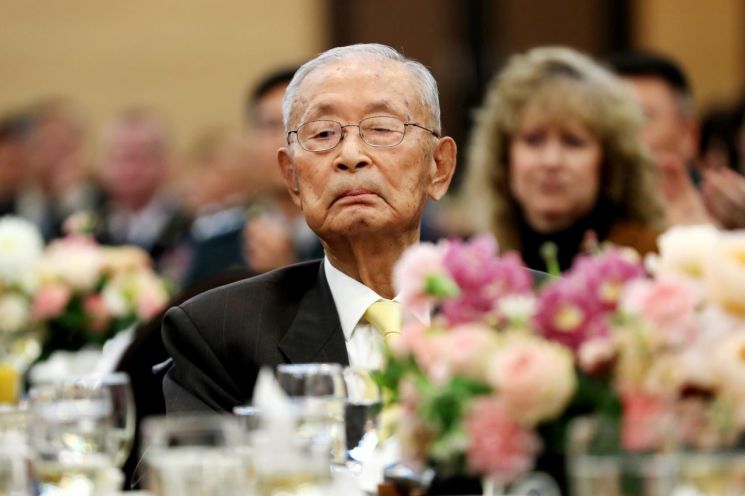 General Baek Seon-yeop passed away at 11:04 PM on the 10th. He was 100 years old. Born in 1920 in Gangseo, Pyeongnam, General Baek entered the military as a second lieutenant in the Manchurian Army during the Japanese colonial period. During the Korean War, he served as the commander of the 1st Division, commander of the 1st Corps, Chief of Staff of the Army, South Korean representative at the armistice talks, ambassador to China, and Minister of Transportation. The photo shows General Baek deep in thought at his birthday party held at the Defense Convention in 2018. [Image source=Yonhap News]
[Asia Economy Reporter Han Seung-gon] General Baek Seon-yeop passed away on the night of the 10th at the age of 100, sparking conflicts within the political sphere over his achievements.
The Democratic Party of Korea decided not to issue an official party statement regarding General Baek's passing. While his contributions during the Korean War are undeniable, they took into account his past pro-Japanese activities.
On the other hand, the United Future Party expressed condolences for General Baek. Spokesperson Kim Eun-hye stated in a comment, "A living hero of the Korean War, a living legend, the most respected soldier by all former commanders of the United States Forces Korea. No title can fully express our gratitude to General Baek," and offered her condolences.
As political conflicts arise over General Baek's achievements, the Ministry of Patriots and Veterans Affairs reported on the 11th that his family applied for his burial at Daejeon National Cemetery that morning. However, the decision on his burial is expected to face difficulties due to political disputes over his past pro-Japanese activities.
The political conflict surrounding General Baek's pro-Japanese activities is not new. Even during his lifetime, there were controversies over his burial at the National Cemetery. Some Democratic Party lawmakers clearly opposed his burial while preparing a 'pro-Japanese grave excavation' bill.
Democratic Party lawmaker Lee Su-jin, then a member-elect, visited the National Seoul Cemetery in her constituency on May 24 with fellow party member-elect Kim Byung-gi and participated in the event "2020 Sites of Pro-Japanese and Anti-Japanese, Correcting the History of the National Cemetery" hosted by the Unam Kim Seong-suk Memorial Association, where she expressed her stance on General Baek's burial.
Lawmaker Kim said, "There are issues with those already buried, but in the future, for example, in the case of Baek Seon-yeop, there is a possibility of problems." He emphasized, "If the grave excavation issue is not resolved by law, conflicts will intensify."
Lawmaker Lee also stated, "To set history right, it is appropriate to exhume pro-Japanese collaborators from the National Cemetery," adding, "Several attempts were made until last year, but the 'pro-Japanese grave excavation' bill did not pass." She explained the background of the bill, saying, "After visiting the National Cemetery, I thought a law to exhume pro-Japanese graves should be made."
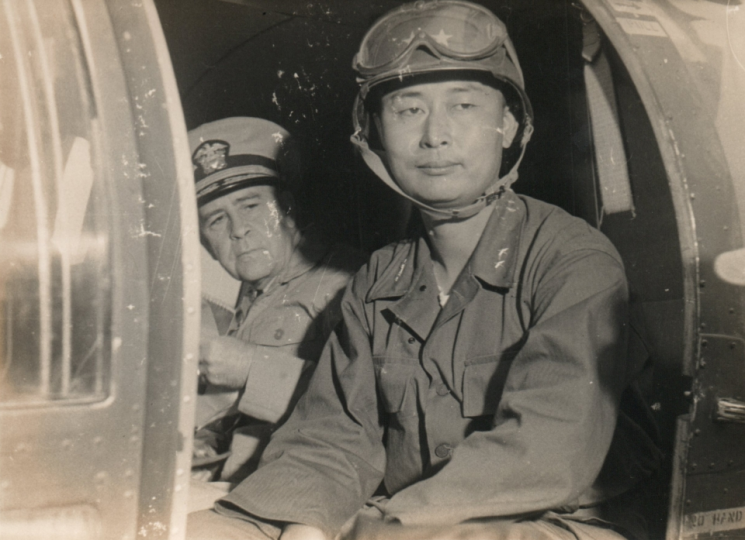 On August 25, 1953, Baek Sun-yeop, then a Major General, riding a US military helicopter to the Panmunjom Armistice Talks venue.
 [Image source=Yonhap News]
The controversy over General Baek's pro-Japanese activities stems from his service in the Gando Special Force. He was commissioned as a second lieutenant in the Manchukuo army in April 1943 and served for two years in the Gando Special Force.
The Gando Special Force was a special unit mostly composed of Koreans, except for some positions like battalion commander, under the pretext that the Korean independence army should be led by Koreans. Until the unit was disbanded following Japan's defeat, it led efforts to annihilate the independence army, and its activities were known to be particularly brutal.
As a result, General Baek, whose name appeared on the list of pro-Japanese and anti-national acts announced by the Committee for the Investigation of Pro-Japanese and Anti-National Acts in 2009, became a subject of controversy. In 2010, a plan to honor him as an 'Honorary Marshal (5-star general)' to commemorate the 60th anniversary of the Korean War was considered but ultimately failed.
Regarding these controversies, General Baek stated in an interview with the Chosun Ilbo in June last year, "When I was assigned to the Gando Special Force in early 1943, the anti-Japanese independence army and Kim Il-sung's units had already moved out of the Gando region due to large-scale Japanese military operations," adding, "I never engaged in combat with the independence army."
About his description of battles with Korean anti-Japanese independence forces during his service in the Gando Special Force in his Japanese autobiography, he said, "It was a painful reflection as a fellow Korean on the unavoidable early 1930s internal conflicts and sacrifices within the Gando Special Force."
The political sphere saw intense debates over General Baek's actions. Democratic Party lawmaker Kim Hong-gul wrote on his Facebook in May, "The crimes of pro-Japanese military personnel did not end during the Japanese colonial period but include massacres of civilians during the Korean War and cooperation with military dictatorship, so their wartime achievements alone cannot be forgiven."
He added, "In Baek Seon-yeop's book published in Japan, he admits to pointing a gun at compatriots and says that even if criticized for it, it cannot be helped," expressing opposition to General Baek's burial at the National Cemetery.
In response, then-Jeju Governor Won Hee-ryong said, "General Baek is a hero of the Korean War who saved the Republic of Korea and can be called the 'Yi Sun-sin of the Korean War,'" adding, "It would be very regrettable if he suffered any damage under Korean law, and it should not happen." He also said, "A place for General Baek must be prepared at the Seoul National Cemetery."
The United Future Party criticized the Democratic Party for not issuing an official statement. Spokesperson Kim referred to General Baek's order during the Battle of Dabudong, "I will lead the charge; if I retreat, shoot me," and said, "This legend who defended the Republic of Korea is now being erased by this era."
He continued, "When some tried to disparage and politically exploit the general's life, he said, 'If a private grave is made in a state-managed place, it would be a special privilege. I have decided my grave will be at Daejeon National Cemetery.' He lived a life different from theirs."
© The Asia Business Daily(www.asiae.co.kr). All rights reserved.



















