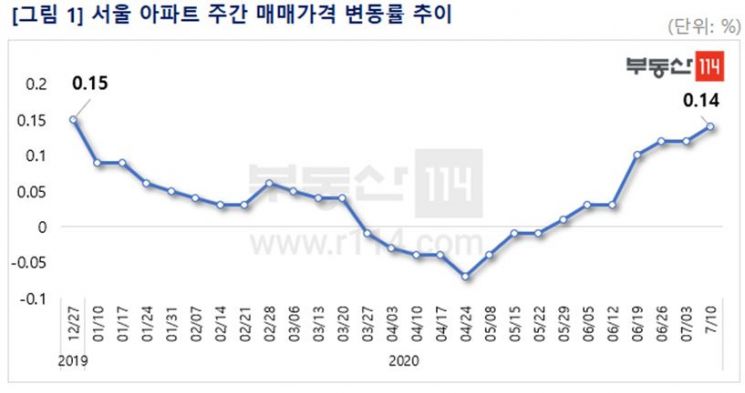
[Asia Economy Reporter Kim Yuri] Apartment prices in Seoul rose by 0.14%, with the rate of increase expanding compared to last week. This week's rise is the largest weekly increase since December 27, 2023 (0.15%). Since the announcement of the June 17 measures, buying demand has increased in the apartment sales market in Seoul, with areas such as Nodogang (Nowon, Dobong, Gangbuk districts) and Geumgwan-gu (Geumcheon, Gwanak, Guro districts) exceeding the average Seoul increase rate. Songpa-gu, where Jamsil-dong is located and designated as a land transaction permission zone, and Gangdong-gu, which is outside the scope of regulations, also saw significant increases.
According to Real Estate 114 on the 10th, Seoul apartment sale prices rose by 0.14%, continuing an upward trend for seven consecutive weeks. Both reconstruction apartments and general apartments increased by 0.07% and 0.15%, respectively, with the rate of increase expanding in both categories. Additionally, Gyeonggi and Incheon rose by 0.10%, and new towns increased by 0.06%.
In Seoul, Gangbuk (0.32%), Nowon (0.30%), Guro (0.29%), Gangdong (0.28%), Gwanak (0.28%), Songpa (0.26%), Mapo (0.20%), Geumcheon (0.18%), and Dobong (0.18%) all saw increases. In Gangbuk, even after the rapid sale of urgent listings, steady buying demand continued, with properties such as Beondong Jugong Complex 1, Mia-dong Samgaksan I-Won, and SK Bukhan-san City rising by 5 to 10 million KRW. In Nowon, areas including Junggye-dong Life, Sindonga, Cheonggu 2nd Complex, Sanggye-dong Sanggye Jugong Complex 11, Sanggye Jugong Complex 3 (high-rise), and Wolgye-dong Seongbuk Station Shindobrenu increased by 10 to 25 million KRW. In Songpa, although Jamsil-dong was designated as a land transaction permission zone, real demand inflow continued, with Jangji-dong Songpa Pine Town Complex 13, Jamsil-dong Jamsil Els, and Sincheon-dong Jamsil Parkrio rising by 5 to 50 million KRW. Gangdong saw a large increase as the burden of large-scale move-ins decreased and it moved out of the regulatory scope of the land transaction permission zone. Properties such as Seongnae-dong Seongnae Samsung, Gildong Gangdong Xi, and Godeok-dong Godeok Raemian Hillstate rose by 15 to 25 million KRW.
New towns saw increases in Ilsan (0.09%), Gwanggyo (0.09%), Jungdong (0.08%), Bundang (0.07%), and Gimpo Hangang (0.07%). In Ilsan, Madudong Gangchon Complex 1 Donga, Juyop-dong Munchon Complex 16 New Samik, and Baekseok-dong Baeksong Complex 7 Imkwang rose by 2 to 5 million KRW. In Gwanggyo, Suwon-si Iui-dong Gwanggyo Jayeon & Xi Complex 1, Gwanggyo Hoban Verdiem, and Yongin-si Sanghyeon-dong Gwanggyo Sangnok Xi increased by 2.5 to 10 million KRW. In Jungdong, Sangdong Hanarum Life, Hyundai, Jungdong Eunha Hyosung, and Eunha Ssangyong rose by 5 to 10 million KRW.
Gyeonggi and Incheon saw the southern Gyeonggi area leading the rise. Gwangmyeong (0.30%), Guri (0.18%), Yongin (0.18%), Namyangju (0.17%), Anyang (0.16%), Goyang (0.13%), Uiwang (0.13%), and Hwaseong (0.13%) all increased. In Gwangmyeong, redevelopment projects continued to drive relocation demand, and some jeonse (long-term lease) demand shifted to sales. Sohadong Dongyang, Haan-dong Jugong Complex 8, Gwangmyeong Doosan We've Trizium, and Gwangmyeong-dong Gwangmyeong Haemoro Iyeon rose by 5 to 15 million KRW.
The metropolitan area jeonse market continued to rise due to a shortage of jeonse listings, with Seoul rising by 0.08%, Gyeonggi and Incheon by 0.06%, and new towns by 0.05%.
In Seoul's jeonse market, Songpa (0.22%), Gangdong (0.19%), Geumcheon (0.15%), Seongbuk (0.15%), Guro (0.11%), and Dongdaemun (0.11%) increased. In Songpa, jeonse prices rose mainly in large apartment complexes. Jamsil-dong Lake Palace, Jamsil Els, Munjeong-dong Olympic Family Town, and Sincheon-dong Jamsil Parkrio increased by 10 to 40 million KRW. In Gangdong, where the burden of large-scale move-ins has been resolved, Godeok-dong Godeok Raemian Hillstate, Myeongil-dong Samik Green Complex 2, and Amsa-dong Seonsa Hyundai rose by 5 to 25 million KRW. In Geumcheon, the large-scale Gasan-dong Doosan We've rose by 5 to 10 million KRW.
New towns saw increases in Jungdong (0.08%), Dongtan (0.08%), Bundang (0.06%), Ilsan (0.06%), and Sanbon (0.06%). Gyeonggi and Incheon saw rises in Hanam (0.21%), Hwaseong (0.19%), Gwangmyeong (0.13%), Anyang (0.12%), Yongin (0.10%), Goyang (0.09%), Namyangju (0.09%), and Osan (0.09%).
Despite the June 17 measures, the upward trend in apartment prices in the metropolitan area continued, leading to the announcement of the July 10 supplementary housing market stabilization measures. These include ▲ measures to reduce the burden on low-income real demand buyers ▲ expansion of housing supply for real demand buyers ▲ strengthening real estate tax measures on multi-homeowners and short-term transactions ▲ reform of the rental business system. In particular, to suppress speculative demand, the comprehensive real estate tax (Comprehensive Tax) surcharge rate will be raised, and the capital gains tax (hereafter capital gains tax) surcharge rate will be increased. The increase in comprehensive real estate tax and capital gains tax surcharge rates is expected to act as a factor pressuring buying sentiment.
However, Real Estate 114's analysis notes that due to the time lag between the comprehensive real estate tax assessment date (June 1 annually) and the payment period (December 1-15 annually), it remains to be seen whether the effect of the tax rate increase will appear in the short term. Lim Byung-chul, Senior Researcher at Real Estate 114, said, "In a rising housing market, house prices can rise more than the increased tax burden, so the possibility that multi-homeowners will hold on cannot be excluded," adding, "The capital gains tax surcharge also has a grace period until June next year, so rather than immediately putting properties on the market, sellers are likely to watch the market situation a bit longer."
The metropolitan area jeonse market continues to rise due to a shortage of listings. He said, "Due to increased waiting demand for subscription, conversion to monthly rent due to low interest rates, and strengthened mandatory residence requirements for mortgage loans in regulated areas, there are not many listings released into the jeonse market, so the upward trend is expected to continue for the time being." Additionally, with the enactment of the three rental laws approaching, landlords may raise jeonse prices in advance, which could act as a destabilizing factor in the jeonse market.
© The Asia Business Daily(www.asiae.co.kr). All rights reserved.
![Clutching a Stolen Dior Bag, Saying "I Hate Being Poor but Real"... The Grotesque Con of a "Human Knockoff" [Slate]](https://cwcontent.asiae.co.kr/asiaresize/183/2026021902243444107_1771435474.jpg)















