[Asia Economy Reporter Ki-min Lee] The number of marginal companies facing financial distress and the demand for restructuring have been increasing globally before and after the COVID-19 pandemic. In South Korea, where the number of marginal companies is rapidly rising, concerns are growing that the impact of COVID-19 could lead to a wave of bankruptcies, highlighting the urgent need for institutional improvements to enable swift restructuring.
On the 9th, the Korea Economic Research Institute (KERI) released a report titled "Trends of Marginal Companies and Implications for Corporate Restructuring Systems," stating that the number of marginal companies in South Korea has recently surged and arguing that the "Act on the Promotion of Corporate Restructuring" should be improved and made permanent to facilitate faster restructuring.
Currently, due to job losses caused by COVID-19, weakened consumer sentiment, and reduced global trade, corporate performance is deteriorating, making bankruptcies a reality. Allianz of Germany forecasts that the number of bankruptcies worldwide will increase by 20% compared to last year. Additionally, Japan's Teikoku Databank announced that the number of corporate bankruptcies in Japan this year could exceed 10,000 cases.
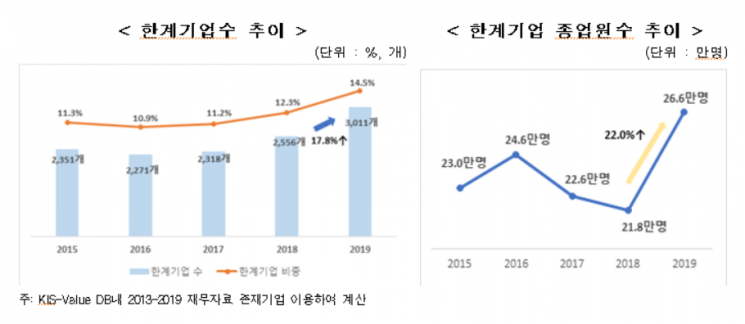
KERI expressed concerns that South Korea is also experiencing an increase in marginal companies due to low growth and declining productivity, and that the adverse effects of COVID-19 could cause significant damage such as a wave of bankruptcies. Analyzing 20,764 non-financial companies subject to the External Audit Act from 2015 to 2019, KERI found that the number of marginal companies last year was 3,011, a 17.8% increase from 2,556 in 2018. The number of employees working at marginal companies also rose by 22.0%, from 218,000 in 2018 to 266,000 last year.
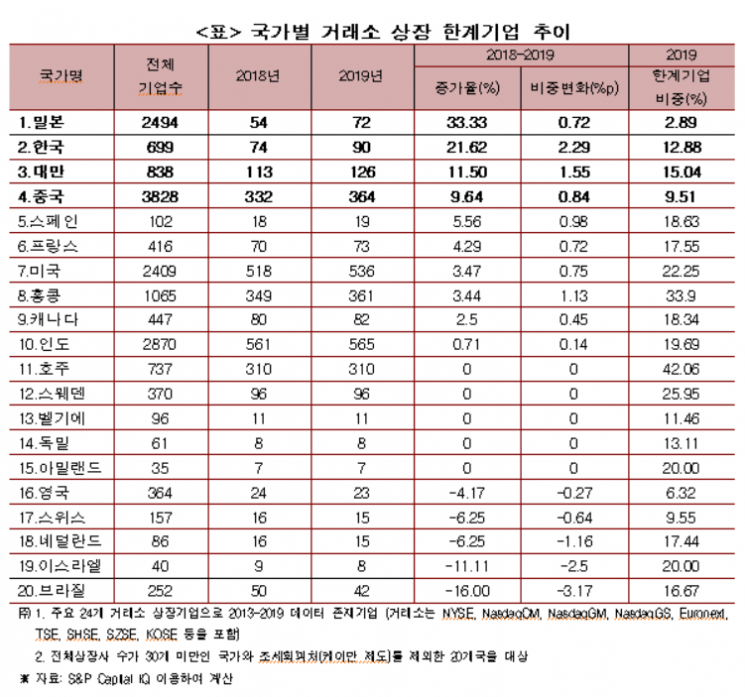
In particular, when comparing listed companies on stock exchanges in 20 major countries worldwide, the number of marginal listed companies in South Korea increased by 21.6%, from 74 in 2018 to 90 last year. South Korea showed the second-highest growth rate after Japan, where marginal companies increased by 33.3% during the same period. The proportion of marginal companies among all listed companies in South Korea rose from 10.6% in 2018 to 12.9% last year, an increase of 2.3 percentage points, the largest growth among the 20 countries.
KERI advocated for the improvement and permanent establishment of the "Act on the Promotion of Corporate Restructuring" (APCR) to enable rapid restructuring of companies with deteriorating financial structures. The APCR was introduced temporarily after the 2001 financial crisis. Since then, due to constitutional controversies, government intervention in finance, and effectiveness issues, the act has not been made permanent and has been extended or reintroduced as needed by companies and creditor financial institutions, currently in its sixth iteration. The report emphasized that since using rehabilitation procedures can stigmatize companies as insolvent and cause unnecessary job cuts, it is desirable to improve and make the APCR permanent.
To this end, KERI suggested the need for mechanisms that exclude policy authorities' influence, citing Japan's business revitalization ADR (Alternative Dispute Resolution through reconciliation and mediation), which utilizes a third-party neutral expert committee as an example. KERI also argued that incentives for corporate managers to use workouts could be enhanced by increasing the utilization of the DIP (Debtor in Possession) system introduced in rehabilitation procedures, while simultaneously establishing measures to sanction managerial moral hazard, thereby revitalizing restructuring. Kim Yoon-kyung, a researcher at KERI, stated, "Various restructuring methods reflecting differences in companies' financial conditions and business opportunities must be prepared," adding, "Along with awareness of the social costs caused by corporate restructuring, active efforts to improve related systems are also required."
© The Asia Business Daily(www.asiae.co.kr). All rights reserved.
![Clutching a Stolen Dior Bag, Saying "I Hate Being Poor but Real"... The Grotesque Con of a "Human Knockoff" [Slate]](https://cwcontent.asiae.co.kr/asiaresize/183/2026021902243444107_1771435474.jpg)
















