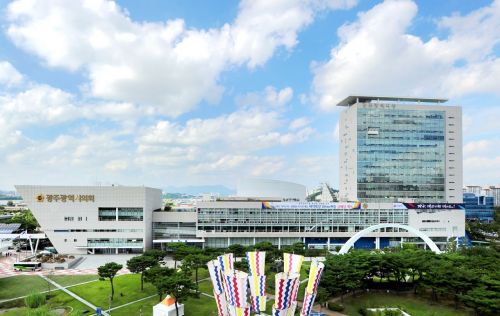
[Asia Economy Honam Reporting Headquarters Reporter Park Seon-gang] Gwangju Metropolitan City announced on the 7th that it will begin full-scale construction of the ‘Clean Air Industry Cluster’ to respond to fine dust, leading the global green industry market, in the Bitgreen Industrial Complex starting in the second half of the year.
The ‘Clean Air Industry Cluster’ will develop key technologies to reduce fine dust-causing substances generated from industrial and transportation sectors, which are considered major sources of fine dust in Korea, and will be equipped with test beds for demonstration and commercialization support facilities.
The Ministry of Environment has decided to establish the ‘Clean Air Industry Cluster,’ a core project of the Green New Deal, in Gwangju. It secured 2 billion KRW for design costs in the government’s third supplementary budget and plans to build a 30,000㎡ (45 billion KRW, fully funded by the national government) facility in the Bitgreen Industrial Complex by 2022.
The air industry will support the entire process from domestic production of materials, parts, and equipment to productization and commercialization of innovative technologies by establishing a nurturing hub such as emission reduction technologies for industrial and transportation sectors and a demonstration complex for measuring instruments.
The global environmental market is rapidly growing with an average annual growth rate of over 13% due to global warming and fine dust issues, but Korea’s technology level remains at about 70-80% compared to the EU and the United States, showing a lack of competitiveness.
Accordingly, the Ministry of Environment announced a green industry promotion policy in 2019 and conducted surveys and reviews of candidate sites in major cities nationwide to establish ‘environmental convergence base complexes’ linked to regional specialized industries.
Mayor Lee Yong-seop proposed Gwangju’s attraction citing ▲the concentration of home appliance and automobile companies, ▲well-established local talent and infrastructure related to the air industry, and ▲expected synergy effects when linked with the air industry. Gwangju was selected and announced as the site for the Clean Air Industry in March.
Since then, the Ministry of Environment and the city have regarded the clean air industry, along with the air industry, as future new growth engines that can solve global crises and environmental problems and create jobs. They included it as a key project of the Korean Green New Deal policy, reflecting design costs in the government’s third supplementary budget.
Gwangju plans to foster itself as the mecca of the air industry by integrating the clean air industry, which fundamentally blocks air pollutants generated from industrial sites and automobiles, with the air industry that improves indoor air quality, expecting significant synergy effects such as securing global competitiveness of related industries and technologies.
Kim Seok-woong, Director of the Environmental Ecology Bureau of the city, said, “While demand for the air industry, including fine dust, is rapidly increasing recently, the high dependence on overseas parts and equipment necessitates systematic development of related industries,” adding, “We will actively strive to support small businesses and create sustainable jobs through the Clean Air Industry Cluster.”
© The Asia Business Daily(www.asiae.co.kr). All rights reserved.
![Clutching a Stolen Dior Bag, Saying "I Hate Being Poor but Real"... The Grotesque Con of a "Human Knockoff" [Slate]](https://cwcontent.asiae.co.kr/asiaresize/183/2026021902243444107_1771435474.jpg)
















