'Cinema Paradiso' and 'Mission' Leave Heavenly Melodies Behind Upon Passing
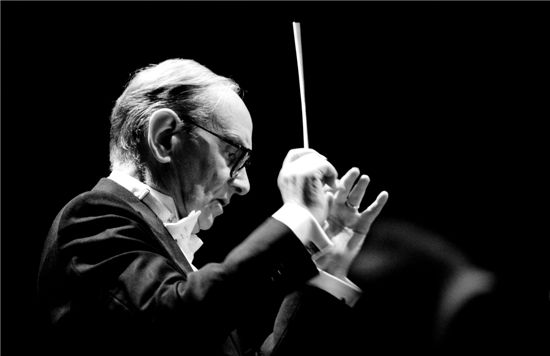
Director Giuseppe Tornatore (64)'s Cinema Paradiso (1988) is a film depicting the lifelong friendship between young Toto (Salvatore Cascio) and the elderly projectionist Alfredo (Philippe Noiret). It is also famous for its theme song of the same name. The lyrical music uses ostinato (a technique of repeating a specific musical pattern at the same pitch in the same voice). It was inserted in all six important scenes featuring Toto. The repeated flow connects different sequences and draws out the hidden meanings of the drama. Each scene features different lead instruments and timbres to convey the story more dramatically. Director Tornatore expressed his gratitude, saying, "When Ennio Morricone's sixteen pieces were completed, Cinema Paradiso was finally complete."
Italian film composer Morricone passed away on the 5th (local time) at the age of 92. According to local media such as La Repubblica on the 6th, Morricone recently suffered a femur fracture due to a fall. He was receiving treatment at the hospital and passed away the night before.
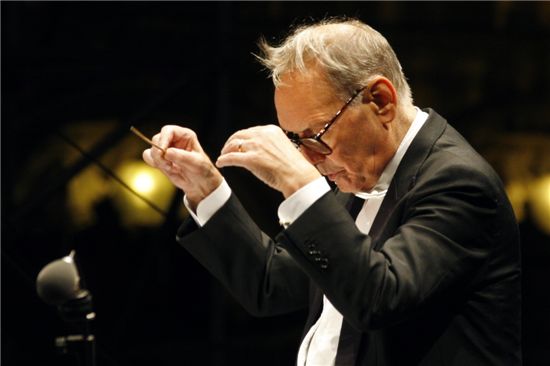
Born in Rome, Morricone was a master who composed music for over 400 films. At the age of nine, he was led by his father to enter the Santa Cecilia Conservatory, where he studied trumpet performance, composition, and choral conducting under the famous composer Goffredo Petrassi (1904?2003). Although he showed passion for pure music, he struggled with severe financial difficulties and arranged music for radio and TV. It was around this time that he ventured into film music. His first project was Il Federale (1961), directed by Luciano Salce (1922?1989). Due to his pride as a classical musician, he worked under pseudonyms such as Leo Nichols and Dan Savio.
Morricone gained worldwide fame working with director Sergio Leone (1929?1989). Their first collaboration was the Italian western known in Hollywood as a "macaroni western," A Fistful of Dollars (1964). It thoroughly broke the conventions of traditional westerns and conveyed a ruthless logic. Morricone's music was also groundbreaking. Centered on simple melodies played with chimes and harmonica, he built a solid bass foundation to create elegant melodies. He further concretized the synchronization between scenes and music, infusing the visuals with intense energy. Especially, the whistled tune that plays whenever Joe (Clint Eastwood) appears is recognized as a symbol of western films. The duo showed remarkable synergy in Once Upon a Time in the West (1968), The Good, the Bad and the Ugly (1971), and Once Upon a Time in America (1984), earning comparisons to the Alfred Hitchcock (1899?1980) and Bernard Herrmann (1911?1975) partnership.
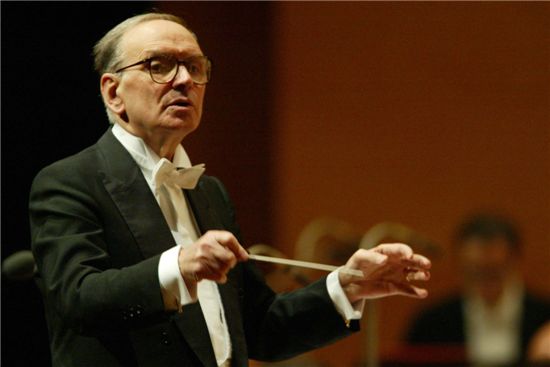
From the 1980s, Morricone began composing solemn music suited to themes such as religion, love, and humanism. He created calm orchestral melodies centered on string instruments, expressing beauty and lyricism deeply. Representative works include Terrence Malick (77)'s Days of Heaven (1978), Roland Joff? (75)'s The Mission (1984), Wolfgang Petersen (79)'s In the Line of Fire (1993), Barry Levinson (78)'s Disclosure (1994), and Glenn Gordon Caron (66)'s Love Affair (1994). Morricone himself cited A Quiet Place in the Country (1968), a lesser-known film among filmmakers, as his most cherished work.
Albums featuring Morricone's music have sold over 50 million copies worldwide. Through innovative approaches, he elevated film music to the level of art and received an honorary award at the 2007 Academy Awards. He won his first Academy Award for music nine years later in 2016 for The Hateful Eight (2015).
© The Asia Business Daily(www.asiae.co.kr). All rights reserved.
![Clutching a Stolen Dior Bag, Saying "I Hate Being Poor but Real"... The Grotesque Con of a "Human Knockoff" [Slate]](https://cwcontent.asiae.co.kr/asiaresize/183/2026021902243444107_1771435474.jpg)














