Global Independent Survival of the Three Battery Companies
Need for Concentration of Core Technology
Supply Chain Reorganization Including Fostering Partners
Establishing a Robust Mobility Ecosystem
[Asia Economy Reporters So-yeon Park, Su-yeon Woo] The most watched aspect by the business community in the 'battery meeting' of Korea's four major groups is whether the long-stalled 'K-Mobility' consortium can be realized. Although the future mobility sector, including electric vehicles, is an industry fostered by the government’s 'Korean New Deal,' the K-Mobility ecosystem development project promoted by the government has not gained momentum as the three domestic battery companies have focused on fierce global competition.
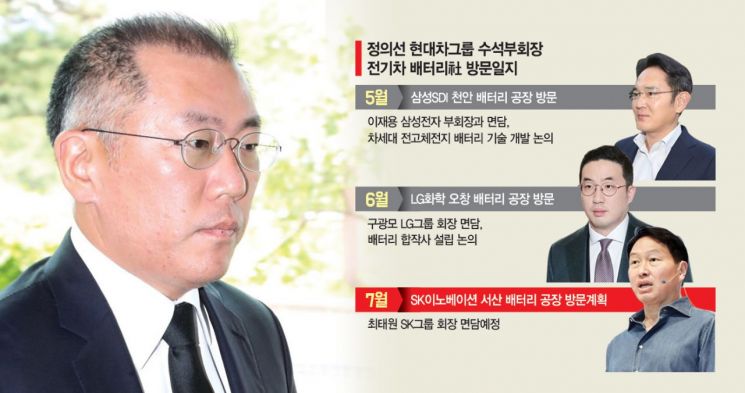
According to the business community on the 7th, Chung Eui-sun, Vice Chairman of Hyundai Motor Group, concluded the 'relay battery meetings' with the heads of major groups by meeting SK Group Chairman Chey Tae-won on the same day.
Vice Chairman Chung previously discussed all-solid-state battery technology development with Samsung Group Vice Chairman Lee Jae-yong and talked about establishing a battery joint venture with LG Group Chairman Koo Kwang-mo. In the meeting with Chairman Chey on this day, the top priority was discussing cooperation plans in future electric vehicle batteries and new technology fields, which are issues of collaboration between individual companies. However, it is reported that the meeting with Chairman Chey, who is regarded as the 'eldest brother' of the business community and leads corporate social value creation, involved a more in-depth conversation about K-Mobility cooperation.
Throughout the meetings, Vice Chairman Chung conveyed the opinion that for Hyundai Motor to stand out in competition with global electric vehicle companies such as Tesla, it is paramount to firmly collaborate with the three domestic battery companies and secure a stable battery supply. He also proposed close communication among the heads of the four major groups for the future of K-Mobility. Expanding on this, he expressed the need for the roles of group companies in creating the K-Mobility ecosystem, and Chairman Chey reportedly actively agreed with this.
The business community anticipates that the K-Mobility consortium could gain momentum following this battery meeting of the four major groups. For the past two to three years, there have been government-led efforts, mainly by the Ministry of Trade, Industry and Energy, to promote a K-Mobility consortium centered on the three battery companies. The core content involves major corporate cooperation to counter Europe and China across mobility, including fostering battery specialists, supporting material, parts, and equipment companies, and establishing a battery win-win fund. With Hyundai Motor joining, there is also an expectation that the four major groups could present joint cooperation plans for future vehicles, including electric cars.
Recently, European Union (EU) countries have been concentrating capital and technology by forming European battery production consortia to counter electric vehicle battery production centered in Korea and China. Since domestic battery companies are centered on large corporations, each company has pursued 'independent survival' based on capital and technology, but there is a need for more systematic supply chain reorganization, including fostering small and medium-sized partner companies related to electric vehicles and batteries. This is from the perspective that groundwork is needed to counter Europe and China across mobility, including fostering battery specialists, supporting material, parts, and equipment companies, and establishing a battery win-win fund.
However, some view that despite Vice Chairman Chung’s mediation, there are many obstacles for the three battery companies to pursue close collaboration. This is because battery companies must consider the interests of global clients such as Tesla and Volkswagen, and the platforms and technologies of the three battery companies differ, which could be a practical barrier. The risk of exposing proprietary technology during collaboration is also a non-negligible concern. A battery industry insider said, "There is pressure inside and outside the battery industry for the concentration of technology and capital among Korean mobility-related companies," adding, "Cautiously, I think fundamental business cooperation beyond creating an ecosystem for partner companies will be difficult."
© The Asia Business Daily(www.asiae.co.kr). All rights reserved.
![Clutching a Stolen Dior Bag, Saying "I Hate Being Poor but Real"... The Grotesque Con of a "Human Knockoff" [Slate]](https://cwcontent.asiae.co.kr/asiaresize/183/2026021902243444107_1771435474.jpg)















