 Stroke stock photo
[Asia Economy Reporter Junho Hwang] The mechanism behind 'functional diaschisis,' which causes various sequelae such as language disorders after stroke due to blockage or rupture of blood vessels in our brain, has been uncovered by domestic researchers. There is growing interest in whether a fundamental treatment for stroke sequelae can be found.
Changjun Lee, head of the Cognitive and Sociality Research Group at the Institute for Basic Science (IBS), and Hyungil Kim, professor of Biomedical Engineering at Gwangju Institute of Science and Technology (GIST), announced on the 7th that they identified abnormal changes in 'astrocytes' as a key factor in functional diaschisis occurring after stroke. Their findings were published in the international academic journal Cell Reports.
Astrocytes Cause Functional Diaschisis
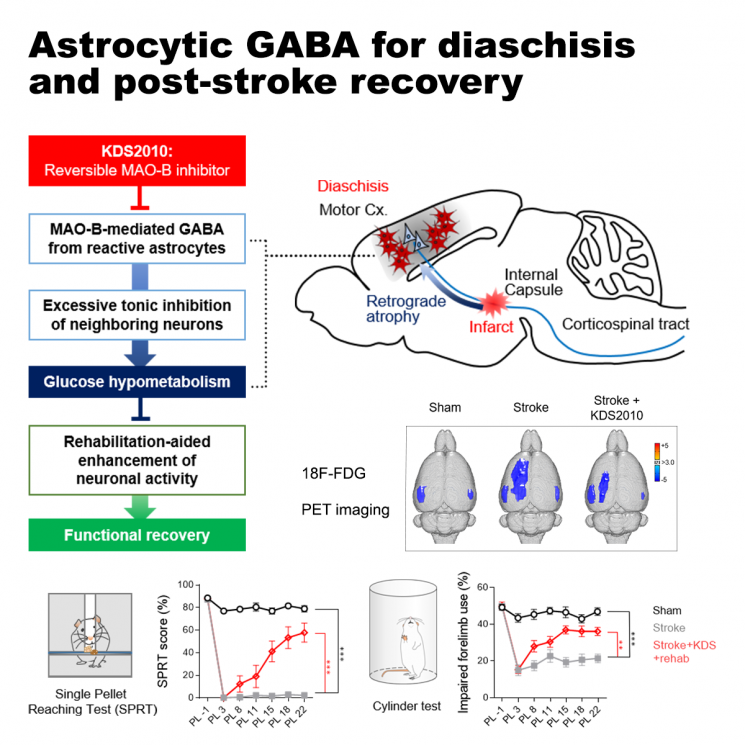 Principles of Functional Dissociation Caused by Stroke and Mechanisms of Functional Dissociation Reversal
Functional diaschisis refers to functional changes not only in the damaged brain area caused by stroke but also in distant regions. When functional diaschisis occurs, the activity of brain neurons decreases, leading to reduced brain metabolism and function.
The research team revealed that micro-neurodegeneration occurs in the motor cortex, which is distant from the stroke site in the brain's white matter. Through this study, they demonstrated that astrocytes, a type of brain neuron in the neurodegenerative area, suppress the activity and metabolism of other neurons, causing functional diaschisis.
To verify how reactive astrocytes affect stroke pathology, the researchers observed the brains of mice induced with stroke in the white matter. They confirmed that GABA was overproduced in the distant motor cortex, leading to impaired brain function. When a stroke occurs, reactive astrocytes excessively secrete GABA, reducing the function of surrounding neurons and causing functional diaschisis.
Astrocytes are star-shaped non-neuronal cells that constitute the largest number of cells in the brain. The state in which the number and size of astrocytes increase and affect surrounding neurons is called 'reactive astrocytes.' This is considered a major cause of various brain diseases such as Parkinson's disease, Alzheimer's disease, and stroke. Reactive astrocytes excessively secrete the inhibitory neurotransmitter GABA, suppressing the activity and metabolism of surrounding neurons, thereby preventing them from functioning properly.
Mechanism of Functional Diaschisis in Various Brain Diseases Including Migraine Uncovered
The research team also confirmed the efficacy of KDS2010, an MAO-B inhibitor developed in-house and licensed to NeuroBiogen. After administering the inhibitor, GABA secretion decreased, alleviating functional diaschisis in the motor cortex and restoring motor and sensory functions. This experiment not only elucidated the principle of alleviating functional diaschisis by regulating astrocytes to suppress GABA production but also demonstrated the effectiveness of their developed therapeutic agent.
Professor Hyungil Kim stated, "We have unlocked the mystery of functional diaschisis and presented one of the first treatment methods for neurological diseases including stroke," adding, "This will serve as a new benchmark for developing treatments for various neurological brain diseases accompanied by functional diaschisis."
Group leader Changjun Lee explained, "This study clarified the mechanism causing functional diaschisis associated not only with stroke but also with various brain diseases such as migraine, brain tumors, and encephalitis," and added, "We expect that regulating astrocytes will open new paths for treating sequelae of various brain diseases in the future."
© The Asia Business Daily(www.asiae.co.kr). All rights reserved.
![Clutching a Stolen Dior Bag, Saying "I Hate Being Poor but Real"... The Grotesque Con of a "Human Knockoff" [Slate]](https://cwcontent.asiae.co.kr/asiaresize/183/2026021902243444107_1771435474.jpg)
















