General Election Held Over 10 Days Amid COVID-19 Pandemic
2.65 Million Voters Elect 93 District Representatives
Effectively a Vote of Confidence for the Prime Minister
Economic Pledges Like Job Creation as Key Indicators
[Asia Economy Singapore Correspondent Seo Jumi] Singapore's political circles have made economic issues such as new job creation a key pledge ahead of the general election. As the direction of the economy remains difficult to gauge following the COVID-19 pandemic, parties are seeking to win voters' hearts through economic matters.
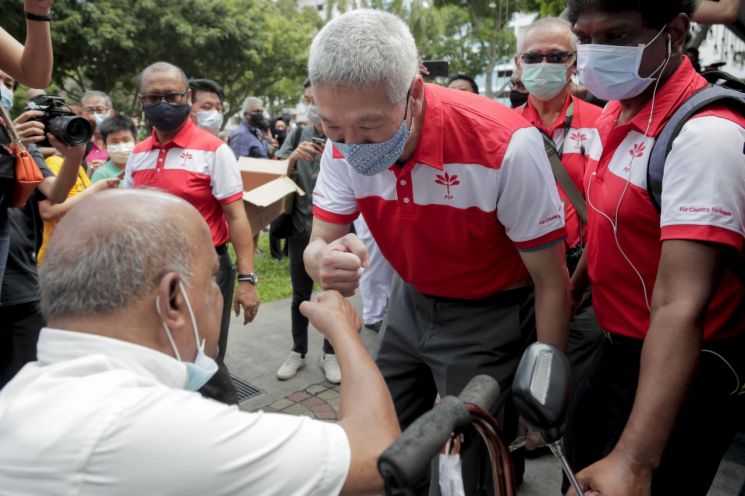 Prime Minister Lee Hsien Loong of Singapore is meeting with supporters.
 [Image source=EPA Yonhap News]
According to local media including The Straits Times on the 7th, the ruling People's Action Party (PAP) has decided to postpone plans to raise the Goods and Services Tax (GST) rate for two years in preparation for the general election on the 10th. Before the COVID-19 crisis, there were considerations to increase the GST rate from the current 7% to 9%, but ahead of the election, the party announced it would maintain the current level until 2022. Although the overall outlook favors the ruling party, since this election is seen as a referendum on Prime Minister Lee Hsien Loong's leadership, there is a recognition that maximizing the vote share is important.
Job creation to prevent unemployment is also a flagship pledge of the ruling party. This includes actively promoting a package of 100,000 jobs, such as 40,000 new jobs announced in the government's COVID-19 support measures in May, training 25,000 trainees, and implementing 30,000 technical training programs.
On the other hand, opposition parties such as the Singapore Workers' Party (WP) and Progress Singapore Party (PSP) are contesting the ruling party on issues like income inequality, housing problems, and policy transparency. Six opposition parties have pledged to either completely withdraw or delay the GST increase by more than five years. They have also proposed key pledges such as legislating Singaporean-first hiring, establishing a minimum wage, and abolishing the retirement age.
This general election was formalized after Prime Minister Lee announced on the 23rd of last month via TV and online live broadcasts the dissolution of the existing parliament and called for an early general election.
In his statement, Prime Minister Lee explained that although the COVID-19 situation has entered a stable phase, overcoming it will require more time, and difficult decisions must be made based on a government composed of new leaders. According to Singapore law, the term of a Member of Parliament is five years, but if the parliament is dissolved, a general election must be held within three months.
In this election, 2.65 million voters will directly elect 93 constituency MPs. Singapore MPs are divided into three groups based on the election method, including single-member and group representation constituencies. Group representation constituencies involve party-based voting, where the party with the most votes takes all seats in that constituency. A total of 192 candidates have registered for this general election.
The second group consists of Non-Constituency Members of Parliament (NCMPs), who can be up to nine in number and are elected without a constituency, and the third group includes up to nine Nominated Members of Parliament (NMPs), experts from various sectors appointed as MPs. NMPs and NCMPs do not have voting rights on key legislation such as no-confidence motions against the Cabinet, presidential impeachment, or budget bills. Singapore adopts a British-style parliamentary system where the majority party in parliament forms the executive. In the 2015 Singapore general election, the People's Action Party won a landslide victory, with only the Workers' Party securing six seats among the opposition, while other parties failed to gain seats.
Meanwhile, the Singapore government is also considering allowing voters under COVID-19 quarantine to vote directly at facilities. Additionally, plans include permitting quarantined voters to vote during specific time periods to prevent virus transmission and increase voter turnout.
© The Asia Business Daily(www.asiae.co.kr). All rights reserved.
![Clutching a Stolen Dior Bag, Saying "I Hate Being Poor but Real"... The Grotesque Con of a "Human Knockoff" [Slate]](https://cwcontent.asiae.co.kr/asiaresize/183/2026021902243444107_1771435474.jpg)















