Nominee for Minister of Unification Sparks Controversy with Funeral Remarks
Criticism of 'Perpetrator-Centered Approach' Ignoring Victims
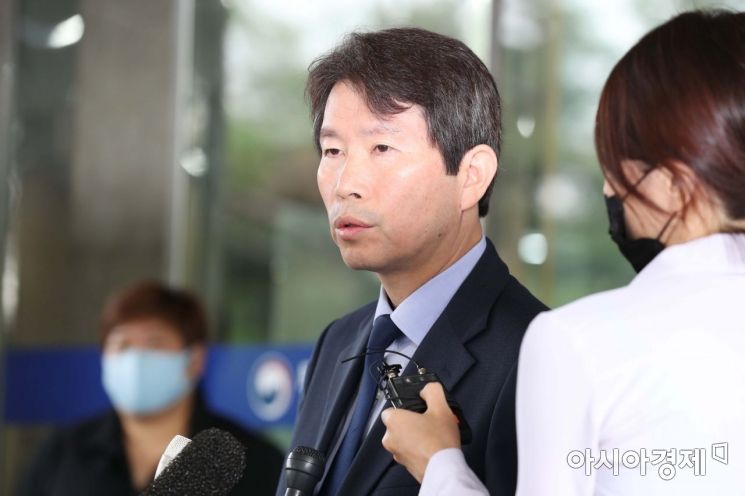 Lee In-young, the nominee for Minister of Unification, is responding to reporters' questions on the 6th while heading to the Inter-Korean Summit Headquarters in Jongno-gu, Seoul. Photo by Moon Ho-nam munonam@
There are criticisms that Lee In-young, the nominee for Minister of Unification, lacked 'gender sensitivity' regarding remarks he made at the funeral of the mother of former Chungnam Governor Ahn Hee-jung.
Lee, who was also a junior at Korea University to former Governor Ahn, said on the 5th after paying his respects, "My father also passed away while I was serving a prison sentence," adding, "I feel very heavy-hearted."
Lee's comparison of his own imprisonment to that of former Governor Ahn is pointed out as revealing a complacent attitude toward clear cases of power-based sexual crimes.
The reason for former Governor Ahn's incarceration is entirely unrelated to the democratization movement.
Former Governor Ahn was tried on charges including sexual assault and molestation against Kim Ji-eun, who worked as his personal secretary, and in September last year, the Supreme Court confirmed a prison sentence of three years and six months.
Criticism has also arisen that Lee is unilaterally empathizing with the perpetrator without considering the victim's position at all.
His remarks are seen as reckless, showing leniency toward the perpetrator, without considering the possibility that his words could be conveyed to the victim through the media and the impact of such messages.
Professor Kim Geun-sik of Gyeongnam National University said, "Since the Cho Kuk incident, shamelessness and brazenness have long become the trend in politics," adding, "This clearly reveals the sentiment trapped in the cave of the dichotomy of good and evil, where one's own side is always right and protected, and the opposing side is always bad and antagonized."
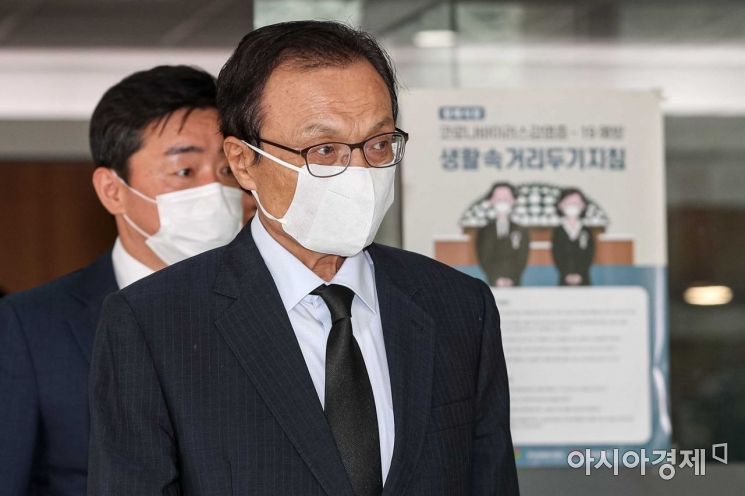 Lee Hae-chan, leader of the Democratic Party of Korea, visited the funeral hall of the late mother of former Chungnam Governor Ahn Hee-jung at Seoul National University Hospital in Jongno-gu, Seoul, on the 6th, and is seen leaving after paying his respects. Photo by Kang Jin-hyung aymsdream@
At former Governor Ahn's funeral, figures from the 1980s student activist movement were notably present.
Democratic Party lawmakers Yoon Ho-jung, Lee Kwang-jae, Ki Dong-min, Park Yong-jin, as well as former lawmakers Kim Boo-kyum, Baek Won-woo, and Lee Kyu-hee also visited the funeral.
Former lawmaker Kim Boo-kyum said, "He (former Governor Ahn) is going through many difficult circumstances, so it is only natural to come under such circumstances," adding, "We must encourage and comfort each other."
President Moon Jae-in also sent a wreath. At the funeral, wreaths sent by President Moon, National Assembly Speaker Park Byeong-seug, Democratic Party leader Lee Hae-chan, floor leader Kim Tae-nyeon, the late President Roh Moo-hyun's wife Kwon Yang-sook, and Shin Dong-bin, chairman of Lotte Group, were displayed.
Wreaths from Kim Sang-jo, Chief of the Presidential Office Policy Office, and Choo Mi-ae, Minister of Justice, were also hung, and condolence flags sent by Lee Jae-myung, Governor of Gyeonggi Province; Kim Kyung-soo, Governor of Gyeongnam Province; Lee Si-jong, Governor of Chungbuk Province; and Yang Seung-jo, Governor of Chungnam Province, were also noticeable.
The 'National Assembly Feminists' (GukhoeFemi), a feminist group of female workers in the National Assembly, stated on the 6th regarding the ongoing condolences from political figures at former Governor Ahn's mother's funeral, "Condolences should not be expressed in the name of the government, political parties, or ministries," and urged that wreaths and condolence flags be handled at personal expense.
The group said, "It is natural courtesy to personally visit and share grief over the loss of a colleague's mother with whom one has worked for a long time," but also pointed out, "The political sphere, which cannot deny responsibility for the 'power' wielded by Ahn Hee-jung and has the duty to strive to realize social justice and create a fair and safe country, should have been careful with their words and actions to ensure that the public does not misunderstand this event as a political rehabilitation of Ahn Hee-jung."
Meanwhile, Lee In-young is a symbol and leader of the 386 group, referring to those from the 1980s student activist movement, who led the democratization movement and served multiple prison terms.
On May 27, 1987, he participated in the founding of the National Movement Headquarters for the Realization of a Democratic Constitution and was arrested on June 1 of the same year. After being elected chairman of the National Council of University Student Representatives in 1987, he was arrested again on charges of violating the Assembly and Demonstration Act and the National Security Act, receiving a sentence of one year and six months in prison with three years probation and two years disqualification on June 30, 1988, but was specially pardoned on December 21, 1988.
© The Asia Business Daily(www.asiae.co.kr). All rights reserved.
![Clutching a Stolen Dior Bag, Saying "I Hate Being Poor but Real"... The Grotesque Con of a "Human Knockoff" [Slate]](https://cwcontent.asiae.co.kr/asiaresize/183/2026021902243444107_1771435474.jpg)
















