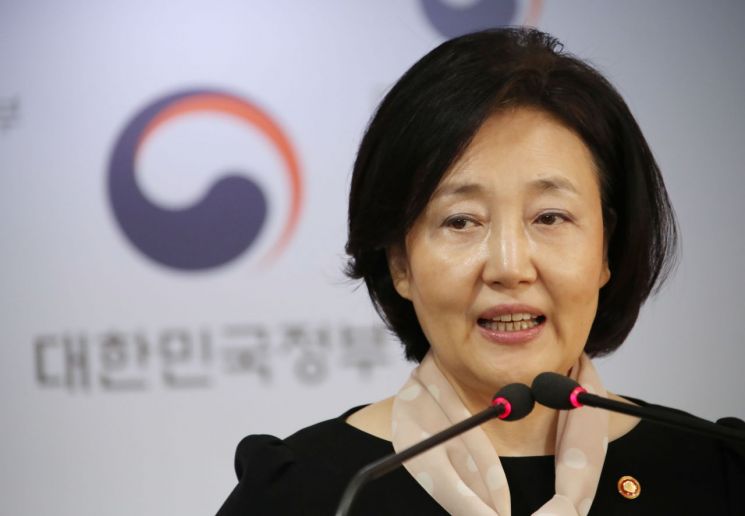
 Minister Park Young-sun of the Ministry of SMEs and Startups is announcing the results of the third review for the designation of regulatory free zones at the briefing room of the Government Seoul Office Building on the 6th. Photo by Yonhap News
[Asia Economy Reporter Moon Hyewon] The government designated seven cities and provinces as the 3rd Regulatory Free Zones on the 6th and decided to establish a ‘Regulatory Free Zone Dedicated Fund’ worth 42 billion KRW in the second half of this year.
The Ministry of SMEs and Startups announced that at the Regulatory Free Zone Committee (hereinafter referred to as the Committee) held at the Government Seoul Office, chaired by Prime Minister Chung Sye-kyun, seven new zones were finally designated.
The zones include seven locations: Busan (Marine Mobility), Daegu (Mobile Collaborative Robots), Ulsan (Genome Service Industry), Gangwon (Liquefied Hydrogen Industry), Chungnam (Hydrogen Energy Transition), Jeonbuk (Carbon Convergence Industry), and Gyeongbuk (Industrial Hemp). Demonstration projects were also added to existing zones in Busan (Blockchain) and Daejeon (Biomedical). With this new designation, the total number of regulatory free zones nationwide reached 21.
The 3rd zones are characterized by many zones designated to effectively respond to internal and external environmental changes and government policies, including medical and non-face-to-face sectors that can enhance infectious disease response capabilities such as COVID-19, green new deal-type zones for establishing new energy utilization bases such as hydrogen, and regional industry-linked zones utilizing regional specialized industries and infrastructure.
The main contents of the 42 regulatory exemptions include areas that have not been industrially approached due to social conventions, such as the use of genomic information (Ulsan) and industrial hemp (Gyeongbuk), areas where current standards are unreasonable such as liquefied hydrogen (Gangwon) and blockchain financial services (Busan), and matters related to easing market entry barriers for SMEs, such as allowing the installation of shared research facilities for pathogens that individual companies must have (Daejeon).
When local government projects are designated as zones, they gain opportunities to develop new technologies and enter new businesses without regulatory restrictions, which is expected by the Ministry of SMEs and Startups to greatly help the local economy by increasing investment and quality jobs in the region.
The Ministry also expects sales of 1.5 trillion KRW, employment effects of 4,390 people, and attraction of 174 companies from this year to 2024 during the zone period, and long-term achievements (estimated by local governments) of sales of 12.6 trillion KRW, employment effects of 57,374 people, and attraction of 1,544 companies by 2030.
The Ministry plans to establish and operate a ‘Safety Committee’ within local governments for each zone, involving research institutions, experts, and related organizations related to demonstration technologies. A management system will be prepared to promote demonstrations while confirming safety from before the start of each demonstration stage, and support up to 50% of liability insurance premiums, up to 15 million KRW, so that zone operators can subscribe to liability insurance to prepare for safety accidents.
Separately from the Safety Management Committee, to regularly inspect safety for each zone, as with the 1st and 2nd zones, a subcommittee chair will be appointed as the zone ombudsman, and an on-site inspection team composed of related ministries, experts, local SME and Startup offices, and the Small and Medium Business Corporation will be operated to strengthen post-management supervision.
Minister Park Young-sun of the Ministry of SMEs and Startups said, “Our attitude in overcoming the COVID crisis and responding to the transition to the digital economy can be summarized in four words: speed, transparency, innovation, and autonomy,” and added, “We will swiftly remove regulations that hinder market entry, strive for transparent and safe data management and distribution, pioneer new markets with innovative technologies and services, and support regulatory free zones so that innovative ventures and startups can become the main players in the digital economy through autonomous market participation.”
© The Asia Business Daily(www.asiae.co.kr). All rights reserved.
![Clutching a Stolen Dior Bag, Saying "I Hate Being Poor but Real"... The Grotesque Con of a "Human Knockoff" [Slate]](https://cwcontent.asiae.co.kr/asiaresize/183/2026021902243444107_1771435474.jpg)















