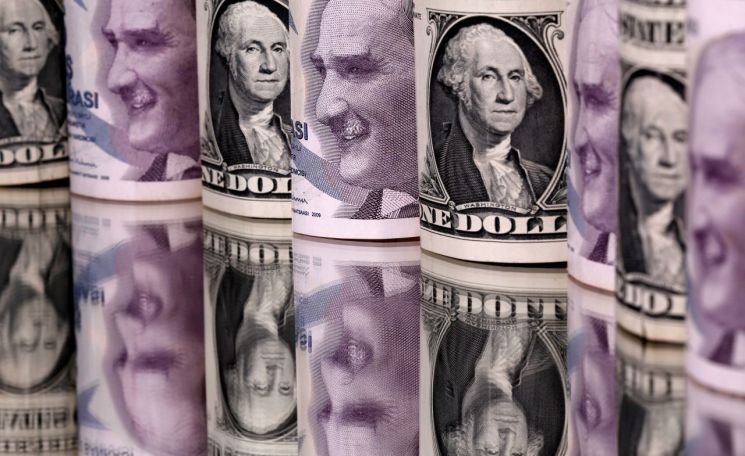
[Asia Economy Reporter Jeong Hyunjin] The economy of Turkey, an 'emerging market,' is showing signs of instability. After experiencing a currency crisis once in 2018, Turkey has recently seen a rapid decline in its foreign exchange reserves and a swift withdrawal of foreign investors. Although Turkish President Recep Tayyip Erdo?an has expressed confidence in economic recovery, the prolonged COVID-19 pandemic raises concerns that this situation could spread across other emerging markets.
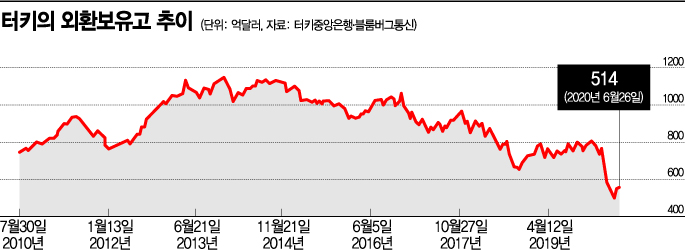
According to the Central Bank of Turkey on the 5th (local time), Turkey's foreign exchange reserves stood at $51.416 billion (approximately 61.67 trillion KRW) as of the 26th of last month, down by more than $20 billion from $77.413 billion at the end of February, when the COVID-19 outbreak began. The International Monetary Fund (IMF), in its recent Global Financial Stability Report, noted that Turkey's foreign exchange reserves have fallen below an appropriate level, and that the sharp decline in industrial production and sudden increase in borrowing costs due to COVID-19 could impact limited fiscal capacity and external financial vulnerabilities.
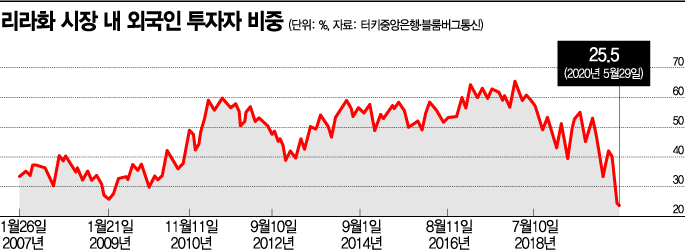
The sharp drop in foreign exchange reserves is concerning because it is linked to the significant depreciation of the Turkish lira. Turkish authorities have injected their foreign currency holdings to defend the exchange rate. Despite these efforts, the lira closed at 6.8623 per dollar on the 3rd, more than 15% weaker compared to the beginning of the year. As concerns over the Turkish economy grow, foreign investors are also withdrawing. The share of foreign investors in the 30-day average trading volume in the lira market increased to nearly 65% in February 2018 but fell to the 20% range by the end of May.
The domestic economic situation is also unfavorable. To stimulate the economy, the Central Bank of Turkey cut its benchmark interest rate from 24% in June last year to 8.25% last month, a reduction of more than 15 percentage points within a year. However, the Consumer Price Index (CPI) remained high at 12.62% last month. The unemployment rate exceeded 13% as of March, and there are growing concerns that it will worsen further as the COVID-19 situation shows no signs of abating.
Credit rating agency Moody's pointed out that Turkey's high inflation and external vulnerabilities persist, warning that "new geopolitical crises and prolonged stagflation could recreate the 2018 currency crisis or lead to even more difficult circumstances." This suggests the possibility of a repeat of the severe turmoil in Turkey's financial markets seen in 2018, when relations between Turkey and the United States deteriorated over the issue of the extradition of an American pastor, causing the lira to surge sharply.
The Central Bank of Turkey is actively taking measures, including requesting currency swaps with major countries. After announcing in April that it was negotiating COVID-19 response measures, it tripled the swap agreement with the Qatar Central Bank to $15 billion. Following the recent allowance to use the yuan in trade with China last month, it was also revealed that Murat ?etinkaya, Governor of the Central Bank of Turkey, requested assistance from Jerome Powell, Chairman of the Federal Reserve, after the lira's value plummeted in May.
Morgan Stanley Capital International (MSCI) recently announced that it is considering downgrading Turkey from an emerging market to a frontier market or an independent market not included in any index. This consideration is attributed to the Turkish government's imposition of various sanctions on investors in the stock market over the past few months, which has reduced market accessibility.
The market is expressing concerns about the possibility of Turkey's financial market instability spreading to other emerging markets. With significant capital outflows from emerging markets due to the COVID-19 pandemic, Turkey's financial instability and the potential default of Argentina are seen as direct shocks to the global financial market. Moody's recently pointed out in its emerging market financial assessment report that Turkey's foreign currency debt has increased at the fastest pace among emerging markets over the past decade.
© The Asia Business Daily(www.asiae.co.kr). All rights reserved.
![Clutching a Stolen Dior Bag, Saying "I Hate Being Poor but Real"... The Grotesque Con of a "Human Knockoff" [Slate]](https://cwcontent.asiae.co.kr/asiaresize/183/2026021902243444107_1771435474.jpg)

















