[Asia Economy Reporter Buaeri] Since the passage of the Passenger Transport Service Act amendment, known as the Tada Ban Act, the mobility industry has rapidly shifted toward 'franchise taxis.' Franchise taxis refer to existing taxi companies paying fees to use a brand and other services. Kakao Mobility's Kakao T Blue, the frontrunner in franchise taxis, is on the verge of reaching its goal of '10,000 registered vehicles' this year. KST Mobility's Macaron Taxi is also approaching the 10,000-vehicle mark, marking the dawn of the 'taxi franchise era.'
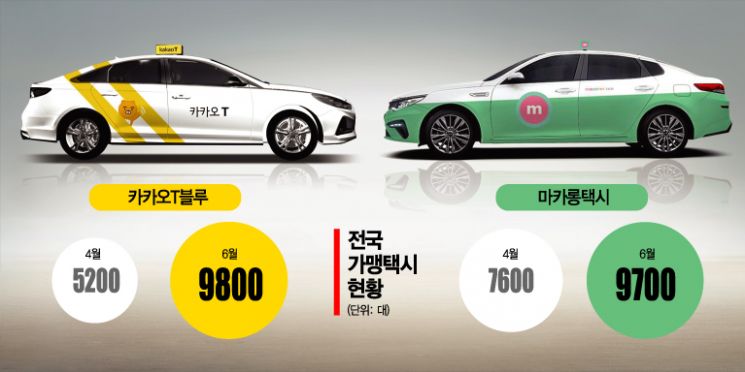
◆ Franchise taxis doubled in two months = According to Kakao Mobility on the 6th, Kakao T Blue, which started service last year, increased its franchise taxis from 5,200 in April to 9,800 across 21 regions nationwide by the end of June. In just over two months, the number of franchise taxis nearly doubled. At this pace, the initially set goal of '10,000 vehicles within the year' is expected to be achieved soon. KST Mobility's Macaron Taxi also increased from 7,600 to 9,700 during the same period. Macaron Taxi plans to expand its fleet to 20,000 vehicles this year.
Kakao T Blue operates by Kakao Mobility signing franchise contracts with taxi corporations. Kakao Mobility takes a 20% commission from taxi operation revenue but provides the franchised taxi corporations with the right to use the Kakao T Blue trademark, as well as comprehensive management systems including accounting, marketing, and driver training. Kakao Mobility explained, "By providing a standardized system, taxi corporations can reduce their own personnel burden," adding, "From the consumer's perspective, they receive standardized quality taxi services." Kakao Mobility also stated that since it manages issues like ride refusals, rudeness, and reckless driving, the quality of taxi services will improve. Macaron Taxi offers similar franchise services based on comparable commission rates.
◆ Big data significantly reduces roaming operations = Another feature of franchise taxis is changing taxi operation methods using big data. This aims to reduce 'roaming operations,' where drivers cruise the streets looking for passengers. To this end, Kakao Mobility provides taxi drivers with a 'demand prediction map' using big data through the Kakao T application (app). It displays in real-time the areas where passengers are expected to gather based on the locations of taxi drivers by region. For example, when a concert ends at the Sports Complex, the app for taxi drivers in Jamsil shows that area in red. Oh Young-hwan (50), a 15-year veteran taxi driver operating Kakao T Blue since last month, expressed satisfaction, saying, "Since using the app for operations, the number of passengers has greatly increased compared to when I was roaming."
Big data technology also enables tailored consulting for franchise corporations. Kakao Mobility said, "By analyzing the monthly operation records of taxi corporations and based on the garage location, we inform them where it is more advantageous to operate," adding, "We can provide efficient taxi operation consulting to franchise corporations based on big data technology."
Unlike regular taxis, franchise taxis can generate additional income through value-added services. KST Mobility is preparing to introduce a dynamic pricing system and a shared ride fare system within the year for Macaron Taxi. The dynamic pricing system charges higher fares than the base fare during high-demand times and offers discounts during low-demand times. The shared ride fare system charges about 70% of the fare to passengers after picking up ride-sharing customers. This became possible after the regulatory sandbox application submitted by KST Mobility passed the Ministry of Science and ICT review on the 30th of last month.
Experts predict that franchise taxis will continue to increase. Professor Kang Kyung-woo of Hanyang University's Department of Transportation and Logistics Engineering said, "Just as people choose McDonald's when eating hamburgers, the Kakao brand will become an important criterion for choosing taxis," and predicted, "Within the next 3 to 4 years, the taxi industry will be reorganized into franchises like restaurants."
© The Asia Business Daily(www.asiae.co.kr). All rights reserved.

















