Federation of Korean Industries & KIEP Hold 'Post-COVID-19 Global Economic Outlook and Korea's Response Seminar'
Angana, IMF Economist: "Asian Economic Recovery Possible Next Year... Policy Authorities Need Caution"
Kim Heungjong, KIEP President: "Severe Trade Environment for Korea Due to Nationalism... Strengthen Technological Innovation and Cooperation with New Regions"
Professor Sung Baekrin: "From Ideological Confrontation to Anti-Virus War... Paradigm Shift Required in Infectious Disease Response"
[Asia Economy Reporter Ki-min Lee] As the prolonged COVID-19 pandemic is expected to cause negative growth in the global economy this year, nationalism and trade conflicts are intensifying. Experts have pointed out that to respond to the rapidly changing global economic situation and crises, South Korea needs both domestic and international measures such as government policies, technological innovation, and cooperation with new regions.
The Federation of Korean Industries (FKI) held a seminar titled ‘Post-COVID-19 Global Economic Outlook and Korea’s Response’ at the FKI Conference Center at 2 p.m. on the 6th, in collaboration with the Korea Institute for International Economic Policy (KIEP). According to FKI, the seminar was organized to share changes in global economic megatrends emerging after COVID-19 and prospects for commercialization of related treatments and vaccines, aiming to minimize external risks.
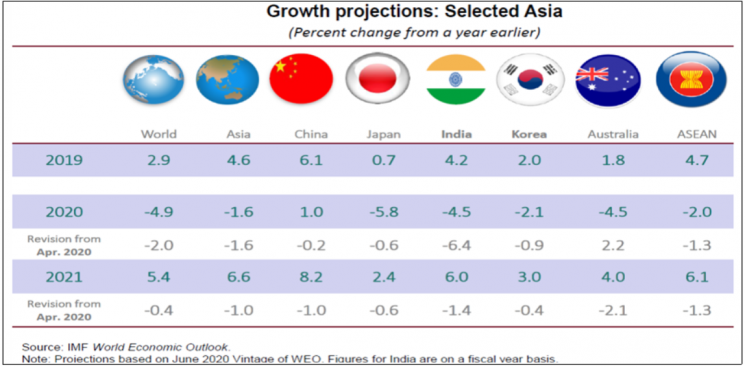 The International Monetary Fund (IMF) last month revised the economic growth forecasts for some Asian countries.
First, the International Monetary Fund (IMF) forecasted that Asia would experience negative growth for the first time due to ongoing lockdowns in the second quarter, decreased export demand, and worsening inequality, with a slow recovery expected next year. Angana Banerji, IMF Senior Economist and the first keynote speaker, stated, “Although some Asian countries are showing signs of economic recovery, overall recovery is delayed compared to initial expectations, and full recovery will likely only be possible next year.” She added that Asia’s growth rate this year is expected to be -1.6%, resulting in Asia’s total production in 2020 being 5 percentage points lower than the IMF’s pre-pandemic forecast. She emphasized, “Given the crisis, policymakers should pay special attention to managing national debt, stabilizing financial systems, strengthening social safety nets, and increasing labor market flexibility.”
The second keynote speaker, Professor Baek-Lin Sung of Yonsei University’s Department of Biotechnology and head of the Government-wide COVID-19 Therapeutics and Vaccine Commercialization Project Group, said, “This COVID-19 crisis demands a paradigm shift in infectious disease response, transitioning from ideological wars of the past 100 years to a war against a common enemy of humanity?the virus.” He added, “Just as wars have historically led to the birth of new war material industries, virus response will herald a new strategic industry shared by all humanity.”
KIEP President Heung-jong Kim, in his opening remarks, pointed out that amid the COVID-19 situation, the U.S. is pursuing a ‘de-coupling’ strategy to exclude China from the global value chain, intensifying U.S.-China trade conflicts. He noted that the global trade order is also deepening nationalism under the pretext of national and economic security, creating a severe external trade environment for Korea. President Kim emphasized that Korea, as an IT powerhouse, should respond by leading technological innovation in the post-COVID-19 era and strengthening economic cooperation with new regions such as the New Southern Policy and New Northern Policy areas.
Additionally, the seminar introduced KIEP’s outlook on the ‘Second Half Economic Forecast and Risks’ for six regions: the U.S., China, Europe, Japan, ASEAN, and India. Yoon Yeo-jun, head of the Americas team at KIEP’s Advanced Economies Division, forecasted that although the U.S. economy showed signs of reopening and improvement in major economic indicators in the second quarter, raising hopes for a V-shaped recovery, the recent resurgence of COVID-19 has made the possibility of a second-half economic rebound uncertain. Yang Pyung-seop, senior researcher at KIEP’s China Economy Division, stated, “The Chinese government has not set an economic growth target this year but introduced the concept of a ‘necessary growth rate’ of over 3%. Despite China’s relatively quick recovery from COVID-19 compared to other major economies, risks remain, including the expansion of U.S.-China trade frictions into technology and finance sectors and conflicts over the Hong Kong National Security Law.”
Cho Dong-hee, head of the Europe team at KIEP’s Advanced Economies Division, explained that almost all Eurozone countries implemented city lockdowns, raising concerns about the severe economic impact of COVID-19. He warned that the massive fiscal burden expected during the recovery process could trigger a recurrence of fiscal and financial crises in some Southern European countries. Kim Gyu-pan, senior researcher at KIEP’s Japan and East Asia team, predicted Japan’s economy would contract by -5.0% this year due to declines in face-to-face service industries such as tourism, accommodation, food service, and retail, as well as reduced exports in traditional manufacturing sectors like automobiles and machinery caused by global supply chain disruptions. He expects economic recovery only by the second quarter of next year.
Jung Young-sik, head of KIEP’s New Southern Policy Economic Division, forecasted that ASEAN economies would achieve a growth rate around -2%, better than major economies like Europe and the U.S., based on limited COVID-19 spread, proactive policy responses, and relatively low domestic service sector proportions. Thailand, Malaysia, the Philippines, and Indonesia are expected to record negative growth rates, while Vietnam is projected to achieve positive growth in the 4% range. Kim Jung-gon, head of KIEP’s India and South Asia team, noted that after the phased lifting of lockdowns in early May, COVID-19 is rapidly spreading in India. Accordingly, India’s economic growth rate for 2020 is expected to be between -3.2% and -5.2%. He added that the swift end of COVID-19, resolution of non-financial sector insolvency issues, and recovery of the manufacturing sector will be key variables for India’s economy going forward.
Kwon Tae-shin, FKI Vice Chairman, in his opening remarks, pointed out, “Exports, the backbone of the Korean economy, fell by more than 20% in April and May and decreased by 10% last month. Companies that have endured difficult business conditions through increased borrowing and asset sales may face liquidity crises starting in October when loan repayment grace periods end if COVID-19 continues in the second half of the year.” He added, “However, Korea has the DNA and experience to overcome crises such as the 1970s oil shock, the 1990s IMF financial crisis, and the 2000s global financial crisis, so let us do our best to turn this COVID-19 crisis into an opportunity.”
© The Asia Business Daily(www.asiae.co.kr). All rights reserved.
![Clutching a Stolen Dior Bag, Saying "I Hate Being Poor but Real"... The Grotesque Con of a "Human Knockoff" [Slate]](https://cwcontent.asiae.co.kr/asiaresize/183/2026021902243444107_1771435474.jpg)















