Professor Lee Junhee's UNIST Team Published in 'Science'
Commercialization Could Enable Ultra-High-Density, Ultra-Low-Power AI Semiconductors
[Asia Economy Reporter Ki-min Lee] A domestic research team has discovered a theory to implement highly integrated semiconductors capable of storing tens of thousands of high-definition (HD) movies in a size as small as a fingernail. By utilizing materials widely used in semiconductor processes, they proposed a theoretical limit to store 1 bit of information in four oxygen atoms, enabling storage of 500Tb (terabits, approximately 62 terabytes, TB) in a fingernail-sized area.
TB is a unit of information capacity, where 1TB equals 1024GB (gigabytes), roughly enough to store 250 HD movies. This research result means that 1 bit can be stored at an atomic-scale distance of about 0.5 nm (nanometers), increasing semiconductor integration density by 1000 times compared to current levels. The industry expects that if this research is commercialized, it will change the paradigm of the semiconductor industry.
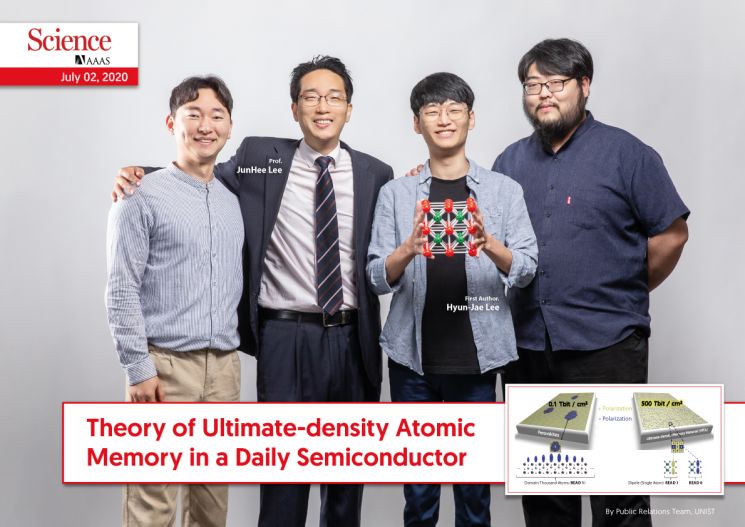
The Ministry of Science and Technology and Samsung Electronics announced on the 3rd that Professor Junhee Lee’s team from the Department of Energy and Chemical Engineering at Ulsan National Institute of Science and Technology (UNIST) published a paper containing these findings in the international journal Science. It is rare for purely theoretical papers to be published in Science. This research, conducted solely by a domestic research team as corresponding authors, was recognized for its theoretical rigor, originality, and industrial impact.
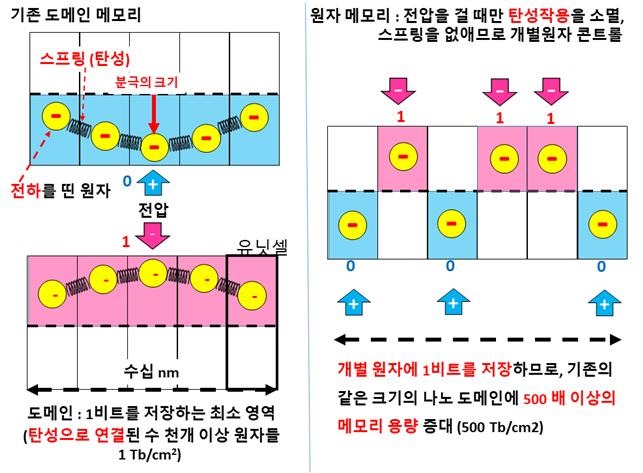
Until now, the semiconductor industry has improved device performance by miniaturizing components to increase integration density per unit area. However, for data storage, a 'domain'?a cluster of thousands of atoms connected elastically?was essential, limiting how small the size could be reduced. When semiconductor devices shrink below a certain limit, a phenomenon called 'scaling' occurs, where the ability to store information disappears. When scaling happens, the fundamental operation of semiconductors representing 0 and 1 cannot be properly realized.
In this study, Professor Lee’s team discovered a new physical phenomenon where the elastic interaction, like springs connecting atoms, completely disappears when voltage is applied to hafnium oxide (HfO2), a material currently used as the gate voltage electrode in semiconductor transistors. They then demonstrated that applying this to memory semiconductors could improve integration density by 1000 times. The complete disappearance of atomic interactions under certain conditions is a phenomenon predicted by the physics theory called the 'flat energy band.' The team was the first to discover that this phenomenon actually occurs when voltage is applied to hafnium oxide. In the voltage-applied hafnium oxide, the elastic interaction disappears, allowing data (1 bit) to be stored or individually controlled in groups of four oxygen atoms, eliminating the need for domains. When the four oxygen atoms move upward, it represents '0'; when they move downward, it represents '1.' This state is maintained even when power is cut off, enabling use as non-volatile memory.
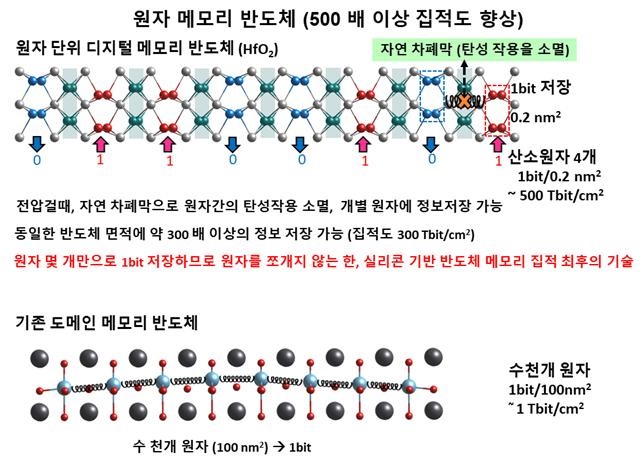
If follow-up research successfully demonstrates and commercializes this phenomenon, the semiconductor industry's paradigm is expected to change fundamentally. The semiconductor process, currently halted at about 10 nm, could be miniaturized to 0.5 nm. Therefore, direct information storage in atoms will be possible, and not only small semiconductors previously thought impossible with existing memory materials but also ultra-high integration and ultra-low power artificial intelligence semiconductors could be realized, according to academia and the semiconductor industry. Especially, hafnium oxide is already commonly used in existing silicon semiconductor processes, making commercialization highly feasible and expected to have significant impact. The research team has filed patents on technologies applying these findings to semiconductors and is pursuing follow-up research with companies.
Professor Lee said, "This research presents a theory that could serve as an important foundation for securing global competitiveness in the field of ultra-high integration semiconductors in the future," adding, "The technology to store information in individual atoms is likely to be the last integration storage technology in the current semiconductor industry unless atoms are split."
Meanwhile, this research was selected as a project under the Samsung Future Technology Development Program in December last year and has received research support. It was also conducted with support from the Ministry of Science and ICT’s Future Materials Discovery project. The Samsung Future Technology Development Program plans to invest 1.5 trillion KRW over 10 years starting in 2013 to support national future science and technology research, having allocated 758.9 billion KRW to 589 projects so far. Samsung Electronics is conducting various shared growth activities and youth education social contribution programs under its CSR vision "Together for Tomorrow! Enabling People," including the Samsung Future Technology Development Program, smart factories, C-Lab Outside, and the partner company win-win fund.
© The Asia Business Daily(www.asiae.co.kr). All rights reserved.
![Clutching a Stolen Dior Bag, Saying "I Hate Being Poor but Real"... The Grotesque Con of a "Human Knockoff" [Slate]](https://cwcontent.asiae.co.kr/asiaresize/183/2026021902243444107_1771435474.jpg)

















