Hong Kong Security Law Enforced from 1st
Fundamental Changes in Hong Kong Society
Like West Berlin Becoming East Berlin
Legal System and Others Inevitably Weaken Hong Kong's Competitiveness
[Asia Economy Reporter Naju-seok] "Hong Kong has been like West Berlin during the Cold War, but now it will become like East Berlin."
Kevin Lai, Head of Research at Daiwa Capital Markets, made this prediction about Hong Kong's future after the Hong Kong National Security Law (Hong Kong Security Law) through a foreign media outlet on the 2nd. West Berlin, which was West Germany's territory during the Cold War, was surrounded by East Germany and served as a bastion of capitalism. At that time, East Berlin, the capital of East Germany, played the role of a propaganda stage to show that the communist bloc was not losing to the Western world in the system competition. Lai's remark contains the diagnosis that Hong Kong, which had served as the vanguard of capitalism against China, has suddenly transformed into a place that demonstrates the power of the 'communist country' China.
The Hong Kong Security Law, which came into effect on the 1st, has shaken the framework of 'one country, two systems' and even changed Hong Kong's fate. Until now, Hong Kong was guaranteed a different system from China within Chinese territory. However, with the implementation of the Hong Kong Security Law, the democracy that Hong Kong had enjoyed can no longer avoid serious restrictions.
Experts explain that although the changes are not immediately visible, a huge transformation has begun with the Hong Kong Security Law. The law stipulates crimes such as secession, subversion of state power, terrorism, and endangering national security by colluding with foreign or external forces, but there are criticisms that the scope of these provisions is very broad.
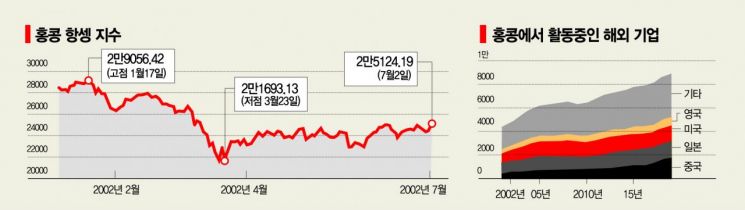
The most noticeable change is in the economic sector. Hong Kong's greatest competitiveness was ▲exchange rate stability and freedom of foreign exchange transactions ▲low tax rates ▲a free business environment ▲and its role as a gateway to China. For these reasons, Hong Kong was able to serve as an international financial center and a major hub for trade. However, after the introduction of the Hong Kong Security Law, this framework itself has been shaken or, even if maintained, its operating methods have fundamentally changed. In particular, the risk of Chinese government intervention and surveillance over the internet and communication networks has increased. In a survey conducted by the American Chamber of Commerce in Hong Kong early last month, 60% of respondents said the security law would harm business, and 30% of the responding companies said they were considering relocating some business activities and assets.
The stability of the legal system has also become precarious. Hong Kong had established a legal system that protected investors and others through its past British colonial process. This stable legal system was one pillar of Hong Kong's competitiveness, but no longer. The Wall Street Journal (WSJ) pointed out that, theoretically, analyses or market reports on Chinese state-owned enterprises could become crimes such as leaking state secrets due to the Hong Kong Security Law. Moreover, as the possibility of Chinese courts intervening in trials instead of Hong Kong courts has increased, legal risks have also grown. Although the Hong Kong government recently called in corporate officials to urge them "not to panic" and said "there is no disruption to business activities," doubts remain about whether the law will be applied differently to individuals and companies.
The security law is also expected to change the fate of the Hong Kong dollar. This is because the peg system, which fixed the Hong Kong dollar at 7.75 to 7.85 per US dollar, may operate differently. The Hong Kong Monetary Authority (HKMA) held $442 billion (531 trillion won) in foreign exchange reserves as of last month, maintaining the stability of the Hong Kong dollar's value. There is no disagreement that the Hong Kong dollar is unlikely to be shaken, but analyses suggest that the operating method will change in times of crisis when dollars are needed. It is now predicted both inside and outside Hong Kong that the institution extending a hand to protect the Hong Kong dollar's value will be the People's Bank of China, not the US Federal Reserve. The HKMA can procure dollars through currency swaps with the People's Bank of China.
Even if Hong Kong maintains its status as a financial center, there is also a forecast that the market will now be subject to the Chinese government's policy will rather than market forces. Although concerns over the Hong Kong Security Law have increased the possibility of foreign companies, capital, and personnel leaving, this has been steadily offset by the movements of Chinese companies. Chinese gaming company NetEase and online commerce site JD.com have recently been listed on the Hong Kong stock market one after another. Earlier, Alibaba also listed on the Hong Kong stock market in November last year. By using Hong Kong's capital market, China's representative technology companies support Hong Kong's status as Asia's hub financial market.
© The Asia Business Daily(www.asiae.co.kr). All rights reserved.
![Clutching a Stolen Dior Bag, Saying "I Hate Being Poor but Real"... The Grotesque Con of a "Human Knockoff" [Slate]](https://cwcontent.asiae.co.kr/asiaresize/183/2026021902243444107_1771435474.jpg)















