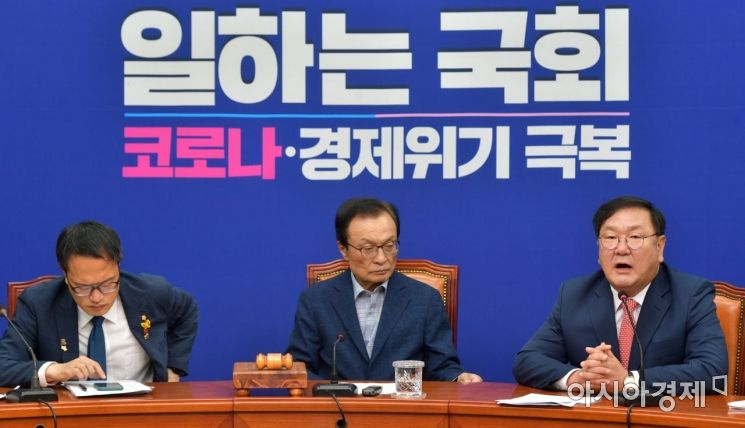
 Kim Tae-nyeon, floor leader of the Democratic Party of Korea, is attending the Supreme Council meeting held at the National Assembly on the 3rd and delivering an opening remark. Photo by Yoon Dong-joo doso7@
[Sejong=Asia Economy Reporter Kim Hyunjung] As the largest-ever third supplementary budget (supplementary budget) is scheduled to be passed in the National Assembly on the 3rd, concerns are growing over the deterioration of fiscal soundness as the ruling party, emphasizing expansionary fiscal policy, takes control of the budget authority. During the review process of the third supplementary budget, the ruling party is already fueling discussions on the payment of the second emergency disaster relief fund and the formulation of a fourth supplementary budget. Considering the precedent that the government's fiscal response to COVID-19 has been mainly driven by the ruling party's proposals, it is expected that such proposals will also gain traction within the party.
The third supplementary budget initially submitted to the National Assembly by the Ministry of Economy and Finance was 35.3 trillion won, but after review by each standing committee, it has increased to around 38 trillion won. Although the ruling party decided to cut constituency complaint budgets (about 350 billion won) that were inserted during the review process in response to public concerns about the ruling party's solo review and passage, some within the ruling party have repeatedly mentioned additional fiscal projects separate from the third supplementary budget, such as the payment of the second emergency disaster relief fund.
On the 29th of last month, Lee Jung-moon, a member of the Democratic Party of Korea, emphasized the necessity of the "second emergency disaster relief fund payment" at the Budget and Accounts Committee. As a first-term lawmaker, Lee said, "From July, when the 14 trillion won in disaster relief funds paid out have almost been exhausted, a vicious cycle of economic downturn due to weak household consumption capacity may begin again," and stressed, "It is necessary to consider whether to pay the second disaster relief fund even if it means using part of the nation's future resources in advance." Another first-term lawmaker from the same party, Lee Gyu-min, also said, "I believe the payment of the second disaster relief fund is absolutely necessary in this unprecedented crisis." In response, Prime Minister Chung Sye-kyun and Deputy Prime Minister and Minister of Economy and Finance Hong Nam-ki maintained a cautious stance, citing concerns about fiscal soundness.
Park Hong-geun, the floor leader of the National Assembly's Special Committee on Budget and Accounts, also attracted attention by mentioning a "fourth supplementary budget." While demanding an increase in financial support for small business owners, he said, "If the economic recession worsens due to the resurgence of COVID-19, some say we might even have to prepare a fourth supplementary budget." This remark came as he expressed the opinion that a sufficiently large-scale response should be reflected in the current third supplementary budget.
Considering the precedent where the government ultimately prepared the final plan by accepting the ruling party's proposal despite disagreements between the ruling party and the government over the disaster relief fund payment target, there is a considerable possibility that such voices for additional fiscal responses will be institutionalized. The biggest problem is the resulting deterioration of fiscal soundness. Deputy Prime Minister Hong also recently expressed concern at a full meeting of the Budget and Accounts Committee that the national debt ratio, currently at 43.5% of GDP, could exceed 50% in five years. However, within the ruling party, there are still opinions that mentioning the establishment of fiscal rules could cause social controversy, and that expansionary fiscal policies should continue for the time being to overcome the economic crisis.
Meanwhile, the opposition party, the United Future Party, has repeatedly proposed fiscal soundness bills, advocating for soundness management. Choo Kyung-ho and Song Eon-seok, lawmakers from the United Future Party who are considered budget experts and former vice ministers of the Ministry of Economy and Finance, recently proposed a bill to maintain the national debt ratio below 45% of GDP and to use all surplus funds to repay the principal and interest of national debt if this threshold is exceeded.
© The Asia Business Daily(www.asiae.co.kr). All rights reserved.
![Clutching a Stolen Dior Bag, Saying "I Hate Being Poor but Real"... The Grotesque Con of a "Human Knockoff" [Slate]](https://cwcontent.asiae.co.kr/asiaresize/183/2026021902243444107_1771435474.jpg)















