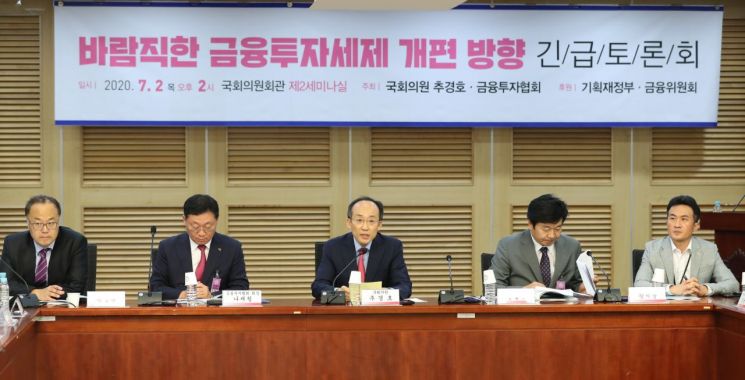
 Rep. Choo Kyung-ho of the United Future Party is speaking at an urgent discussion on the desirable direction for reforming the financial investment tax system held at the National Assembly in Yeouido, Seoul, on the afternoon of the 2nd.
 [Photo by Yonhap News]
[Asia Economy Reporter Joo Sang-don] There is growing demand for revisions to the 'Financial Tax System Modernization' plan announced by the government on the 25th of last month. Criticisms include that income from collective investment schemes (funds) is not subject to a basic deduction unlike domestic stocks, resulting in reverse discrimination, and that tax support is needed to encourage long-term stock investment. For now, the government is rebutting these claims and drawing a line. The government will hold a public hearing on the 7th to begin formal opinion gathering.
Participants at the urgent debate on 'Desirable Directions for Financial Investment Tax Reform,' held on the 2nd at the National Assembly Members' Office Building hosted by Chu Kyung-ho, a member of the Future United Party, also argued for the application of a basic deduction to fund income and the need for tax support for long-term investment.
Earlier, the government announced the 'Financial Tax System Modernization Promotion Direction for Financial Investment Activation and Taxation Rationalization,' which, starting in 2023, expands the taxable scope of capital gains from the sale of domestic listed stocks to include small shareholders and lowers the securities transaction tax from the existing 0.25% to 0.15%. When taxing capital gains, 20 million KRW is deducted for capital gains on domestic listed stocks, but there is no basic deduction for capital gains from stock-type ETFs or listed stocks in collective investment schemes (funds).
Regarding this, Lee Sang-yeop, Senior Research Fellow at the Korea Institute of Public Finance, pointed out, "This violates tax fairness among financial assets and tax neutrality for financial asset investments," adding, "It could lead to an increase in direct investment in domestic stocks and a decrease in indirect investment." Kim Dae-jun, Senior Researcher at Korea Investment & Securities, also expressed concern, saying, "If there is no basic deduction for funds unlike stocks, investors will have no incentive to invest in indirect investment products like funds, which will further shrink the asset management industry already in a critical state."
In response, Kim Moon-geon, Director of the Financial Taxation Division at the Ministry of Economy and Finance, said, "Even if it is the same financial investment income, there is a difference between direct investment and entrusting funds (like with funds)." He added, "When investing in stocks, investors must directly select portfolio composition, but funds are a concept of entrusting money, so it is not appropriate to deduct necessary expenses for them."
There were also calls for tax support for long-term investment. Hwang Se-woon, Research Fellow at the Capital Market Institute, emphasized, "Considering that individual investors tend to have a strong short-term investment tendency, there is a need for tax support to promote long-term investment," and added, "Preferential tax rates should be applied to long-term investments (held for more than one year) to encourage individual investors to invest long-term." In response, Director Kim explained, "To provide tax support for long-term investment, a 'first-in, first-out (FIFO)' system must be enforced to distinguish which stocks were bought when and at what price," adding, "Investors usually consider taxes based on average purchase price without this, which inevitably causes discrepancies with the actual tax amount." Previously, the Ministry of Economy and Finance stated in explanatory materials that financial investment income such as stocks differs in tax rate system and economic characteristics from real estate capital gains, and since real estate is a tangible asset requiring long-term holding benefits considering inflation, but financial assets do not have inflation factors, preferential treatment for long-term holding is unnecessary.
Debate participants also showed differing opinions on the necessity of maintaining the securities transaction tax. The government’s position is that if the securities transaction tax is abolished, it will be impossible to tax foreigners’ domestic stock trading at all, and there is concern that measures to counter market distortions such as high-frequency trading will disappear. Hwang said, "Except for securing tax revenue, it is difficult to find justification for maintaining the securities transaction tax," and pointed out, "There is a great need to send a clear signal to the market about abolishing the securities transaction tax from a long-term perspective." Researcher Kim said, "The theory that transaction tax prevents speculation was proposed by economist Keynes in 1936, but there is no recent empirical research on this," adding, "High-frequency trading may increase, but this also promotes trading, so it cannot be considered solely a disadvantage."
The Ministry of Economy and Finance plans to hold a public hearing on the financial tax system modernization plan on the 7th. A ministry official explained, "It will be a session to explain the previously announced reform plan and gather opinions on it."
© The Asia Business Daily(www.asiae.co.kr). All rights reserved.
![Clutching a Stolen Dior Bag, Saying "I Hate Being Poor but Real"... The Grotesque Con of a "Human Knockoff" [Slate]](https://cwcontent.asiae.co.kr/asiaresize/183/2026021902243444107_1771435474.jpg)















