Research Team of Professors Jeong Won-jun and Kim Byung-hee Announces Study Results on Improving Quality of Life for the Elderly
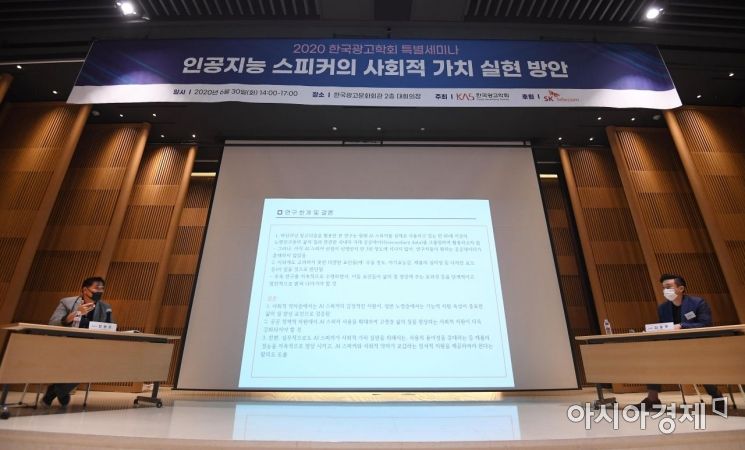 On the 30th of last month, at the Korea Advertising Culture Center in Songpa-gu, Seoul, during the seminar on Realizing the Social Value of AI Speakers hosted by the Korean Advertising Association, Professor Jeong Won-jun of Suwon University (left), who finished his presentation on "A Study Predicting the Feasibility of Realizing the Value of AI Speakers: Using Machine Learning Algorithms," is discussing with Professor Kim Dong-hoo of Inha University. Photo by Kim Hyun-min kimhyun81@
[Asia Economy Reporter Kim Heung-soon] "We predicted that the quality of life for so-called 'socially vulnerable' groups such as elderly living alone or people with disabilities would be low, but the results showed that the positive effects of using artificial intelligence (AI) speakers were greater."
On the 3rd, Professor Jung Won-jun of the Department of Media Communication at Suwon University said, "Socially vulnerable people have limited communication with the outside world, but emotional support such as the 'companion function' provided by AI speakers alleviated loneliness, alienation, and depression." Professor Jung and Professor Kim Byung-hee of the Department of Advertising and Public Relations at Seowon University, along with their research team, recently presented these findings at a special seminar hosted by the Korean Advertising Association titled 'Predictive Study on the Social Value Realization Potential of AI Speakers.'
"AI Speakers Are Companions, Not Machines"
Socially Vulnerable Groups Alleviate Alienation Through Companion Functions
The research team conducted a study using machine learning algorithms on 458 users aged 60 and above who owned and used AI speakers in daily life. Among them, 271 respondents who answered 'living alone,' 'socially vulnerable,' or 'having a disability' were classified as the socially vulnerable group, while 187 respondents who did not fall into any of these categories were grouped as general elderly.
Computer predictions anticipated that the quality of life for the socially vulnerable group would be low when various variables (attributes or characteristics related to the study data) were applied. However, actual analysis showed that the sensitivity of the socially vulnerable group was 0.62, lower than that of the general elderly group (0.91). According to the research team, a lower sensitivity means less influence from variables, and satisfaction with quality of life through AI speaker use is interpreted as relatively higher.
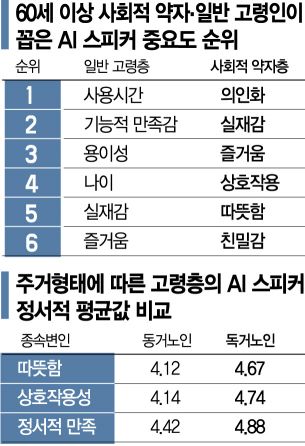
There was a clear difference in perception of AI speakers between the two groups. The socially vulnerable group ranked 'anthropomorphism,' or viewing the AI speaker as a person rather than an object, as the most important factor. Emotional aspects such as presence (2nd), enjoyment (3rd), interaction (4th), warmth (5th), and intimacy (6th) ranked high. The general elderly group mainly valued functional aspects: usage time of AI speakers ranked 1st, functional satisfaction 2nd, ease of use 3rd, age 4th, presence 5th, and enjoyment 6th. Professor Jung explained, "Emotional and functional support from AI speakers can be an effective way to improve the quality of life for the elderly."
Similar results were found in an analysis by a research team including PhD candidate Kim Ah-yeon, Professor Sung Yong-jun of the Department of Psychology at Korea University, PhD candidate Song Yoo-jin, and Professor Choi Se-jung of the Department of Media at Korea University. They analyzed 467 AI speaker users aged 60 and above, dividing them into 'elderly living alone (345)' and 'elderly living with others (122).' While satisfaction with functional aspects showed little difference between the two groups, emotional evaluations covering 'warmth,' 'interactivity,' and 'emotional satisfaction' were higher among the elderly living alone. Professor Choi explained, "For elderly living alone, AI speakers are not just machines but entities with which they can share emotions and receive emotional support."
Activation of AI Speaker Support by Companies and Local Governments
"A Minimal Alternative for Vulnerable Groups"
Local governments and private companies, recognizing these effects, are utilizing AI speakers to protect the emotions and safety of socially vulnerable groups. SK Telecom's 'Artificial Intelligence Care' service using the AI speaker 'NUGU' is a representative example. Key features of this service include 'emotional care' such as music listening and empathetic conversations, and '24-hour emergency SOS' which allows voice-only calls to 119 in urgent situations.
According to SK Telecom, from May last year to April this year, there were a total of 328 emergency SOS calls. Among these, 23 cases required 119 dispatch and led to actual emergency rescues. NUGU also offers the 'NUGU Care Call' service, which calls individuals under self-quarantine or active monitoring suspected of COVID-19 to check for symptoms such as fever, temperature, and cough.
Some raise concerns about whether it is a desirable social value realization for vulnerable groups isolated from family or society to rely on devices like AI speakers and feel intimacy. Lee Junho, head of SK Telecom's Social Value (SV) Promotion Group, said, "Our society does not want communication to be only with machines or for vulnerable groups to anthropomorphize AI speakers," adding, "We plan to support AI speakers as an auxiliary means to provide minimal access for these groups."
© The Asia Business Daily(www.asiae.co.kr). All rights reserved.


















